Deodato Orlando
 Italy
Italy- Deodato Orlandi, an Italian Artist
- Influences and Works in Pisa
- Paintings and Frescoes
- Surviving Works
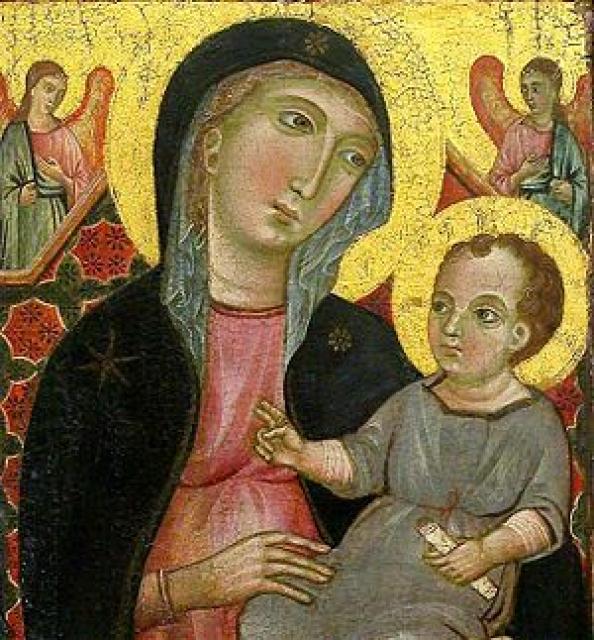
- - "Madonna and Child" (1308; private collection, New York)
- - "Painted Crucifix" (Museo San Matteo, Pisa)
- - Two panels with stories of John the Baptist (Berlin-Dahlem)
- Basilica of San Piero a Grado
Deodato Orlandi, an Italian Artist
Early Life and InfluencesDeodato Orlandi developed as an artist in Lucca, but worked extensively in Pisa. It is widely accepted that he trained in the Berlinghieri workshop, active in the second half of the 13th century in Tuscany, creating works in the Byzantine style. Orlandi was not an innovator, but rather an eclectic artist influenced by various forces at different times.
Influences and Works in Pisa
Orlandi arrived in Pisa as a young man. While there, he worked on mosaics in the Pisa Cathedral, alongside Cimabue. It is likely here that he encountered new artistic ideas that would shape his subsequent painted crucifixes. During Cimabue's time in Pisa, he created the renowned "Maestà" (Louvre, Paris), which became a model for Giotto's work and clearly influenced Orlandi. Orlandi's subsequent works from the first decade of the 14th century, four variations on "Madonna and Child with Angels" (Museo San Matteo, Pisa; Museo Villa Guinigi, Lucca; Louvre, Paris; and Lindenau Museum, Altenburg), show the influence of Florentine innovations.
Paintings and Frescoes
The frescoes Orlandi painted in the Basilica of San Piero a Grado near Pisa (c. 1300) share compositional and iconographic traits with Cimabue's frescoes in Rome and Assisi. Orlandi's 1301 painted crucifix recalls Giotto's similar work for the church of Santa Maria Novella. Despite these innovations, Orlandi's art remained rooted in the late 13th and early 14th century Lucca художественная традиция.
Surviving Works
There are four extant works signed and dated by the artist:- "Painted Crucifix" for the suburban convent of San Cerbone (1288; Museo Villa Guinigi, Lucca)
- "Madonna and Child with Saints Dominic, James, Peter, and Paul" (1301; Museo San Matteo, Pisa)
- "Painted Crucifix" (1301; Conservatorio di Santa Chiara, San Miniato a Tedesco)
- "Madonna and Child" (1308; private collection, New York)
Attributed WorksSeveral additional works are attributed to Orlandi based on stylistic similarities:
- Fresco in the monastery of San Francesco, Lucca, depicting "Madonna and Child with St. Francis and a Donor" (detail of Bonagiunta Tignoposi's tomb, d. 1274)
- "Painted Crucifix" (Museo San Matteo, Pisa)
- "Madonna and Angels Enthroned" (Museo San Matteo, Pisa)- "Madonna and Child Enthroned" (Lindenau Museum, Altenburg)
- "Madonna and Child" (Louvre, Paris)
- "Madonna and Child" for the church of Santa Maria dei Servi (Museo Villa Guinigi, Lucca)
- Two panels with stories of John the Baptist (Berlin-Dahlem)
- "John the Baptist," possibly a fragment of a painted crucifix (Städelsches Kunstinstitut, Frankfurt)
Basilica of San Piero a Grado
Orlandi's largest work is the fresco cycle in the Basilica of San Piero a Grado (c. 1300). The basilica was built on the road connecting Pisa to its maritime port of Marina di Pisa, through which goods flowed from across the Mediterranean. Recent restoration work for the frescos' 700th anniversary confirmed Deodato Orlandi as their author. Orlandi decorated the basilica's central nave with a long series of portraits of popes, from St. Peter to John XVIII, above the arches, and "Scenes from the Life of St. Peter" above the portraits. The frescoes exemplify the Lucca-Pisan school of painting at the turn of the 13th and 14th centuries.