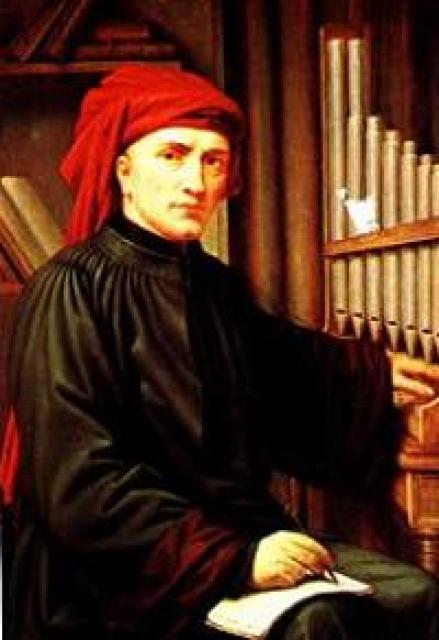
des Prez Josquin
 France
- Early Renaissance Composer
- Formative Years and Court Service
- Papacy and Royal Patronage
- Death and Legacy
- Musical Innovations
- Reinterpretation of church modes within a harmonic framework
- Mastery of polyphonic composition based on a predefined cantus firmus
Early Renaissance Composer
Josquin des Prez, born sometime between 1440 and 1450 in Burgundy or Picardy, is hailed as a pivotal figure in the early Renaissance. His name appears in various forms, including Josquin, Josse, and De Prez, among others.
Formative Years and Court Service
Josquin's early life is shrouded in mystery, but it is believed he sang in the choir of the Collegiate Church of Saint Quentin. From 1459 to 1472, he served as a chorister in the Milan Cathedral, followed by a stint at the court of the Duke of Milan from 1474 to 1479.
Papacy and Royal Patronage
In 1486, Josquin joined the payroll of the papal chapel in Rome, where he remained until 1494. He later served at the court of Duke Ercole d'Este in Ferrara, visiting France in between. From 1503 onwards, he likely resided primarily in Ferrara until the Duke's death in 1505.
Returning to France, Josquin became maître de chapelle for King Louis XII until his death in 1515. He simultaneously held positions as canon of the Church of Saint Gudula in Brussels and provost of the Cathedral of Notre Dame in Condé.
Death and Legacy
Josquin's death is estimated to have occurred in Condé in 1521 or shortly thereafter. He is remembered as an amiable man with a keen wit and a relentless pursuit of musical excellence.
Musical Innovations
Josquin inherited the medieval contrapuntal tradition, which he refined and elevated. His innovations included:
Reinterpretation of church modes within a harmonic framework
Preference for duple time signatures over the traditional "perfect" triple time
Mastery of polyphonic composition based on a predefined cantus firmus
Development of imitative counterpoint and fuguesDramatic use of sequences and tutti sections
Works and Impact
Josquin's extensive oeuvre includes:
20 masses
Over 100 motets, psalms, and hymns
52 secular chansons (in French and Italian)
Notable compositions such as "Bergerette Savoysienne," "Ave Maria," and the "Stabat Mater"
Thanks to Ottavio Petrucci's printing press, Josquin's music became widely disseminated. Scientific editions of his works were later compiled, culminating in the complete collection published by Dr. A. Smijers in 1969.



