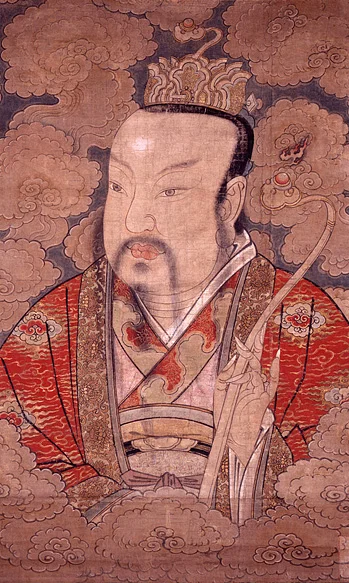
Devadatta
- Family and Entry into the Buddhist Community
- A Rival for Leadership
- The Prince Ajātasattu and the Attacks on the Buddha
- Different Traditions and Later Memory
- Legacy
Devadatta is remembered in Buddhist tradition as a monk who challenged Gautama Buddha’s authority and tried to divide the monastic community. The stories cast him as a formidable and controversial figure: once a respected member of the Buddha’s circle, he is later portrayed as driven by ambition, willing to court royal power, and determined to lead a stricter faction. The details come chiefly from Buddhist texts written and transmitted by communities that regarded his challenge as a serious breach, so his biography is best read as both a narrative about a rival and an account of how early Buddhists debated authority and discipline.
Family and Entry into the Buddhist Community
Traditional biographies identify Devadatta as a member of the Śākya clan and a relative of the Buddha. Some accounts call him the Buddha’s cousin and brother-in-law, while the precise family relationships vary among sources. He is also associated in several traditions with Ānanda, another of the Buddha’s close relatives and disciples. The texts do not provide a securely established birth date or a modern historical record of his early life.
Stories of Devadatta’s youth and renunciation differ. In the monastic narratives, he joins the Buddha’s community along with other Śākya nobles. Some accounts describe him as a capable monk who initially gained attention and respect. Later Buddhist writings often interpret his actions through the themes of jealousy, fame, and material gain, giving his life the shape of a moral warning about spiritual ambition. Such explanations reflect the religious purpose of the stories and cannot be independently verified as a record of his private motives.
A Rival for Leadership
The Vinaya, the Buddhist monastic discipline, places Devadatta’s conflict with the Buddha in the community at Rājagaha. In its account, Devadatta sought to take over leadership as the Buddha grew older. The Buddha declined to appoint a successor in the way Devadatta wanted, and the disagreement developed into a struggle over who could guide the community.
Devadatta proposed five stricter practices for monks: that they live in the forest, rely on alms, wear robes made from discarded cloth, live at the foot of trees, and abstain from fish and meat. Versions of the list and its interpretation vary across Buddhist traditions. The Buddha did not make these rules compulsory for every monk, though some could be followed voluntarily. The disagreement was therefore not simply a rejection of asceticism; it concerned whether one leader could impose a single austere standard on the entire community.
Devadatta then persuaded a group of monks to follow his separate discipline. Buddhist monastic accounts treat this as a schism, a grave rupture in the Sangha. The texts say that senior disciples, including Sāriputta and Mahāmoggallāna, went to the breakaway group and helped persuade its members to return. The episode became an important precedent in monastic law: rules in the Vinaya explicitly address attempts to divide the community and the steps monks should take when a schism is threatened.
The Prince Ajātasattu and the Attacks on the Buddha
Several Vinaya narratives link Devadatta with Prince Ajātasattu of Magadha, who later became king. They say Devadatta gained the prince’s favor and urged him toward power, while the prince supported Devadatta and his followers. In the same narrative tradition, Ajātasattu plots against his father, King Bimbisāra. The stories connect political ambition with the breakdown of family and religious order, although the exact chronology and historical details are uncertain.
The most dramatic accounts say Devadatta tried to kill the Buddha. They describe hired archers, an attempt to crush him with a boulder, and the release of a fierce elephant named Nāḷāgiri. In the narratives, each plan fails, and the Buddha responds with composure and compassion. These episodes are central to Devadatta’s later image, but they belong to religious biography and should not be treated as independently confirmed events.
Different Traditions and Later Memory
Devadatta’s story was transmitted across Buddhist schools, and the versions do not always agree. The traditions share the central themes of a dispute over monastic leadership and an effort to create a separate group, but vary in their explanations of the conflict and the five practices. Later biographies add further dramatic details about his fate, sometimes describing a miraculous or punitive death. These elaborations made him a lasting emblem of schism and spiritual pride.
His portrayal has also prompted modern scholars to ask how much can be recovered about a historical person behind the stories. The earliest extant accounts already present him through the perspective of the community whose authority he challenged. It is therefore difficult to separate biography from polemic. Some historical core may lie behind the reports of a rival ascetic faction, but Devadatta’s exact role, motives, and family background remain uncertain.
Legacy
Within Buddhist teaching, Devadatta functions as a cautionary figure whose religious standing did not protect him from ambition or conflict. His story also preserves evidence of early disagreements over austerity, discipline, succession, and the unity of the Sangha. The narratives place him in stark opposition to the Buddha, yet their survival across multiple traditions shows that the question of his challenge mattered far beyond one community’s account.
His name continues to appear in Buddhist discussions of monastic law and in popular retellings of the Buddha’s life. Rather than a fully documented biography in the modern sense, the life of Devadatta is a layered body of tradition: part memory of a religious rival, part legal precedent, and part moral drama about how communities define legitimate leadership.



