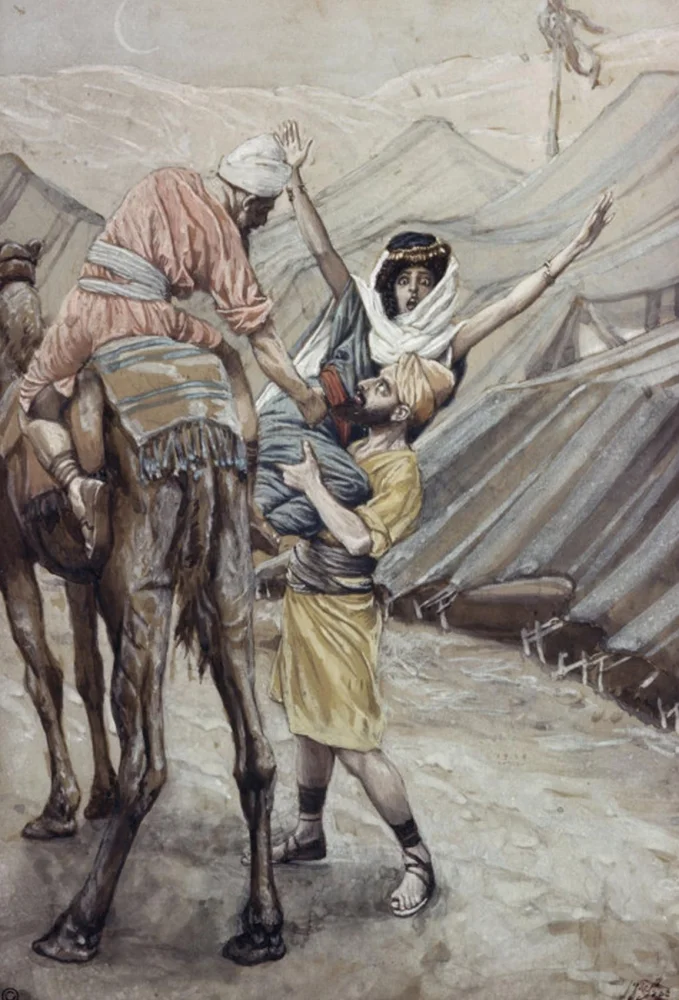
Dinah
Dinah is a daughter of Jacob and Leah in the Book of Genesis, and the only daughter named among Jacob’s children. Her brief appearance in Genesis 34 becomes the center of a story about sexual violence, family honor, revenge, and the limits of patriarchal power. The biblical narrative gives her little direct speech, leaving generations of readers to confront both what happens to her and how others speak and act in her name.
Family and the biblical account
Genesis introduces Dinah as Leah’s daughter, born to Jacob. The story that defines her appears after Jacob’s family returns to Canaan. Dinah goes out to visit the women of the region, where Shechem, the son of Hamor and a local Hivite ruler, sees her. The text describes him taking and humiliating her; translations and later interpreters differ over the exact nuance of the Hebrew, but the episode is widely understood as sexual assault.
The narrative then says that Shechem becomes attached to Dinah and asks his father to arrange a marriage. Hamor approaches Jacob’s family with a proposal for intermarriage and settlement. Jacob hears what happened and remains silent until his sons return from the fields. The men of Shechem’s city agree to circumcision as part of the proposed arrangement, but Simeon and Levi use the city’s vulnerability to attack. They kill the men, while Jacob’s other sons plunder the settlement and take its women and children.
A story of silence and revenge
Dinah does not speak in the chapter. The negotiations about marriage take place between men, and her brothers’ retaliation becomes the action’s climax. Jacob condemns Simeon and Levi’s violence, first fearing that the neighboring peoples will retaliate against his small household. Later, in Genesis 49, he condemns their anger again and predicts that their descendants will be scattered.
Readers have long debated what the episode is meant to explain. The USCCB’s biblical notes, for example, suggest that the story may reflect relations between the tribes associated with Simeon and Levi and their Canaanite neighbors around Shechem. Other commentaries focus on the family’s deception, the massacre, and the narrative’s treatment of sexual violence. The text does not offer a modern historical record that can be independently verified; Dinah’s story survives as part of the Hebrew Bible’s account of Israel’s ancestors.
Traditions and later readings
Jewish interpretive traditions expanded the sparse account, sometimes imagining Dinah’s childhood, character, or later fate. Modern biblical scholarship has paid particular attention to the tension between the story’s silence about Dinah’s perspective and the force with which her brothers claim to defend her. Feminist readings have asked whether the episode gives Dinah agency at all, and how the narrative can be read without allowing the men’s revenge to eclipse the harm done to her.
The story remains unsettling because its central questions resist easy answers. Shechem’s request to marry Dinah does not undo the violence described before it; the brothers’ fury does not make their mass killing a simple act of justice; and Jacob’s concern for family survival sits uneasily beside his daughter’s treatment. Across Jewish and Christian traditions, Dinah has consequently become a figure through whom readers examine consent, silence, kinship, and the danger of turning a woman’s suffering into a justification for further violence.