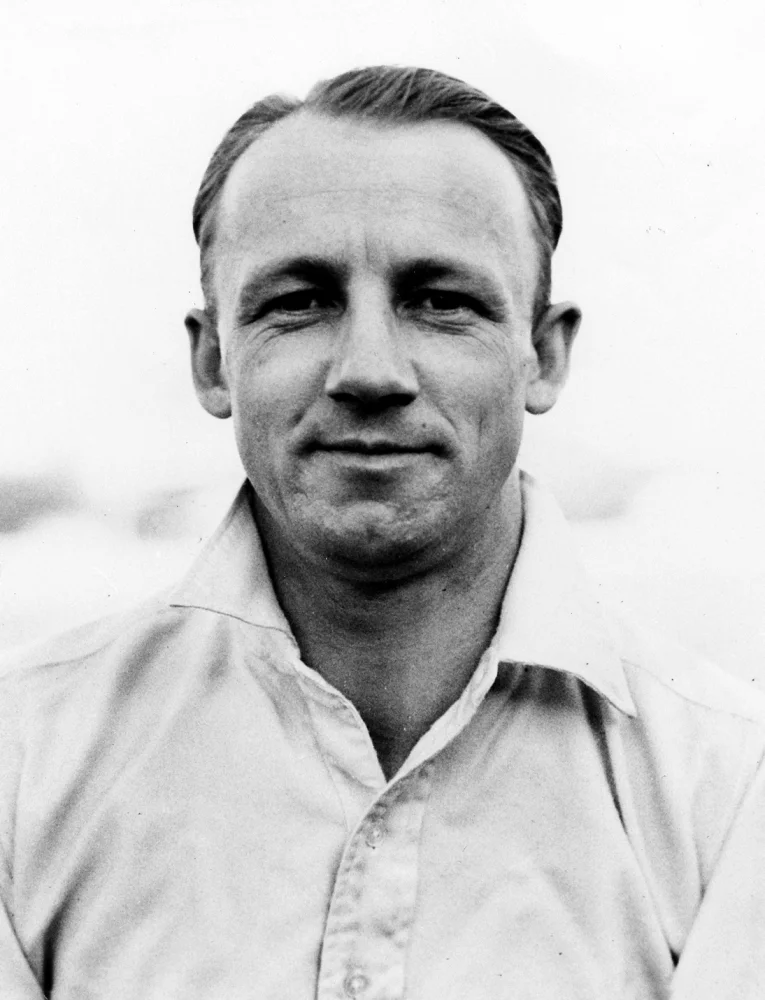
Don Bradman
Don Bradman became cricket’s most famous batter by making extraordinary scores look almost routine. His career Test average of 99.94 remains unmatched, a record so close to 100 that his final innings has become one of sport’s most retold moments. Beyond the statistics, the boy from rural New South Wales became an emblem of Australian confidence during the Depression and a respected voice in cricket administration.
From Bowral to the national team
Donald George Bradman was born on 27 August 1908 in Cootamundra, New South Wales, and grew up in Bowral. He practiced with a cricket stump and a golf ball, developing the reflexes and precision that would later unsettle the world’s best bowlers. As a teenager, he travelled long distances by train to play club cricket in Sydney while working as a clerk.
Bradman made his Test debut against England in 1928. After an unsteady start, he scored his first Test century in Melbourne, aged 20. His breakthrough came on the 1930 Ashes tour of England. He made 974 runs across the five Tests, including 334 at Leeds, a world record at the time. His fast scoring and concentration transformed expectations of what a batter could achieve.
Bodyline and wartime years
Bradman’s success helped spark England’s controversial “Bodyline” tactics during the 1932–33 Ashes series. Under captain Douglas Jardine, English bowlers repeatedly targeted the bodies of Australian batters with short-pitched deliveries and a packed leg-side field. The tactic provoked anger among Australian crowds and strained relations between the countries. Bradman adapted his approach and still averaged 56.57 in the series, a figure regarded as low only by comparison with his usual dominance.
He later captained Australia and moved to South Australia, where he led the state team and served as a selector. A serious illness kept him from international cricket for several years, and the Second World War further disrupted his career. He returned to captain Australia after the war and led the team to England in 1948. The side, known as “The Invincibles,” won four of the five Tests and completed the tour without losing a match.
A famous final innings
Bradman’s last Test came at The Oval in 1948. He needed four runs in his final innings to finish with a Test average of 100, but was bowled for a duck by England’s Eric Hollies. The missed milestone only sharpened the legend: Bradman finished with 6,996 runs in 52 Tests, at an average of 99.94, including 29 centuries.
Knighted in 1949, Bradman remained influential as a selector, administrator, and chairman of the Australian Cricket Board. He died in Adelaide on 25 February 2001, aged 92. His name remains synonymous with exceptional batting, while his records continue to set the standard by which later generations measure greatness.