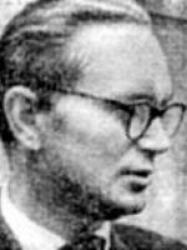
Donald Ronald Bensen
 USA
- From literary agency to book editing
- An editor with a sense of the field
- The strange history of And Having Writ...
- A lasting editorial legacy
Donald Roynald Bensen made his mark in American publishing as an editor who helped science fiction find a wider place on bookstore shelves. He also wrote fiction, including the witty alternate-history novel And Having Writ..., which turns the 1908 Tunguska explosion into the starting point for an unusual encounter between aliens and human history. In publishing, he was known for sharp literary judgment and an ability to connect readers with imaginative work.
From literary agency to book editing
Bensen was born in Brooklyn, New York, on October 3, 1927. He began in the book world as a literary agent at the Scott Meredith agency, where he worked with authors and learned the business from the point of view of manuscripts and the people trying to place them.
In 1957, he joined Pyramid Books, eventually becoming its science-fiction editor. During his decade there, Pyramid grew into an important publisher of both original science-fiction novels and paperback reprints. Bensen also edited two anthologies drawn largely from stories in the fantasy magazine Unknown: The Unknown: 11 Stories (1963) and The Unknown Five (1964). The collections helped bring a distinctive earlier generation of fantasy writing back to readers.
Bensen moved to Berkley Books in 1968 as an executive editor. He later worked with The Dial Press and Dell Books, where he helped shape the Quantum science-fiction program. The imprint brought new work to a broad trade audience and became associated with ambitious, internationally recognized fiction.
An editor with a sense of the field
Bensen’s editorial contribution was not limited to science fiction. He was known for editing the work of P. G. Wodehouse and helping bring Wodehouse books back into print in American paperback editions. That work reflects a practical side of his editorial career: he was interested not only in discovering new books but also in giving established writers another route to readers.
At Dial and Dell, he consulted on science-fiction titles that included works by Gregory Benford, John Varley, Joan D. Vinge and Spider and Jeanne Robinson. The Quantum program’s list gave space to a varied range of speculative writing, from large-scale space fiction to more personal and experimental stories. Bensen’s career thus linked the paperback boom of the mid-century with a period when science fiction was establishing itself as a major part of commercial publishing.
The strange history of And Having Writ...
Bensen wrote under the name D. R. Bensen and sometimes used other names for his fiction. His best-known work as an author is And Having Writ..., published in 1978. The novel imagines that the Tunguska event in Siberia was caused by an alien spacecraft whose occupants survived the crash. Their presence nudges history in unexpected directions: Thomas Edison is elected president in 1908, and H. G. Wells enters the story.
The book combines alternate history with a light, humorous touch. Rather than treating the past as fixed, it asks how a few improbable interventions might redirect familiar events and personalities. Its playful premise also reflects the kind of cross-pollination Bensen encouraged as an editor, where science fiction could draw on history, fantasy and comic invention.
Bensen wrote other fiction as well, including western novels, but And Having Writ... remains his most visible contribution to science fiction. He was also part of New York’s literary circles, including the Mystery Writers of America and the Trap Door Spiders, a private group of writers and editors that served as the inspiration for the Black Widowers in Isaac Asimov’s mystery stories.
A lasting editorial legacy
Bensen spent much of his life shaping what other people read, often from behind the scenes. He moved among agency work, paperback publishing, major trade houses and specialized science-fiction programs, bringing a broad view of the book market to each role. His own fiction was comparatively small in volume, but his editorial work touched many more books and helped strengthen the publishing infrastructure around speculative fiction.
He died at his home in Croton-on-Hudson, New York, on October 19, 1997. His legacy rests in both parts of his career: the imaginative alternate history he wrote and the editorial decisions that helped carry science fiction to new readers.