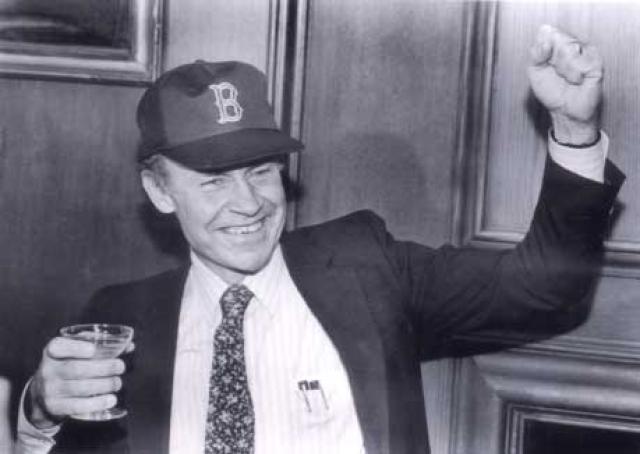
Dudley Robert Herschbach
 USA
USABiography of Dudley Robert Herschbach
Dudley Robert Herschbach is an American chemist who was awarded the Nobel Prize in Chemistry in 1986. He was born to Robert Dudley Herschbach, a contractor-builder, and Dorothy Edith Herschbach. Growing up in rural California, Herschbach was an active participant in outdoor games and sports, and even aspired to become a professional athlete. His success in the high school football team earned him a scholarship to Stanford University, where he played on the freshman team and was invited to try out for the professional club "Los Angeles Rams". However, during his second year at the university, Herschbach started conducting experiments in chemical kinetics under the guidance of G. Johnston.
In 1954, Herschbach earned a bachelor's degree in mathematics, although he could have equally qualified in chemistry or physics. He went on to receive a master's degree in chemistry in 1955 for his dissertation, which developed methods for more accurate calculations of pre-exponential factors for a series of simple reactions in the transition state theory. After completing his undergraduate studies, Herschbach continued his research at Harvard University, where he obtained a master's degree in physical sciences in 1956 and a doctorate in chemical physics in 1958. His doctoral work, conducted in collaboration with E.B. Wilson's group, made significant theoretical and experimental contributions to the calculation of energy levels for intramolecular rotation and rotation of entire molecules.
Herschbach served as a junior fellow of the Harvard College from 1957 to 1959, an assistant professor from 1959 to 1961, and an associate professor from 1961 to 1963 in the Department of Chemistry at the University of California, Berkeley. In 1963, he became a professor of chemistry at Harvard University. During his time at Harvard, Herschbach was the director of the Program in Chemical Physics from 1964 to 1977, the dean of the Faculty of Chemistry from 1977 to 1980, and a member of the Faculty Council from 1980 to 1983.
Contributions to Chemical Dynamics
As a student, Herschbach became interested in molecular beams - streams of molecules intersecting a vacuum chamber where changes in energy are recorded. This method allowed for more precise tracking of individual molecules during their interactions. Together with a small group of students and graduate students, Herschbach constructed a device in which two molecular beams intersected, with one beam containing potassium atoms and the other consisting of carbon, hydrogen, and iodine molecules. The reaction details after the intersection of these streams were studied using a device called a surface ionization detector. In the initial experiments, Herschbach was able to obtain detailed dynamics of productive molecular collisions and register the energy changes accompanying the formation of reaction products. This information enabled Herschbach's group to characterize the reaction mechanism (called the rebound mechanism) and discover that, in most cases, the release of chemical energy occurs in the form of vibration energy concentrated in the reaction products.
Experiments were conducted in more complex variants with substances of the same class, which yielded slightly different results as the reaction mechanism differed (known as the stripping mechanism). The released energy manifested more as internal excitation of molecules rather than kinetic energy. Numerous other reactions were studied, particularly after Herschbach moved to Harvard University in 1963. His experiments covered a wide range of reactions, including those with a mixed mechanism (involving elements of both previously mentioned mechanisms) and reactions that involved the formation and subsequent decay of long-lived complexes during the synthesis of final products. The obtained data allowed for the validation of statistical theories of chemical reactions and a better understanding of the important role played by momentum.
In 1967, while conducting postdoctoral research at Harvard, Herschbach began collaborating with Y.T. Lee. The crossed molecular beam technique, where the initially measured quantities are translational and angular distributions, was discovered by Herschbach and Lee in 1967. In 1986, Herschbach, together with Y.T. Lee and D. Polanyi, was awarded the Nobel Prize for their contributions to the development of research on the dynamics of elementary chemical processes. Herschbach compared the previous state of kinetic studies to baseball, where "a whole darkness of pitchers is throwing a darkness of balls at darkness of bats, and one absolutely cannot see what is happening." The study of reaction kinetics allows for simplifying the game in such a way that an observer can follow "how one pitcher throws one ball on one field."
Publications
- "Molecular Dynamics of Elementary Chemical Reactions: Nobel Lectures" (translated from English, Moscow, 1988)
- "Angular correlations in chemical reactions. Statistical theory for four-vector correlations" (with D. Barnwell, J.G. Loeser)


