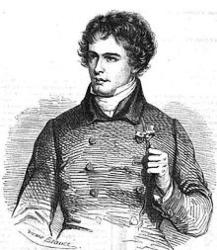
Eduard Eyre
 Great Britain
Biography of Edward Eyre
Edward John Eyre (1815-1901) was an English explorer of Australia, a sheep farmer, and the Governor of New Zealand. He began his expeditions into the interior of the continent in 1873. Eyre discovered the Flinders Ranges, Lake Torrens, Lake Eyre, and explored the route from Adelaide to Perth with great difficulty, reaching Albany in King George Sound.
Eyre was born into a clergyman's family in England. In 1832, he immigrated to Australia and became involved in sheep farming. He established a large sheep farm about 250 kilometers north of Adelaide, which served as a base for his initial explorations into the interior of South Australia. In 1839, he discovered the Brouton River, which flows into Spencer Gulf, and the Flinders Ranges to the north. From one of its peaks, later named Mount Eyre, Edward saw the vast Lake Torrens to the west. He then surveyed a significant portion of the South Australian coastline between Spencer Gulf and Streaky Bay. On the return journey, he crossed the Lincoln Peninsula (now known as the Eyre Peninsula) and reached Adelaide.
In 1840, South Australian sheep farmers raised a substantial sum of money and offered Eyre the opportunity to organize an expedition to search for new grazing lands. Eyre immediately informed the settlers that searching for pasturelands to the north and west of Adelaide would be futile. However, he proposed another important objective: to find a route to the western and northern coasts of Australia. In June 1840, Eyre left Adelaide and headed along the Flinders Ranges. However, his progress was hindered by salt lakes and swamps. Thinking that Lake Torrens, which he had discovered to the west of the Flinders Ranges, also extended to the north, Eyre mistakenly believed that the mountain range connected to the lake in that direction. It was only eighteen years later that it was revealed that Lake Eyre, which periodically dries up or floods, exists to the northwest of the Flinders Ranges, separate from Lake Torrens. It was also discovered that the route from the southern coast of Australia to its center passes between Lake Torrens and Lake Eyre.
Believing that the northern route was impassable, Eyre turned south from the summit of Mount Hopeless and decided to return to the southern coast. He planned to then travel along the Great Australian Bight to the western coast of Australia. On February 25, 1841, Eyre set off from Fowler's Bay to the west. He brought along his old companion James Baxter and three Aboriginals native to Western Australia. One of them, named Wylie, would play a significant role during the expedition. They were faced with a journey of over 3,000 kilometers.
The surrounding landscape was a monotonous plain, scattered with sparse shrubs in some areas. At times, Eyre and his companions walked along the coast, but their horses got stuck in loose sand dunes. By the end of March, their water supplies had run out, and they quenched their thirst with morning dew collected by the resourceful Aboriginals. Despite the assistance of the Australians, the expedition found themselves in a dire situation by the end of March 1841. Some of the horses died, and the surviving animals and people became tired and weakened.
In late April 1841, a tragedy occurred. In Eyre's absence, two of the Aboriginals killed Baxter and fled, taking all the food supplies. It is unlikely that it was a coincidence that Baxter, rather than Eyre, became their victim. Eyre treated the indigenous people with respect, whereas Baxter behaved like a typical colonizer. It is worth noting that at the beginning of the expedition, Baxter kidnapped an Aboriginal woman to use her as a hostage for information about water sources. This almost led to a violent confrontation, and it was only when he released the woman that Eyre averted it.
Baxter's murder did not change Eyre's attitude towards the Aboriginals. In his book about the expedition, Eyre strongly condemned the "unjust, barbaric, and unchristian system of colonization in New Holland" (Australia) and, based on his experience as a government official, stated that "during the three years I was a resident, there was not a single serious attack by the natives on Europeans."
Eyre's position can perhaps be explained by the fact that the expedition ultimately achieved its goal thanks to Wylie, the third Aboriginal participant. He voluntarily stayed with Eyre and essentially saved his life. Without Wylie's ability to find water and his hunting skills, Eyre would have perished from hunger and thirst.
They continued their journey throughout May. It was only on May 30 that they encountered a "very beautiful lake of moderate size with fresh water... This was the first body of water we encountered on our journey from Fowler's Bay, a distance of about 1700 miles."
On June 2, from a high cliff, Eyre spotted a ship at sea. The crew noticed the signals from the travelers, and soon Eyre and Wylie were taken aboard. They were rescued by the French whaling ship "Mississippi." The captain of the "Mississippi" was willing to take the travelers to any port in South Australia, but Eyre was determined to reach King George Sound on foot.
On June 14, Eyre and Wylie set off on their journey and reached Albany in July. Eyre had covered a distance of 3,500 kilometers across the barren coastal plain, which he named the Nullarbor ("no trees"). While the name is originally Latin, Eyre's fellow countrymen anglicized it according to English phonetics, turning Nullarbor into Nallarbor or Nellabor. After this expedition, it was discovered that the Great Australian Bight does not have any significant rivers flowing into it. Eyre only crossed small rivers during the final leg of his journey, between the bays of Esperance and King George.
Those searching for grazing lands were disappointed with Eyre's findings. However, geographers recognized his expedition as one of the most remarkable achievements in Australian exploration history. Eyre detailed his journey in a book that was repeatedly published in England and Australia.
In 1846, John Horrocks continued Eyre's explorations in the Lake Torrens area. However, Horrocks accidentally discharged his gun and was fatally wounded, leading to the immediate return of the expedition to Adelaide.
In 1858, John McDouall Stuart circumnavigated Lake Torrens from the west and discovered Lake Gardner to the southeast of the lake. In the same year, he traveled on a circular route, mapping the area between Lake Torrens and Lake Eyre.