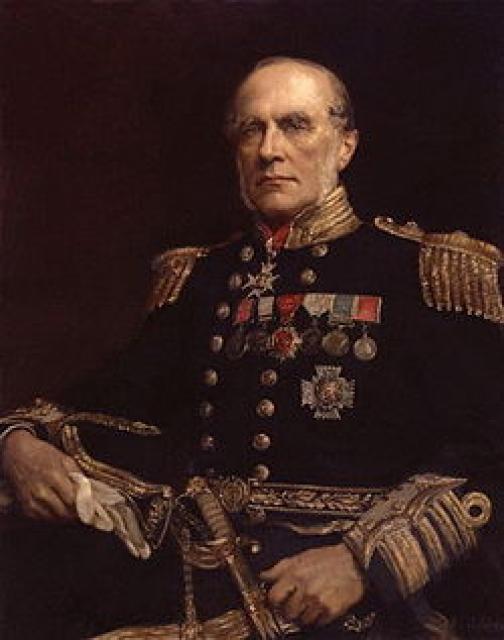
Edward Augustus Inglefield
 Great Britain
Early Life and Education
Born into a naval family, Edward Augustus Inglefield was the eldest son of Rear-Admiral Samuel Hood Inglefield. On October 6, 1832, he entered the Royal Naval College, launching his distinguished career at sea.
Arctic Explorations
In 1852-1854, Inglefield embarked on an expedition to the Barrow Strait aboard the steamer "Isabella." Commissioned by Lady Franklin, his mission was to provision an expedition searching for Sir John Franklin and to explore the northern shores of Baffin Bay.
Inglefield navigated Smith Sound to a latitude of 79° N, proving that the passage was open contrary to the claims of John Ross. His findings opened the way for future expeditions to the North Pole. On the "Phoenix," he also explored part of western Greenland, which was later named Inglefield Land in his honor.
Naval Career
Inglefield's naval career progressed rapidly. He was elected a Fellow of the Royal Society in 1853 and promoted to Captain in the same year. From 1855 to 1856, he commanded the frigate "Firebrand" in the Crimean War, engaging in combat in the Black Sea. He subsequently commanded the frigate "Sidon" in the Mediterranean.
From 1861 to 1864, Inglefield captained the "Majestic" in Liverpool. In 1866-1868, he commanded the armored frigate "Prince Consort" in the Channel and the Mediterranean.
Retirement and Final Honors
Inglefield was promoted to Rear-Admiral in 1869 and Rear-Admiral of the United Kingdom in 1872. He served as Superintendent of Malta Dockyard from 1872 to 1876 and was made a Knight Commander of the Order of the Bath in 1877.
In his later years, Sir Edward retired from the Navy and dedicated himself to painting. His detailed watercolors depicting Arctic landscapes were exhibited in galleries across London. He passed away on June 21, 1887, after a remarkable career in service to his country and the advancement of exploration.




