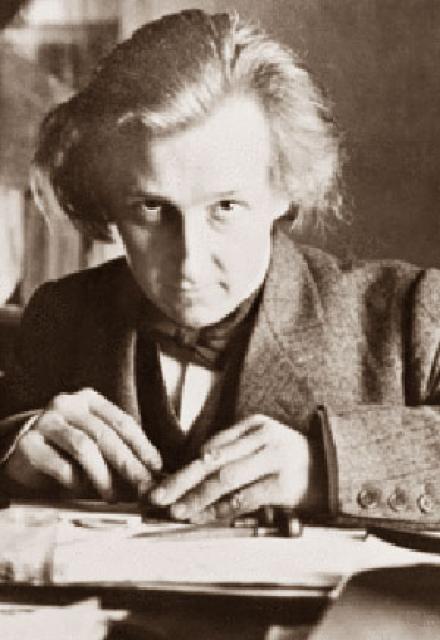
Edward Gordon Kreg
 Great Britain
Biography of Edward Gordon Craig
Edward Gordon Craig was an English director, artist, and theater theorist. He was born on January 16, 1872, in the village of Harpenden, Hertfordshire. His father was the renowned English architect, archaeologist, and theater designer Edward William Godwin, and his mother was the famous actress Ellen Terry. Unfortunately, Craig's parents separated when he was only three years old, and he deeply mourned the loss of his father. Growing up behind the scenes of the Lyceum Theatre, where his mother performed, Craig became immersed in the world of theater from an early age. In 1889, he changed his name to Edward Henry Gordon Craig, taking his father's first name, his godfather's name, and incorporating his mother's maiden name.
At the age of seventeen, Craig joined the Lyceum Theatre company and began his professional acting career. By 1897, he had already played numerous Shakespearean roles, such as Hamlet, Romeo, Macbeth, and Petruchio, both at the Lyceum and with various touring companies. His talent was acknowledged by his peers, with Henry Irving, one of the greatest actors of the time, stating that Craig would become a brilliant and even genius actor. However, Craig made the decision to leave the Lyceum, realizing that he would never be able to surpass Irving's legacy and refusing to settle for anything less.
Craig then focused on mastering the art of wood engraving and became a skilled woodcut artist. He also developed an interest in collecting books, encouraged by Irving. In 1898, his engravings started appearing in major London newspapers and magazines, and with the help of his mother, he published his first book, "Toy Books" in 1899. He also became an avid bookplate designer, earning a decent income from this pursuit. In late 1899, the composer Martin Shaw invited Craig to collaborate on a production of Purcell's opera "Dido and Aeneas." This marked a turning point in Craig's career.
The premiere of "Dido and Aeneas" in 1900 showcased Craig's innovative approach to theater. He began exploring new ways of utilizing stage space, lighting, and actor expression. Alongside Shaw, Craig also staged "The Masque of Love" (1901) from Purcell's "The History of Dioclesian," Handel's forgotten pastoral opera "Acis and Galatea" (1902), and the musical drama "Bethlehem" (1902) with a libretto by L. Hausman and music by D. Moore. These productions demonstrated Craig's ability to create a harmonious blend of music, light, movement, and color on stage. His signature grey curtains served as a backdrop for vibrant costumes, and he experimented with breaking the boundary between the stage and the audience, incorporating processions and interactive elements.
According to Craig, music, like architecture, belonged to the art forms where harmony, perfection, and beauty could be fully achieved. Despite the short duration of his early productions, they gained recognition among contemporaries and marked the emergence of a new poetic and symbolic theater.
During this period, Craig ended his relationship with Jess Dorin and fell in love with the young violinist Elena Meo. Despite Craig's marriage to May Gibson and the birth of four children, he pursued a romance with Dorin, resulting in the birth of their daughter Kitty. Naturally, May did not take this lightly and denied Craig the right to see his children.
In 1907, Craig relocated to Florence, Italy, where he lived until 1918. He continued to travel to London, Paris, and Moscow, occasionally residing in these cities for extended periods. Craig developed a passion for puppetry and collected dolls from European and Eastern theaters. He also had an impressive collection of masks from various cultures, which he considered the embodiment of genuine emotions and art.
In 1907, Craig introduced movable screens on hinges, which allowed for dynamic stage transformations. These lightweight and versatile screens became an integral part of his stage design, altering the vertical lines and overall volume of the stage. He aimed to reintroduce architecture into theater and replace flatness with dimensionality.
In 1908, Craig published his theoretical work "The Art of the Theatre," where he formulated his three fundamental components of theater: action, the supermarionette, and the mask. He believed that the ideal actor for his poetic and symbolic theater should transcend individual facial expressions and focus on using symbols as the primary means of communication. He saw the true authenticity and artistry in the expressions of a mask.
Craig's collaboration with Konstantin Stanislavski's Moscow Art Theatre (MAT) in 1911 for the production of "Hamlet" marked another significant milestone in his career. He served as both director and designer, while Stanislavski worked with the actors. However, conflicts arose between the two directors, particularly regarding the casting of the lead role. The production did not fully align with Craig's vision, and he felt that his artistic soul had been compromised.
After the premiere of "Hamlet," Craig distanced himself from theater and focused on writing and publishing books. He continued to explore the history and theory of theater, releasing works such as "Henry Irving" (1930) and "Ellen Terry and Her Secret 'Self'" (1931). Throughout his life, Craig published three journals dedicated to theater and art. He also illustrated several books, including an edition of Shakespeare's "Hamlet" with engravings that accompanied each scene.
In his later years, Craig lived a secluded and financially modest life in Italy, near Genoa. Although his ideas influenced theaters worldwide, including Russia, Germany, France, and America, he struggled to find practical recognition and financial stability. He remained dedicated to his theoretical and historical research, leaving behind a vast literary legacy.
Edward Gordon Craig passed away on July 29, 1966, in Vence, France. His innovative ideas and contributions to theater continue to inspire and shape the world of performance art.


