Edward Teach
 Great Britain
Edward Teach, also known as Blackbeard, was an English pirate who gained infamy during the Golden Age of Piracy. He was born John Teach, but little is known about his childhood and youth. There is a curious hypothesis that he was once a mercenary-instructor, as his nickname "Teach" comes from the English word "teacher." The first documented mentions of him date back to 1713 when he was already a pirate under the command of Captain Benjamin Hornigold.
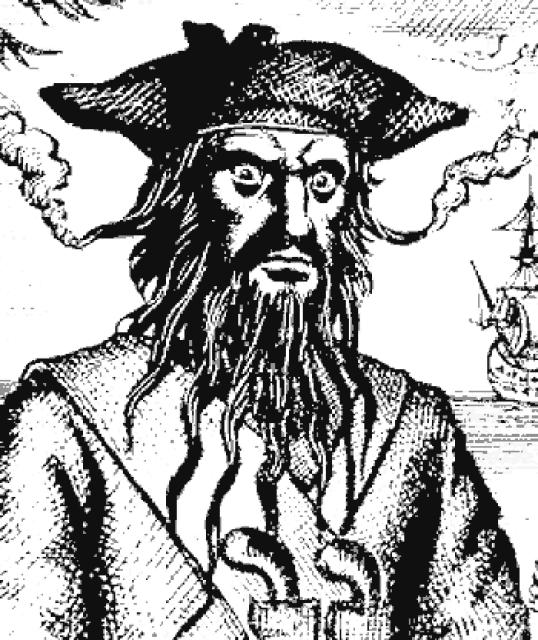
Blackbeard served as the prototype for the pirate character Flint in Robert Louis Stevenson's novel "Treasure Island." His fearsome appearance played a significant role in his reputation as one of the most terrifying villains in the region. His beard, which was jet-black and covered most of his face, along with his terrifying eyes, made him appear incredibly menacing.

In the pirate community, those who committed the greatest number of crimes were seen with envy as extraordinary and exceptional individuals. Blackbeard, with his numerous crimes, unmatched skill, and bravery, fit this description perfectly. However, he also had eccentricities that made him seem like a devil. Once, while at sea and slightly intoxicated, he proposed creating their own hell and seeing who could endure it the longest. He locked several pirates in the hold, set it on fire, and endured the torture alongside them until they begged to be released. This act solidified his reputation as the bravest.

At the beginning of his pirate career, Blackbeard joined numerous raids with Jamaican privateers during the last war against the French. Despite his courage in battle, he never managed to obtain a command position until the end of 1716 when he became a pirate and was given command of a captured sloop by Captain Hornigold.

In early 1717, Blackbeard and Hornigold set sail from New Providence, heading towards the American mainland. Along the way, they captured a bark carrying provisions and a ship loaded with goods destined for South Carolina. After making necessary repairs to their fleet on the Virginia coast, the pirates headed back to the West Indies. North of the 24th parallel, they seized a French ship en route from Guinea to Martinique, which added considerable wealth to their loot.
In the meantime, Blackbeard armed his new ship, Queen Anne's Revenge, with forty cannons and set sail around the island of St. Vincent, where he captured a large English trading ship under the command of Christopher Taylor. The pirates took what they needed from the ship and set fire to it, leaving the crew stranded on the island. A few days later, Blackbeard encountered a forty-gun ship named Scarborough, with which he engaged in a battle lasting several hours. Sensing defeat, Scarborough's captain decided to use the ship's speed to escape, ending the pursuit.
In December-January 1718, after restocking their supplies, Blackbeard and his crew, now numbering around three hundred, arrived at Ocracoke Inlet, near Bath, North Carolina. The pirates blockaded Charleston, South Carolina, for several days, capturing ships leaving the city's port. These events terrified the peaceful inhabitants, who had already suffered from a war with indigenous tribes. Trade in the area came to a halt.
Blackbeard demanded a small ransom from the governor of Charleston, including medical supplies and medicines worth less than £400. When the boat carrying the ransom capsized, delaying the fulfillment of the conditions by five days, the captives were desperate. Eventually, they were released unharmed. The townspeople wondered why Blackbeard settled for such a small ransom and why he demanded medicine, which he easily could have obtained in Bath. Some historians suggest that his crew suffered from syphilis and needed mercury as a treatment.
Blackbeard, aware that his deception might be exposed, decided to burn his flagship, Queen Anne's Revenge, claiming it had multiple leaks and posed a threat to the harbor's exit. He received permission from the governor to take the ship to a nearby river and set it on fire. The upper part of the ship burned brightly above the water while the hull sank beneath the waves.
Blackbeard spent three or four months in Bath, occasionally cruising in the nearby waters and trading with passing ships. He generously entertained local nobles, and in return, they hosted parties for him. He married a sixteen-year-old daughter of a planter, making her his fourteenth wife. It is known that he had a total of twenty-six wives in his lifetime.
It is important to mention that according to contemporary accounts, Blackbeard was a sexual deviant. His relationships with his wives were highly unconventional, with him spending the entire night with one wife and then inviting five or six companions to engage with her in his presence the next morning. Additionally, he was known to exploit the wives of his captives and friendly plantation owners for his own pleasure.
Blackbeard was aware that his deception could be discovered, and the ship could be recognized by someone docking at the harbor. Thus, he asked the governor for permission to move the ship up the river and burn it, claiming it had leaks. The governor granted his request, and the ship was burned, with the flames visible above the water while the hull sank.
In June 1718, Blackbeard embarked on a new expedition, heading towards the Bermuda Islands. Along the way, he encountered and plundered several English ships for provisions and other necessary items. When he reached Bermuda, he captured two French ships heading to Martinique, one of which was loaded with sugar and cocoa. After transferring the crew from the captured ship to the empty one, Blackbeard sailed with the cargo to North Carolina.
In Bath, Blackbeard was received warmly. He and four of his men visited the governor and claimed they found the ship abandoned at sea. This allowed them to legally claim the ship as their own booty. The governor received sixty crates of sugar as his share, and Mr. Knight, his secretary and tax collector, received twenty crates. The rest was divided among the pirates. Governor Eden "pardoned" Blackbeard for his pirate activities.
Blackbeard bought a house near the governor's residence and moored his ship at the southern end of Ocracoke Island. He married a sixteen-year-old daughter of a plantation owner and generously entertained local nobility. In return, they organized receptions for him.
Blackbeard realized the dangers of being discovered and being held accountable for his actions. Therefore, he decided to retire from piracy and settle down. However, his retirement was short-lived. In November 1718, a British naval force led by Lieutenant Robert Maynard attacked Blackbeard's hideout in Ocracoke Inlet. In the ensuing battle, Blackbeard was killed, and his head was hung from the bowsprit of Maynard's ship as proof of his demise.
Edward Teach, aka Blackbeard, left a lasting legacy as one of the most notorious and feared pirates of his time. His fearsome appearance, audacious exploits, and eccentric lifestyle continue to capture the imagination of people even today.