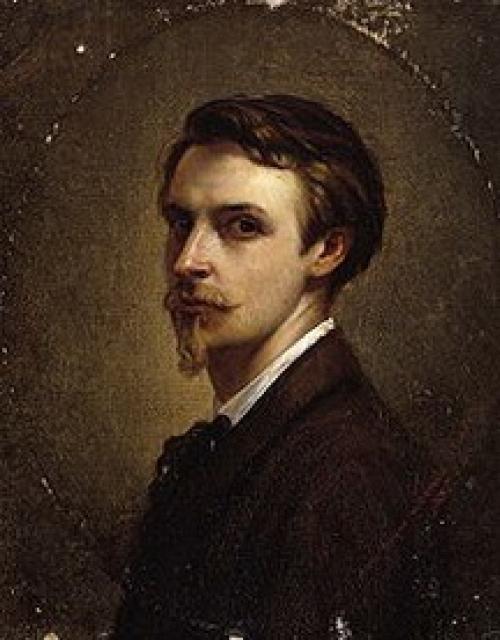
Emile Claus
 Belgium
- Early Life and Artistic Beginnings
- Realism and Genre Painting
- The Influence of Paris and Impressionism
- Luminism and Artistic Recognition
- International Success and Travel
- Exile and Return
- Later Years and Legacy
Early Life and Artistic Beginnings
Emile Claus was born into a large family of a country shopkeeper and began his artistic education at a local art school. Inspired by the composer Peter Benoit, Claus enrolled at the Antwerp Academy of Fine Arts in 1869, where he studied portraiture, historical painting, and landscape art. He graduated from the Academy in 1874.
Realism and Genre Painting
Claus's early artistic career focused on portraiture and genre painting, working in a realistic style with a somber tonal palette. He often delved into social themes, as exemplified in his painting "Wealth and Poverty" (1880).
The Influence of Paris and Impressionism
In 1882, Claus exhibited his work at the Paris Salon, marking his debut in the French art scene. He spent significant time in Paris, particularly during the winter months, and came under the influence of the French painter Julien Bastien-Lepage, who also worked in a realist style.
Around this time, Claus's palette began to brighten, and he became interested in the interplay of light and shadow. This shift towards impressionism was influenced by his exposure to the works of Claude Monet and other French impressionists.
Luminism and Artistic Recognition
Claus's constant exploration of light and color made him a forerunner of Luminism, a significant art movement in Belgium. He became a member of the Union Artistique in 1893 and later co-founded the group Vie et Lumière with Georges Buysse, fostering connections with other notable artists such as James Ensor and Adrián Heymans.
International Success and Travel
Claus's reputation continued to grow, with his works being exhibited at the Brussels group La Libre Esthétique and the Berlin Secession. He traveled extensively, visiting Paris, the Netherlands, the United States, and the French Riviera.
Exile and Return
With the outbreak of World War I, Claus fled to England, where he resided in a house on the banks of the River Thames. Here, he painted numerous landscapes of the river in a post-impressionist style, which gained considerable popularity both in London and Brussels after the war.
Later Years and Legacy
After the war, Claus returned to his villa in Astene, where he passed away in 1924. He was buried in his garden, with a marble monument by George Minne marking his grave. Claus is celebrated as one of the most influential figures in Belgian impressionism, leaving an indelible mark on the development of Belgian art. He was a member of the Antwerp Academy of Arts from 1905 and received numerous awards, including the Belgian Order of Leopold and the Legion of Honour.


