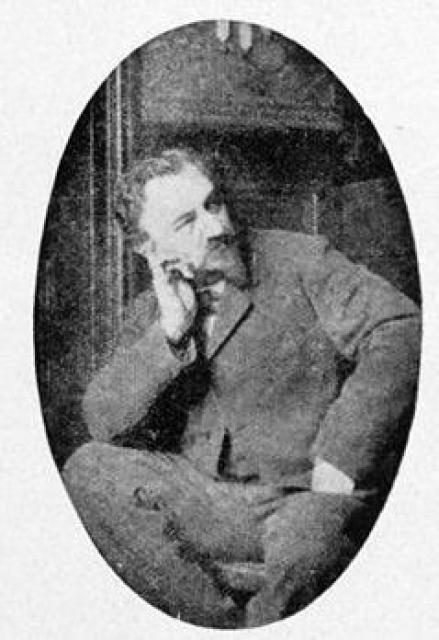
Emile Reynaud
 France
- Biography of Émile Reynaud
- The Praxinoscope and the Théâtre Optique
- The Théâtre Optique and its Demise
Biography of Émile Reynaud
Émile Reynaud was a French inventor, artist, and science popularizer, considered a pioneer of animation cinema. Born into a family of medal makers and watchmakers, Reynaud began working in his father's workshop from a young age. In 1858, he started learning the repair and calibration of optical instruments and later became an assistant to the renowned Parisian portrait photographer, Adam Salomon, where he specialized in retouching photographs. In 1864, Reynaud became the assistant to the famous lecturer and science popularizer, Abbot Moigno, traveling with him throughout France and honing his skills in delivering engaging lectures.
The Praxinoscope and the Théâtre Optique
In 1876, Émile Reynaud invented the Praxinoscope, a device for viewing drawings on a paper strip attached to a rotating drum. The image was reflected in a mirror. Two years later, he further improved the device to project the images onto a screen. By combining the Zoetrope, which allowed viewing moving pictures through a peephole, with a magic lantern, Reynaud enabled multiple viewers to enjoy the spectacle simultaneously. He replaced the cylinder of the device with a flexible strip, on which gelatin plates measuring 4x5 cm were attached. These images were reflected on the screen through a mirror placed in the center. Additionally, Reynaud was the first to use separate backgrounds, drawn separately from the characters, and projected them onto the screen using a separate magic lantern. He was also the first to synchronize images with sound, composing the music for his films himself.
The Théâtre Optique and its Demise
In 1877, Reynaud settled in Paris and began giving his own popular lectures. During this time, he constructed the Théâtre Optique, an optical device that allowed the sequential display of several drawings as smooth motion. Over the next fifteen years, Reynaud refined his apparatus, and in 1892, he was able to publicly demonstrate the sequential pictures on a screen at the Musée Grévin in Paris. In 1892, the first public screening of an animated film took place when Reynaud presented his "illuminated pantomimes" to the amazed audience gathered at the Musée Grévin. He showcased programs consisting of multiple storylines, with each screening lasting fifteen to twenty minutes. Reynaud drew, colored, and edited all his "films" himself, creating images on long strips, with each story consisting of several hundred pictures.
Reynaud introduced several techniques that laid the foundation for animation technology, including the separate drawing of characters and backgrounds. In 1893-1894, he created his masterpiece, "Autour d'une cabine" (Around a Cabin). However, in 1895, the birth of cinematography dealt a devastating blow to Reynaud. His handcrafted films could not compete with the faster and cheaper motion pictures. Desperate, the inventor smashed his apparatus and drowned it in the Seine River along with the filmstrips. Only two of them survived, "Pauvre Pierrot" (Poor Pierrot) and "Autour d'une cabine."
Reynaud's contributions to animation cannot be overstated, but he cannot be credited as the creator of the first animated film in history, as he did not use film as the image carrier in his productions.