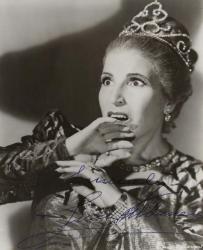
Emma Albani
 Canada
Biography of Emma Albani
Emma Albani, born Marie-Louise-Emma-Cécile Lajeunesse, was a Canadian opera singer and soprano. She was the first Canadian singer to achieve international recognition and was one of the leading voices of the 19th and early 20th centuries. Her repertoire mainly focused on the works of Mozart, Rossini, Donizetti, Bellini, and Wagner. Albani performed extensively in Europe and North America.

Early Life
Emma Albani was born on November 1, 1847, in Chambly, Quebec. She was the daughter of professional musician Joseph Lajeunesse and his wife Mélina Mignault. At the age of four, Emma began receiving musical education under the guidance of her father. Her mother passed away in 1856, and Joseph continued to train his daughter until 1858 when she was accepted into the women's monastery, now known as Collège Notre-Dame du Sacré-Cœur, in Montreal. Emma remained in the monastery for seven years and left in July 1865 to live with her father and sister Cornelia in Edward County, Ontario, and later in Albany, New York.

Rise to Fame
Emma quickly became one of the most sought-after singers in Albany, and by 1868, she had accumulated enough funds to go to Europe. She studied in France under former opera singer and tenor Gilbert-Louis Duprez before moving to Italy, where she changed her surname from Lajeunesse to Albani. She made her debut on the Italian opera stage in Messina on April 30, 1870, performing the role of Amina in Bellini's "Sonnambula." Following her triumphant debut, Albani was invited to perform in Malta, where she continued to portray Amina and other roles such as Lucia in Donizetti's "Lucia di Lammermoor," Ines in Meyerbeer's "L'Africaine," and Rosina in Rossini's "Il Barbiere di Siviglia."

In June 1871, Frederick Gye, the impresario of Covent Garden, offered Albani a lucrative five-year contract. She accepted the offer and made her first appearance in the London theater on April 2, 1872, once again performing as Amina. In the winter of 1873, the singer visited Moscow. In 1874, she embarked on her first North American tour, making her first stop in New York. During the tours, Albani was accompanied by Frederick's son, Ernest. Emma and Ernest fell in love and got married on August 6, 1878, at the Bavarian Chapel in London. Unfortunately, Frederick passed away in December 1878, and in honor of him, Emma named her son Frederick-Ernest, who was born on June 4, 1879.

Later Career and Legacy
Expanding her repertoire to include Wagner's works, Albani took on the role of Elsa in "Lohengrin," Elisabeth in "Tannhäuser," and Senta in "The Flying Dutchman." She also became acquainted with Sir Arthur Sullivan and performed in the world premiere of his oratorio, "The Golden Legend." On December 23, 1891, Albani officially made her debut at the Metropolitan Opera, portraying Gilda in Verdi's "Rigoletto." Her final operatic appearance was as Valentina in "Les Huguenots" on July 24, 1896.
Emma continued to perform in concerts worldwide and toured Canada in 1901, 1903, and 1906. Her last public performance was a solo concert at the Royal Albert Hall in London on October 14, 1911. She was appointed a Dame Commander of the Order of the British Empire in 1925. However, in the same year, her husband Ernest passed away. Left with little money, Emma began performing in charitable concerts, which allowed her to live comfortably in her later years. She passed away on April 3, 1930.