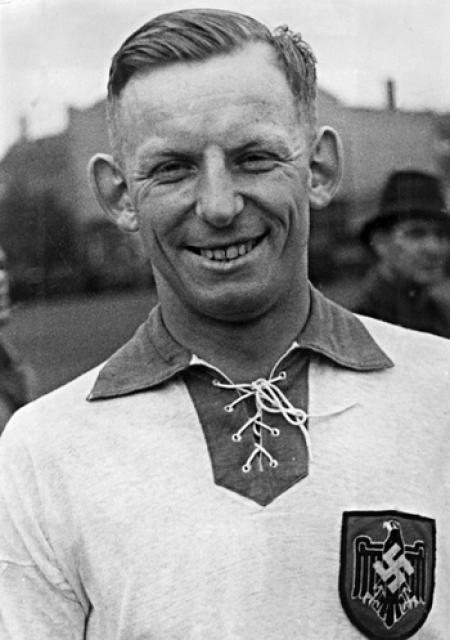
Ernest Otton Wilimowski
 Poland
Early Life
Ernest Wilimowski was born into a Silesian family residing near the Polish-German border. Given the name Ernst Otto Pradella at birth, he acquired Polish citizenship following the reintegration of Eastern Upper Silesia into Poland in 1922. His parents, Ernst-Roman and Paulina, were ethnic Germans. His father, Ernst-Roman Pradella, met an untimely demise on the Eastern Front during World War I.
Following the war, his mother remarried, and at the age of 13, Ernest adopted his stepfather's surname, Wilimowski. German was the primary language spoken at home, alongside the regional Silesian dialect. Despite his Polish citizenship, Wilimowski self-identified as a Silesian.
Early Career
Wilimowski, notably born with six toes on his right foot, played as a left winger and exhibited exceptional dribbling skills and goal-scoring prowess. He commenced his career with German club Kattowitz before joining Polish club Ruch Chorzów in 1933 at the age of 17.
Known as "Ezi," Wilimowski rapidly asserted himself as a pivotal player for Ruch, netting 33 goals in his debut season, the highest in the league. His first match in the Polish Championship was on April 8, 1934, followed by his debut for the Polish national team a few weeks later. Alongside other talented players such as Teodor Peterek and Gerard Wodarz, Ruch dominated Polish football, clinching the league championship in 1933-1936 and 1938.
Wilimowski made 86 appearances for Ruch, registering 112 goals and emerging as the league's top scorer in 1934 and 1936. He also led the scoring charts in 1939 before the German invasion of Poland. Notably, on May 21, 1939, he netted an astonishing 10 goals in a single match against Union-Touring Łódź, contributing to his club's 12-1 victory. This feat remains a league record.
Polish National Team
Shortly after his club debut, Wilimowski made his debut for Poland against Denmark in Copenhagen on May 21, 1934, at the age of 17 years and 332 days. The match ended in a 2-4 loss. Overall, Wilimowski featured in 22 matches for Poland, scoring 21 goals, averaging nearly a goal per game.
However, his behavior was not without controversy. In 1936, Wilimowski's affinity for alcohol and nightlife led to a one-year suspension by the Polish Football Association, just prior to the Berlin Olympics. His absence was deeply felt, as Poland managed only a fourth-place finish in the tournament. It is widely believed that his presence could have brought Poland the gold medal.
Wilimowski's appearances for Poland included two memorable and historic matches.
1938 FIFA World Cup
In a match against Brazil in Strasbourg, France, during the 1938 FIFA World Cup, Wilimowski etched his name in the annals of football history by becoming the first player to score four goals in a single World Cup match. His prolificacy continued as he drew a penalty due to a foul by Brazilian goalkeeper Batatais, which resulted in Poland's fifth goal, scored by Fritz Scherfke. Despite these efforts, Poland narrowly lost 5-6 and were eliminated from the tournament. While Wilimowski's record was later equaled by other players, it was only surpassed 56 years later when Oleg Salenko netted five goals against Cameroon in the 1994 World Cup. As of 2014, it still stands as the only World Cup match where a player on the losing team scored four goals.
Poland vs. Hungary
Wilimowski delivered another unforgettable performance on August 27, 1939, in Warsaw, during an international friendly against Hungary, which was one of the world's top teams at the time and had finished as runners-up in the 1938 World Cup. By the 33rd minute of the game, Hungary led 2-0. Wilimowski retaliated with three goals and earned a penalty converted by his teammate Leonhard Piątek, securing Poland's 4-2 victory. This match marked Wilimowski's last appearance for his country before the outbreak of World War II, which commenced just four days later.
Accolades
Team- Polish Champion: 1934, 1935, 1936, 1938, 1939
- FIFA World Cup Participant: 1938
- Olympic Games Participant: 1936
- German Cup Winner: 1942
Individual
- Polish Championship Top Scorer: 1934, 1936, 1939
- Second-Highest Goalscorer in a Single FIFA World Cup Match: 4 goals (June 5, 1938)