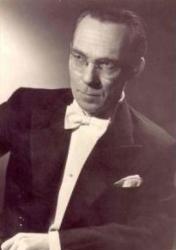
Eugyne Aynsley Goossens
 Great Britain
- Early Life and Education
- Conducting Career
- American Years
- Australian Residency
- Return to England and Legacy
- Conductorship and Legacy
- Personal Life and Scandal
Early Life and Education
Eugène Goossens, a British conductor and composer of Flemish descent, was born into a musical family. His father, Eugène Goossens Sr., was a conductor, and his brother, Léon Goossens, became a renowned oboist.
Goossens began his musical training in Bruges, Belgium, before moving to Liverpool and eventually to London's Royal College of Music. There, he studied under esteemed musicians such as Charles Villiers Stanford and Achille Rivarde.
Conducting Career
After graduating, Goossens joined Thomas Beecham's orchestra as a violinist in 1912. He quickly rose through the ranks, becoming assistant conductor in 1915. In 1916, he gained initial recognition for conducting the premiere of Stanford's opera, "The Critic."
Concurrently, Goossens performed as a violinist with the Philharmonic Quartet alongside cellist Cedric Sharpe. In 1921, he left Beecham's orchestra to form his own ensemble, which notably introduced Stravinsky's ballet "The Rite of Spring" to the United Kingdom.
American Years
In 1923, Goossens was appointed conductor of the Rochester Philharmonic Orchestra in New York. He simultaneously taught at the Eastman School of Music. From 1931 to 1946, he led the Cincinnati Symphony Orchestra.
Australian Residency
In 1947, Goossens moved to Australia, where he became director of the Sydney Symphony Orchestra and the New South Wales Conservatorium. He was knighted in 1955, but a year later was forced to resign from his posts due to a public scandal involving pornography.
Return to England and Legacy
Goossens returned to England and largely ceased conducting. However, he continued to make notable recordings, including an acclaimed version of Respighi's "Roman Festivals."
As a composer, Goossens's works include the opera "Don Juan de Mañara," the oratorio "Apocalypse," two symphonies, an oboe concerto (dedicated to his brother), two string quartets, two violin sonatas, and other chamber music.
Conductorship and Legacy
Goossens is renowned as a conductor who commissioned a series of торжественные (solemn) pieces from American composers during World War II. His 1942 initiative resulted in the creation of notable works like Aaron Copland's "Fanfare for the Common Man."
Personal Life and Scandal
Goossens's scandalous affair with the erotic occultist Rosaleen Norton led to the end of his career. This relationship has been the subject of various artistic works, including the 2004 opera "Eugène & Roie" by Australian composer Drew Crawford.