Ferencz Gyulai
 Austria
- Franz Gyulai: A Military and Political Figure
- Early Career and Military Accomplishments
- The 1848 Revolutions and the Italian Campaign
- Minister of War and Viceregal Appointments
- The Second Italian War of Independence
- Later Life and Legacy
Franz Gyulai: A Military and Political Figure
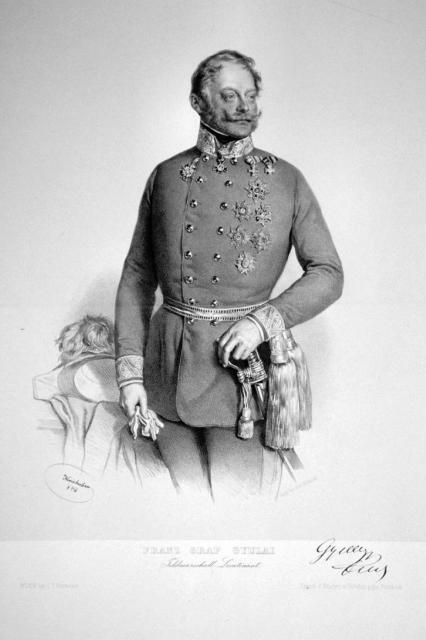
Franz Gyulai was an Austrian military and political leader who played a significant role in the Austrian Empire's history. Hailing from a renowned Hungarian aristocratic family in Transylvania, Gyulai rose through the ranks of the Austrian army, ultimately becoming a key figure in the Empire's military and political spheres.
Early Career and Military Accomplishments
Born into a family of distinguished military officers, Gyulai began his military service in 1815, joining the 60th Infantry Regiment, which bore his father's name. His exceptional courage and military prowess earned him rapid promotions: by 1839, he had risen to the rank of General-Major. His subsequent command of the 33rd Infantry Regiment in 1845 and his appointment as Governor of Trieste and General Governor of the Austrian Littoral in 1846 further solidified his position as a respected military leader.
The 1848 Revolutions and the Italian Campaign
During the 1848 Revolutions, Gyulai's resourcefulness and leadership were tested. As commander of the Austro-Hungarian fleet in Trieste, he successfully restored order and combat readiness to his forces. He then joined forces with Field Marshal Radetzky in Italy, where he participated in the Battle of Custoza in 1848.
Minister of War and Viceregal Appointments
Gyulai's military achievements earned him recognition from Emperor Ferdinand I, who appointed him Minister of War in 1849. In this role, Gyulai oversaw the Empire's military reorganization. In 1850, he was sent to Milan to command the 2nd Imperial and Royal Army of Austria.
When Emperor Franz Joseph I appointed his brother Maximilian I as Viceroy of the Kingdom of Lombardy-Venetia in 1857, Gyulai was entrusted with the governance of the territory. He held this position until 1859, when the outbreak of war between Austria and Sardinia and its allies forced him to assume command of the Austrian forces in northern Italy.
The Second Italian War of Independence
In the Second Italian War of Independence, Gyulai faced the combined forces of Sardinia and France. Despite his strategic maneuvers, he suffered defeats at the battles of Montebello and Magenta. As a result, he was removed from command and replaced by the Emperor himself.
Later Life and Legacy
Undeterred by his military setbacks, Gyulai remained loyal to the Austrian Empire. He volunteered to command a regiment bearing his name, which he led in the defense of Mantua. After the Italian unification movement's success, Gyulai retired with the rank of Field Marshal.
In his later years, Gyulai penned his memoirs, recounting the Italian campaign of 1859. He remained a respected figure within the Austrian military and aristocracy, leaving a lasting legacy as a military leader and political servant of the Austrian Empire.