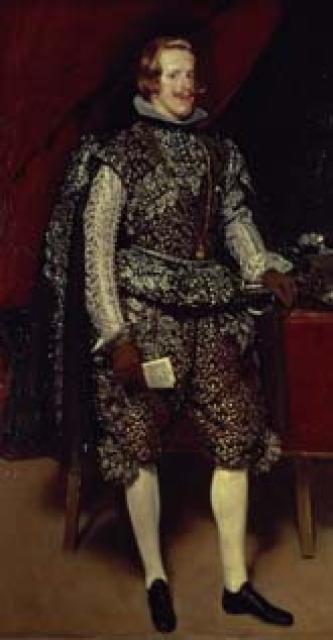
Fillipp 4
 Spain
SpainBiography of Philip IV of Spain
Philip IV of Spain, a member of the Habsburg dynasty, reigned as the King of Spain from 1621. He was often detached from state affairs, serving as a pawn in the hands of his favorites, namely Olivares until 1643 and Luis de Haro from 1643 to 1661. Philip IV officially recognized the independence of the Dutch Republic in 1648 and ceded several territories to France in the Treaty of the Pyrenees in 1659. His troops brutally suppressed the Segadors' Revolt (1640-1652) in Catalonia, but Philip IV was compelled to affirm Catalan privileges with certain reservations. He refused to recognize the independence of Portugal in 1640 and continued to strive for Spanish dominance over the country throughout his reign.
Philip IV's reign was fundamentally different from that of his father. While his father's rule was characterized by a lack of active political will, Philip IV had ambitious plans both domestically and in foreign affairs. His conception of the monarch's mission was closely tied to the Catholic ethic and moral teachings of the time. The defense of Catholicism as the only true faith and the preservation of the crown's authority were paramount among the divine functions of the Spanish monarch.
Upon ascending the throne in March 1621, Philip IV began implementing a program aimed at renewing and reforming Spain. The Catholic Majesty's rule was intended to gain universal recognition as a Christian leader. The reform program encompassed not only external and internal political matters but also a complete overhaul of moral and ethical principles. The intention was to return to the customs of past centuries. The peaceful policy pursued under Philip III was condemned as weak and damaging to the authority of the king and monarchy in Europe. Hence, a new policy that would halt the process of disintegration became imperative. The monarchy's claim to hegemony prompted an interventionist policy, not shying away from military conflicts.
In the domestic sphere, the focus of the reforms was to combat corruption and the corrupt court of Philip III, which had paralyzed his ability to act. The court's venality and scandalous extravagance often invited public criticism, so the announcement of expense reduction was met with general approval. Philip IV dismissed the favorites of the Duke of Lerma, Osuna, and Uceda from their positions and some were brought to trial. Administrative matters were resolved more swiftly and efficiently. However, Philip IV and his prime minister, Olivares, aimed above all to see Spain as a unified political entity. In their view, the elimination of special rights and privileges in various provinces was necessary to create a centralized state. They believed that Spain would then achieve the power to reclaim its indisputable leadership in the world. In 1624, Olivares announced this project in a program: "Your Majesty's most important goal of your reign should be to become the king of all of Spain. Your Majesty should not be content with being the king of Portugal, Aragon, Valencia, and the count of Barcelona. Your Majesty should strive to unite all the parts that make up Spain according to the laws of Castile. If Your Majesty achieves this goal, then Your Majesty will become the most powerful monarch in the whole world."
The contemporary project of creating the "Union de Armas" (Union of Arms) to allow all parts of the kingdom to participate in military endeavors without relying on special rights and privileges inevitably failed and ultimately turned into its opposite. Throughout the 1640s, a wave of uprisings swept through almost all regions of the state, some seriously threatening the unity of Spain. Nevertheless, the desire for reforms and the measures adopted in the early years of Philip IV's reign initially had a positive resonance. These plans gave rise to great hopes, as people expected a revival of Spain's former glory and strength.
Source: Spanish Monarchs, edited by V.L. Berneker; "Phoenix", Rostov-on-Don, 1998.


