Flavius Victor
 Italy
Flavius Victor was a child when his father, Magnus Maximus, raised him to the rank of Augustus during a challenge to Roman imperial rule. His name appears on coins, but the surviving record tells us little about his personal life. Victor’s brief reign was shaped entirely by his father’s bid for power and ended with the collapse of that revolt in 388.
A Title in a Time of Civil War
Magnus Maximus had seized power in the western provinces in 383, setting himself against the reigning emperor Gratian and the young Valentinian II. The balance of power shifted repeatedly as Maximus sought recognition from Theodosius I, the eastern emperor. Sources differ on when Victor was proclaimed Augustus: some date the elevation to 384, while numismatic scholarship places it around 387, shortly before Maximus invaded Italy.
The title made Victor a nominal co-ruler and gave the regime the appearance of a dynasty. Yet he was still very young and had no independent political or military role. His authority was symbolic, tied to his father’s control of Gaul and later to Maximus’s attempt to take Italy from Valentinian II.
Coins and Imperial Image
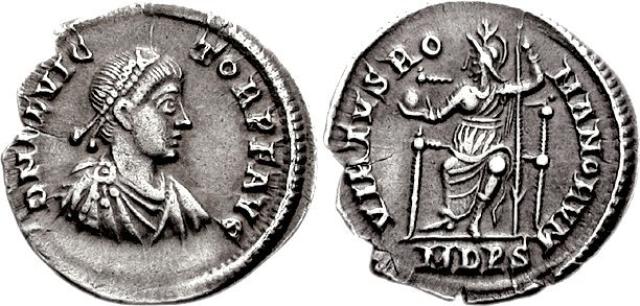
The most tangible traces of Victor’s rule are his coins. Issues bearing his name were struck at Trier and at mints in Milan and Aquileia after Maximus’s forces moved into Italy. Their portraits and inscriptions presented Victor as a legitimate Augustus, even as his father’s position remained contested. On some coin designs, the younger ruler appears smaller than his father, a conventional visual cue that also reflected his subordinate status.
The End of the Revolt
Theodosius I defeated Maximus’s forces in 388. Maximus was captured at Aquileia and executed. Victor had remained in Gaul, probably at Trier, where he was killed shortly afterward by the general Arbogast, acting for Theodosius. The ancient accounts and later scholarship differ in some details of the timing and circumstances, but they agree that Victor was executed after his father’s defeat.
Victor’s reign lasted only a few years, and history preserves no speeches, policies or personal judgments from him. His significance lies in what his elevation reveals about late Roman politics: even a child could be named co-emperor to strengthen a rival ruler’s claim, while the coins issued in his name projected an image of continuity that could not survive the defeat of his father.