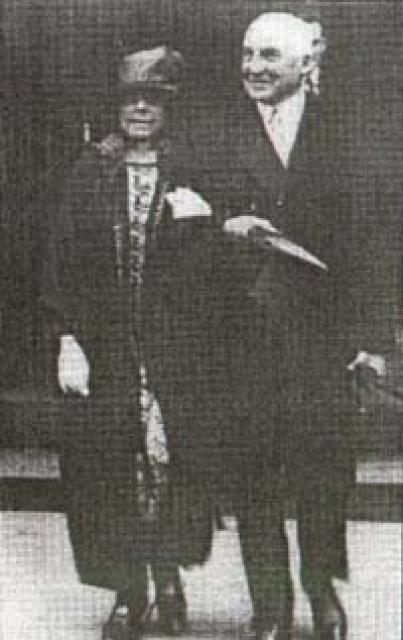
Florens Harding
 USA
USABiography of Florence Harding
Florence Kling Harding, also known as Flossie, was the wife of the 29th President of the United States. She was the first first lady to have a personal security detail. While Warren G. Harding was not the first president to have a mistress, he was the first to have his mistress write a memoir, which was published in 1927 and caused a scandal. Four years after Harding's death, a book titled "The President's Daughter" was published by Nan Britton, in which she detailed her affair with Harding. They met when she was 16 and he was already a senator, and their relationship continued until 1923.
Nan Britton was a beautiful, graceful, and precocious girl. Once, when the senator visited New York, they spent a night together in Manhattan, but their idyll was interrupted by two detectives who burst into the room and caught them in a compromising situation. Harding paid them $20 to keep quiet, and when the detectives left, he confessed that he would have paid $1000 to protect his political career. In 1919, Nan Britton gave birth to a daughter named Elizabeth, whom she claimed to be Harding's child. Some biographers doubt his paternity, suggesting that he was infertile. The court dismissed Britton's claim for Harding's inheritance due to lack of substantial evidence. However, a man named Caston B. Minns claimed that he stole documents confirming Harding's paternity at the request of Mrs. Harding.
According to Nan's account, she once visited Harding in his Senate office, where they became intimate and she became pregnant. She also claimed that Harding, though he never saw their daughter Elizabeth, was interested in her development and looked at pictures of her. She often visited him at the White House, and he always gave her several hundred dollars to support the child. Sometimes the money was passed through a Secret Service officer. They engaged in sexual activities in a small room next to his office at the White House, which usually served as a dressing room for guests. Harding put guards at the doors and told them that he would be busy, and no one, including his wife, was allowed to enter the office.
In her exposé book, Nan shared an anecdote: "Once, in 1921, President Harding's wife, Flo, driven by some female instinct, decided to enter the office just at the moment when Nan was there. One of the officers told her that he couldn't let her in as per the President's orders. If he disobeyed the order, he would lose his position. Secretly, he informed the President about the impending danger. Shortly after that, Harding, adjusting his tie, left the office." Nan dedicated her book to all single mothers and their children. She emphasized that she published her memoir to draw attention to the neglect of the rights of illegitimate children. Initially, no publisher was willing to take her book. And when the manuscript was finally accepted by one of the publishers, the printing plates were stolen from the printshop and returned to the publisher only after a court case. They also hindered exhibitions and films based on Nan Britton's book.
In the 1920s, Harding became too burdensome for the Republican Party. Numerous scandals, involving not only his personal life but also corruption, tarnished his reputation. Nan Britton was not the only mistress of Harding. For ten years, he maintained an intimate relationship with Carrie Phillips, the wife of his friend James Phillips, a former merchant from Marion. This affair ended in 1920 and became known only after Harding's death, when over two hundred love letters to Carrie Phillips, nicknamed "Sis," were discovered, signed as "Constant." An attempt to publish the letters was unsuccessful. Harding's heirs sued the owner of the letters, and in 1971, a court decision prohibited their publication until 2014.
According to many historians, Warren Harding was the most pathetic president in the history of the United States. His wife, Florence, was considered one of the most unsuccessful First Ladies, although this may not be entirely fair.
Florence Kling was born on August 15, 1860, in Marion, Ohio. She was the daughter of banker Elias Kling, the wealthiest man in their town. Florence received a good education at a private school, took horseback riding lessons, and studied piano at the Cincinnati Conservatory.
Florence was a sociable person. Young people would often visit her, but none of the potential suitors appealed to her. Eventually, she fell in love with Henry DeWolfe, known as Pete. In March 1880, Florence and Pete eloped and secretly got married. Six months later, their son was born. However, their marital happiness did not last long. Pete turned out to be an irresponsible man who drank and did not care for his family. Two years later, he left Florence and their child, disappearing on the Wild West without a trace.
Florence decided to return to her hometown of Marion. Her pride prevented her from seeking help from her parents, so she gave music lessons for 50 cents per hour. With the financial support of her husband's parents, she was able to support herself and her son.
In 1886, Florence obtained a divorce. She learned of her husband's death many years later. Her father forgave her for leaving home and, upon seeing that she was supporting herself, offered for her to return. He acknowledged her son, Eugene, as his grandson, adopted him, and took care of his upbringing. However, despite all this, the relationship between father and daughter remained strained. Both were stubborn and had a strong desire for independence, often leading to arguments.
Ten years after returning to Marion, Florence met Warren Harding. She lived near him and often saw him walking along the main street. Harding was tall, good-looking, and admired by women. Perhaps he would have never taken notice of the slim and not very beautiful Florence if she hadn't arranged a "chance" meeting in 1890, seeking to give music lessons to his younger sister. Although he tried to avoid her, she always found ways to "throw herself at him."
Florence's father was not thrilled about their acquaintance. He believed that Harding, the owner of the not-so-popular provincial newspaper "The Marion Star," was not a suitable match for his daughter, the richest person in town. And when thirty-year-old Florence married Harding against her father's wishes, he did not speak to her for seven years. It was only after Harding began to climb the political ladder that he changed his opinion about him.
Their wedding took place on July 8, 1891. Warren was 25 years old, and Florence was 30. Florence's father did not attend the wedding ceremony; only her mother, Louise Kling, was present, without the knowledge of her husband.
Harding built a home for their family of four, but their family did not grow any larger. It was rumored that Florence did not want any more children and took "little white pills" to avoid pregnancy. Their son continued to live with Florence's parents, and she rarely saw him. He was 11 years old at the time. When he grew up, got married, and had children of his own, she did not acknowledge her grandchildren, lacking any maternal feelings.
Harding was a peaceable and affable man, while his wife enjoyed giving orders. She exuded energy and commanded everyone. Harding called her "The Duchess," and the name suited her well.
Florence soon became the nominal owner of "The Marion Star," and she ran the newspaper for 14 years. "I came to the office just for a few days to help out, and I stayed there for 14 years," she recalled later. She maintained discipline and order among the staff. No one received a salary raise. At the same time, Harding discreetly played high-stakes poker with the newspaper staff. If they lost, he would secretly give them higher salaries. To give Florence her due, she not only closely supervised the work of the employees but also worked hard herself. If the office floor was dirty, she wasn't afraid to roll up her sleeves and clean it.
Florence was the first to hire young boys to deliver newspapers and organized their work herself. If any of them didn't work diligently, she would give them a slap. Under her leadership, the newspaper's circulation quickly increased. Among the paperboys was Norman Thomas, who would later become a multiple-time candidate for President from the Socialist Party of America. He wrote about his former boss, "Mrs. Harding was a true boss. She had an incredible mind and was not interested in many things and lacked sensitivity. However, she had a strong will and even kindness. Her husband was just a bystander, although he was considered a good guy. Everyone loved him more than his wife. But it was she who achieved the success of 'The Marion Star.'” Florence was constantly involved in the newspaper's affairs and even wrote articles herself. She had a keen interest in politics and actively participated in Republican Party activities.
Florence was the first lady of Ohio when Harding was elected as a senator for the state in 1898. In 1902, he became the lieutenant governor of Ohio. In 1914, Florence convinced her husband to run for senator in the federal parliament in Washington and even found support for him among influential Ohio Republican politicians. Harding won the election, and in 1915, they moved to Washington.
Florence took great pride in being the wife of a senator. She enjoyed attending receptions with prominent politicians and participating in various events. She visited the best houses along with her husband, where representatives of Washington society gathered for poker games, although she did not play herself. She eagerly attended high society seances.
As the wife of a senator and later president, Florence paid great attention to her appearance. Always aware that she was older than her husband, she tried to mitigate this difference with her appearance and behavior.
When influential American politician Harry Daugherty began promoting Harding's candidacy for the 1920 presidential elections, Florence initially had significant doubts about the success of this endeavor. She was not sure if her husband would actually be nominated, and there was a risk of losing all the money invested in the campaign. However, Daugherty knew who he had to convince: "Harding loves her very much and respects her opinion... If she supports his candidacy, he will fight for it. But if she objects, he is unlikely to do anything against her will."
There were moments when Harding doubted the possibility of his candidacy. He called his representatives in Ohio and told them that he intended to withdraw from the race. Florence happened to be in the room and overheard his words. She quickly grabbed the phone from her husband's hand and shouted, "Warren, what are you doing? Withdraw from the race? Never, especially not before the end of the party convention! Think about your friends in Ohio." Harding, as always, listened to his wife. Some of his biographers believe that he only became President of the United States thanks to her determination at that moment. Florence personally participated in the work of the nominating convention, observed the behavior of delegates, and gave her final assessment of her husband's chances in the competition. She willingly spoke to journalists and even agreed to have her words recorded, which was unusual for women in politics at the time. When asked if she advocated women's suffrage, she replied, "Yes, I am a suffragette."
Florence believed in fortune-telling. In May 1920, she visited the famous Washington fortune teller Madame Marcia and asked about the horoscope of a man born on November 2, 1865, at two o'clock. Madame Marcia predicted that this person was a prominent statesman and would become President of the United States but would not live to see the end of his presidency. Additionally, he would become entangled in many romantic affairs.
Regarding her husband's affairs, it is difficult to say how much Florence was aware of. The prediction of his presidency was more important to her than anything else.
Harding was nominated as the Republican Party's candidate only after the tenth ballot. Just before the vote, party bosses invited Harding for a conversation and asked if there were any circumstances in his career that could create difficulties for him if his candidacy were announced. For a moment, he thought about Nan Britton, her child, and the rumors spread by the competitors of "The Marion Star" that the Harding family was involved in shady dealings. But then he confidently said that his life path was as pure as snow. Florence once said, "If he becomes president, the only word I see over his head is 'tragedy,'" and despite this, she decided to actively participate in the campaign. It required a certain amount of effort, as Harding started traveling across the country. He delivered speeches to voters from the porch of their home in Ohio. Florence entertained numerous guests, gave speeches to women, and convinced voters that both she and her husband were average, ordinary Americans. And when Harding finally embarked on a short trip across the United States, she went with him.
Florence did not like being photographed. When Daugherty ordered a large brochure with a biography of Harding and his wife and asked Florence to have her photo taken, she refused. So, Daugherty brought an old, hideous photograph and said that he would include it in the brochure if she refused to take a new, beautiful photo. Only then did she let herself be persuaded.
Harding won the election. It was the first election where women voted, and commentators emphasized that he owed his victory to the majority of women's votes.
On March 4, 1921, the day of Harding's inauguration, Edith Wilson and Florence Harding created a precedent. Former and current First Ladies arrived at the ceremony in the same car for the first time in U.S. history.
When the Hardings moved into the White House, Florence repeatedly emphasized that she and her husband were "ordinary people." It was well-received by society and set them apart from the cold intellectual arrogance of the Wilsons. Florence swung the doors of the White House wide open, which Mrs. Wilson had closed.
When Harding entered office, Florence constantly repeated that she and her husband were "plain folks." This was well-received by society and set them apart from the cold intellectual arrogance of the Wilsons. Florence swung the doors of the White House wide open, which Mrs. Wilson had closed.


