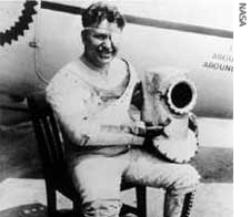
Francis Gary Powers
 USA
USABiography of Francis Gary Powers
Francis Gary Powers, an American pilot, was born in Jenkins, Kentucky, in a family of a miner turned cobbler. He completed his college education at Milligan College near Johnson City, Tennessee. In May 1950, he voluntarily enlisted in the US Army and received training at the Air Force base in Greenville, Mississippi, and later at the base near Phoenix, Arizona. During his training, Powers flew on various aircrafts, including the T-6, T-33, and F-80.

After completing his training, Powers served as a pilot on different US Air Force bases, holding the rank of First Lieutenant. He flew the F-84 fighter-bomber. He was supposed to participate in the Korean War, but an appendix issue prevented him from being deployed. After recovering, Powers was recruited by the CIA as an experienced pilot and did not end up going to Korea. In 1956, he left the Air Force with the rank of Captain and fully transitioned to work for the CIA, where he was involved in the U-2 spy plane program.
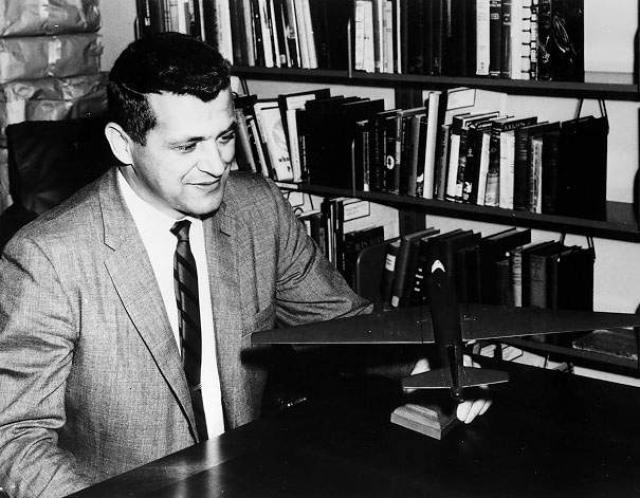
Powers received a monthly salary of $2500 for reconnaissance missions, compared to the $700 he received while serving in the US Air Force. After being recruited by the CIA, he underwent special training at an airfield located in the desert of Nevada. There, he studied the Lockheed U-2 high-altitude aircraft and learned to operate equipment for intercepting radio signals and radar stations. Powers conducted training flights on U-2 planes at high altitudes and over long distances, covering areas such as California, Texas, and northern parts of the United States.
Following his special training, Powers was sent to the American-Turkish military aviation base in Incirlik, near the city of Adana. Since 1956, as part of the "10-10" unit, Powers regularly conducted reconnaissance flights along the borders of the Soviet Union with Turkey, Iran, and Afghanistan. On May 1, 1960, Powers was flying over the USSR on a mission to photograph military and industrial objects and record signals from Soviet radar stations. His planned flight route began at the military airbase in Peshawar, passed through Afghanistan, and then over the USSR from south to north, at an altitude of 20,000 meters, along the route Aral Sea - Sverdlovsk - Kirov - Arkhangelsk - Murmansk, and ended at the military airbase in Bodø, Norway.
However, the U-2 aircraft violated the state border of the USSR at 5:36 am Moscow time, about twenty kilometers southeast of the city of Kirovabad, Tajik SSR, at an altitude of 20 km. At 8:53 am, near Sverdlovsk, the aircraft was shot down by "surface-to-air" missiles from the S-75 air defense system. The first missile hit the U-2 near Degtyarsk, severing one wing and damaging the engine and tail section. Several more missiles were launched to ensure the destruction of the aircraft (a total of eight missiles were fired that day, although this was not mentioned in the official Soviet version of events). As a result, a Soviet MiG-19 fighter jet, which was flying below and unable to reach the altitude of the U-2, was accidentally shot down. The pilot of the Soviet aircraft, Senior Lieutenant Sergei Safronov, died and was posthumously awarded the Order of the Red Banner. Additionally, a single Su-9 fighter was scrambled to intercept the intruder. However, as the aircraft was being transferred from the factory to the unit and was not armed, its pilot, Igor Mentyukov, was ordered to ram the enemy aircraft but failed to do so.
After the U-2 was hit by a surface-to-air missile, Powers ejected with his parachute and was captured by local residents near the village of Kosulino. According to instructions, Powers was supposed to use the ejection seat system but failed to do so, and he jumped out of the aircraft with a parachute at a high altitude during the chaotic descent. Upon examining the wreckage of the U-2, it was discovered that there was an explosive device in the ejection system that would have been triggered upon ejection. On August 19, 1960, Francis Gary Powers was sentenced by the Military Collegium of the Supreme Court of the USSR under Article 2 "On Criminal Responsibility for State Crimes" to 10 years of imprisonment, with the first three years to be served in prison.
On February 11, 1962, Powers was exchanged for Soviet spy William Fisher (also known as Rudolf Abel) on the Glienicke Bridge in Berlin, with the assistance of East German lawyer Wolfgang Vogel. For a long time, a small exhibition dedicated to the downing of Powers' aircraft was displayed at the Officers' House in Sverdlovsk, including wreckage of the aircraft, the headset through which the order to shoot was given, a model of the missile that downed the intruder. Upon his return to the US, Powers was initially accused of failing to destroy the reconnaissance equipment on his plane or of not committing suicide using a specially poisoned needle that was given to him. However, all charges were dropped following a military inquiry.
Powers continued working in the military aviation field, but there is no information about his further collaboration with the intelligence community. From 1963 to 1970, Powers worked as a test pilot for Lockheed. He then became a radio commentator for KGIL radio station and later worked as a helicopter pilot for the KNBC radio-television agency in Los Angeles. On August 1, 1977, he died in a helicopter crash while returning from covering a fire in the Santa Barbara area. The crash was likely caused by fuel shortage. George Spears, an operator for the television company, also died in the crash. Powers was buried at Arlington National Cemetery.
Despite the failure of his famous reconnaissance flight, Powers was posthumously awarded multiple medals in 2000 for his service (including the POW Medal, Air Medal, and National Defense Service Medal).