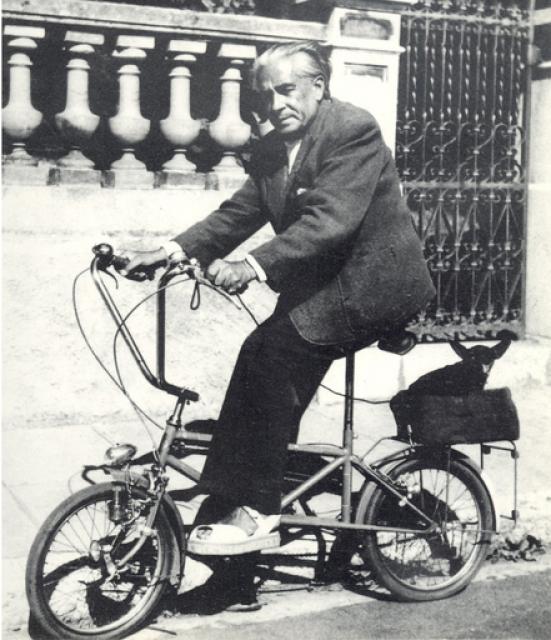
Francisco Picabia
 France
- Francis Picabia: The Eccentric Avant-Garde Artist
- Biography
- The Defining Influence
- Another Artistic Shift
- The Zigzagging Trajectory
Francis Picabia: The Eccentric Avant-Garde Artist
Francis Picabia, a French avant-garde artist, graphic designer, and writer, gained fame as an eccentric artist who did not conform to any political or stylistic dogmas. He had a significant influence on modern art, particularly Dadaism and Surrealism. Francisco María Martínez Picabia della Torre, known as Francis Picabia, was born in Paris to a French mother and a Spanish father, and he died 74 years later in Paris (at 82 rue des Petits-Champs). Picabia's father initially worked in the sugar industry in Cuba, and then served in the Cuban embassy in France. It was in Paris that he met Picabia's future mother.
Biography
Francis Picabia was known for his flexible and sociable nature, as well as his highly changeable and choleric temperament. His abrupt shifts in mood and creative energy sometimes resulted in long periods of depression or fits of irritable outbursts, usually within the family setting. Throughout his life, Picabia constantly changed his artistic style, as well as his personal and aesthetic preferences. He may even be considered a record holder in this regard. If we were to count all the transformations of his style, direction, writing style, and even ideology, there would be no fewer than seven (if not ten) sharp turns. In this respect, Francis Picabia surpasses even his more famous contemporary and friend, Pablo Picasso.
In 1895-1896, Francis Picabia took lessons at the Paris School of Decorative Arts under Amber and Cormon, and in his early style, he painted solid, typically French landscapes, continuing in the Impressionistic tradition of famous works by Camille Corot. After 1899, Picabia began exhibiting at the Salon des Indépendants and gained some recognition as an Impressionist in Parisian artistic circles. However, his Impressionism did not last long. By 1902, after a trip to Spain, Picabia's artistic interests gradually began to shift towards the colorful and provocative Fauvist style.
The Defining Influence
In 1910, Francis Picabia's life and artistic development were significantly influenced by his acquaintance with Marcel Duchamp. He transitioned from Fauvism to Cubism and geometric abstraction before the war with Germany. His most famous painting of this time, "The Dancer on an Atlantic Cruise" (1913), served as a testament not only to Picabia's abstract style but also to his extended stay in New York (over three years). Picabia had a habit of leaving places where wars were taking place. He exhibited his new abstract cubist style paintings at the "Armory Show" (New York, 1913), which brought him further recognition. However, Picabia did not stop there. From 1915 to 1917, during his three years in New York, he closely associated with avant-garde artists and, along with Duchamp, led the New York section of the Dada movement. But just two years later, in a paradoxical manner, he once again changed his style. This time, instead of choosing an existing style or movement, Francis Picabia created a series of unique artistic compositions that became the most recognizable and characteristic of his personal painting style. These paintings can be categorized as "mechanical" or "anthropomorphic drawings." By coloring copies of technical drawings and adding unexpected, often vibrant and meaningless details, Picabia gave them paradoxical traits of human forms. His most famous works, such as "Parade of Love" (1917), "The Daughter Born Without a Mother" (1917), and "The Carburetor Child" (1919), are vibrant "mechanomorphic" drawings filled with provocation, Dadaist shock, and sarcasm. They simultaneously demonstrate the meaninglessness and power of human perception, capable of infusing real images into any abstract or absurd form. These works, it seems, are the closest and most representative of Picabia's creative individuality, which paradoxically manifested itself in both his life and his art.
Another Artistic Shift
After the Dadaist period, during which he was recognized as one of its leaders alongside Tristan Tzara (1914-1920), Francis Picabia made yet another sharp turn in 1921 and joined the direct opponents (and followers) of Dada - the Surrealists. He regularly struggled with depressions, for which he had to resort to codo-lata tablets (a word that he found amusing), which deeply influenced his artistic output during his Parisian period. During this time, Picabia left his "mechanical" style and focused mainly on collage techniques and surrealist objects. Examples of this period include his works "The Straw Hat" (1921), "The Codo-lata Painting" (1922), and "The Woman with Matches" (1923). In this period, one of Picabia's highest achievements was not in pure painting but in ballet and the film "Relache" ("Intermission" or "The Show is Cancelled"), created in collaboration with the avant-garde composer Erik Satie and the up-and-coming young film director René Clair. From around 1927, Picabia's artistic style shifted to "transparent paintings," in which he experimented and sought various ways to distort perspective. By juxtaposing differently sized faces, figures, and objects, he intertwined them in linear spatial overlays, attempting to achieve an illusion of optical deception or stereoscopic planar movements. These paintings, with their large transparent silhouettes and intricate landscapes, create a unique "spatial surrealism" rarely seen in the works of other Surrealist artists. Examples of this style include "He and His Shadow" (1928), "Sphinx" (1929), and "Medea" (1929). Picabia's Surrealist period gradually waned by the beginning of the 1930s. However, his stylistic metamorphoses did not end there.
By the mid-1930s, Picabia shifted from transparent forms to rigid, brutal paintings in the style of amateur pseudo-classicism. Parodying or reproducing the style of hack writers, Picabia delved into what almost amounted to blatant kitsch. He created dozens of paintings in the genre of nudes, allegories, portraits, and even classical biblical scenes that intentionally appeared as absurd or anti-art. During this time, he worked extensively on commissioned projects. Francis Picabia was always a bon vivant, enjoying the pleasures of life and the luxuries often advertised in tourist brochures (beautiful women, racing cars, private yachts, coastal villas, sunny beaches, etc.). In his "critical fifties," Picabia began openly making money and turning his famous name into "cash." In the last years of his life, he had close associations with existentialists and was reintroduced to his poetic writings and articles on art theory from the 1910s, which had been forgotten for a time. Perhaps the pinnacle of Francis Picabia's life and career, which encompassed almost all of his artistic pursuits, can be seen in the Dada ballet "Relâche" with music by Erik Satie. The premiere took place on December 4, 1924, at the Théâtre des Champs-Élysées. Here, Picabia demonstrated his skills as a set designer, costume designer, writer of the ballet libretto and film screenplay, actor (playing two roles in the film), and as an exceptional organizer of the theatrical production process. He also demonstrated his leadership role among Dadaists and Surrealists (and his knack for intrigue), attracting the best talents to participate in the spectacle and successfully neutralizing most of his enemies. The central position in creating the new ballet belonged to Erik Satie, the eccentric and perpetually innovative composer who, at 58 years old, could easily outshine any young artist. Picabia and Satie, both highly vibrant artists with complicated personalities, were able to collaborate actively and created a work that stands alone in the history of ballet.
The Zigzagging Trajectory
Francis Picabia's relationship with Erik Satie followed a zigzagging trajectory. In 1919, when Picabia still lived in Zurich and was not yet embroiled in conflicts and quarrels among Parisian art movements, he included the misspelled name "Erick Satye" in his painting titled "Dada Movement," intended to illustrate Tristan Tzara's journal. Six months later, in Paris, Picabia was already at odds with Jean Cocteau's group, alongside André Breton and his mischievous Surrealists. One of his Dada poems in 1920 was titled "Auric Satie à la noix de Cocteau" (Auric Satie with Cocteau's nuts). In the text of his poem, he sarcastically mocked Erik Satie, "who decided that his 'Furniture Music' could give him a place in high society," published in the journal "Dadaphone" in 1919, issue no. 7. However, devoid of stubbornness and dogmatism, Picabia changed course without hesitation. Just a few months later, he sent Satie a letter expressing his sympathy, writing "Erik est Satierik" on the cover of one of his journals as a gift. Half a year later, Satie published two slightly lewd aphorisms in Picabia's almanac "391," which appeared prominently on the first page of the journal. However, at the beginning of 1922, during another "war" between Surrealists led by Breton and Dadaists led by Tzara, Satie and Picabia found themselves on opposite sides once again. But a year later, Satie resumed his relationship with Picabia, this time to collaborate on the creation of a new ballet, which had not yet received the provocative name "Relâche" or "The Show is Cancelled."
This ballet became the pinnacle of Satie and Picabia's collaboration. Initially commissioned in the fall of 1923 by the director of the "Swedish Ballet" in Paris, Rolf de Maré, the ballet was composed by Erik Satie with a libretto by poet Blaise Cendrars and set designs by Picabia. In its initial version, the ballet did not bear such a provocative title. In Cendrars' libretto, the ballet was called something much more modest: "After Dinner" ("Après Dîner"). However, within three to four months, Francis Picabia, with his characteristic nonchalance, pushed Cendrars out of the project (as he had gone to Brazil at an inopportune time), rewrote the script (according to Satie, "adding just a few lines"), and became the full-fledged author as well as the artistic director of a much more radical Dadaist spectacle.
An important note: Unfortunately, there is no precise equivalent in Russian for the word used as the title of Picabia and Satie's ballet. It should be noted that the title "Relâche" (or "The Show is Cancelled") is a familiar and everyday word for Parisians. It is often written in large letters on a sign and displayed on theater doors when a performance is canceled or cannot take place for some reason. In a sense, "relâche" is the opposite of a similar word, "complet" (sold out). When spoken loudly and briskly, "relâche!" is a command accompanied by a sharp hand movement, remotely resembling the Russian words "shabash!" or "oblom!" but without a strict association with the theater. According to Satie, this title guaranteeing the ballet's success because "we can be absolutely certain that we will see it in the program at least once a week, and in any theater, and in the summer - in all theaters at once!" Thus, by giving the ballet a conceptual title like "The Show is Cancelled," Francis Picabia conceived a highly avant-garde spectacle, in which the main principle of Dadaism - the play of absurdity and the absence of a clear meaning - was embedded from the start.
In any case, by the end of April 1924, the former ballet "After Dinner" with libretto by Blaise Cendrars had definitively transformed into "The Show is Cancelled." Picabia envisioned a provocative performance in which many arts would unite in a single absurdity: theater, ballet, music, sculpture, painting, and even film. "Relâche" included two film projections, one at the beginning of the performance (the prologue) and another during the intermission. The film, titled "Intermission," featuring numerous famous Dadaist and Surrealist artists, the chief choreographer of the "Swedish Ballet," as well as Erik Satie and Francis Picabia themselves, was directed by the emerging filmmaker René Clair. It brought the director widespread recognition and firmly established itself as a masterpiece of 20th-century cinema, separate from the "Relâche" ballet.
Francis Picabia also created Dadaist and Futurist set designs for his ballet, actively participating in the ballet and musical composition process, consistent with his intention to create a total work of art permeated with the idea of Dadaism. For example, some ballet numbers were performed in complete silence, with the dancers moving without any musical accompaniment. In other moments, on the contrary, music played in the absence of choreography. Erik Satie fully embraced all these grimaces by the author, especially since they were in line with his early intentions. In the regular theater program accompanying the premiere of "Relâche" at the "Swedish Ballet," one could read the following words by Picabia and Satie:
"When people leave the theater, they will be more tired than when they entered. We will make them work hard to find meaning in everything, and if they find it, they will feel that we intentionally deceived them. We will not give them any explanation; we will not tell them what it all means. Let them figure it out for themselves. They will learn something from it."
Thus, Francis Picabia conceived a provocative performance that merged various art forms into a single nonsensical spectacle, embodying the main principles of Dadaism.




