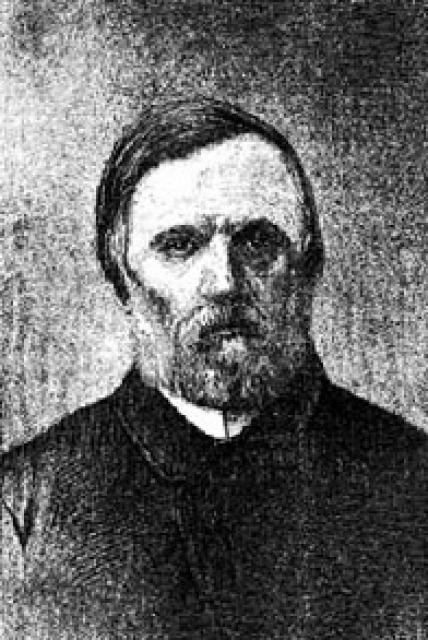
Franciszek Duchinski
 Poland
- Early Life and Education
- Emigration and Academic Career
- Vice-President of the Parisian Ethnological Society
- Founder of the Società per l'Alleanza Italo-Slava
- Turanian Theory of Russian Origin
- Political and Cultural Motivations
- Criticism and Decline
- Legacy
Early Life and Education
Franciszek Duchinski, a prominent Polish ethnographer and historian, emerged from a Ukrainian-Polish family in the Right-Bank Ukraine. His initial academic pursuits focused on the historical relationship between Russia and Poland.
Emigration and Academic Career
Following the uprising of 1831, Duchinski sought refuge in France, where he became a professor at the Polish School in Paris. Subsequently, he accepted the position of curator at the Polish Museum in Rapperswil, Switzerland.
Vice-President of the Parisian Ethnological Society
Duchinski's involvement in the Parisian Ethnological Society propelled him to the prominent role of Vice-President, while simultaneously holding membership in the Société d'Anthropologie de Paris and the Société de Géographie.
Founder of the Società per l'Alleanza Italo-Slava
Beyond his contributions to the Parisian Ethnological Society, Duchinski co-founded and served as Secretary of the Società per l'Alleanza Italo-Slava, established in Turin in 1849.
Turanian Theory of Russian Origin
Duchinski formulated his own version of the Turanian Theory, proposing that the Russian people originated from Asia. This theory contended that Great Russians, or "Moscals" as he referred to them, did not belong to the Slavic or even the Aryan race. Instead, he categorized them as a branch of the Turanian tribe, akin to Mongols.
Political and Cultural Motivations
Duchinski's Turanian Theory was not solely driven by scientific research but also by political aspirations and the sentiments of the Polish emigration. He envisioned the restoration of a Slavic Polish state encompassing Little Russians and Belarusians, which would serve as a bulwark against the threat of Turanian Moscal power.
Criticism and Decline
Despite the initial enthusiasm among Polish intellectuals, Duchinski's theory faced rigorous criticism from Russian historians such as N.I. Kostomarov. As time passed, its credibility waned within the Polish community as well.
Legacy
Duchinski's Turanian Theory became a symbol of Polish cultural bias and was met with significant skepticism in the academic community. However, his contributions to the field of ethnography and the Polish diaspora remain notable.