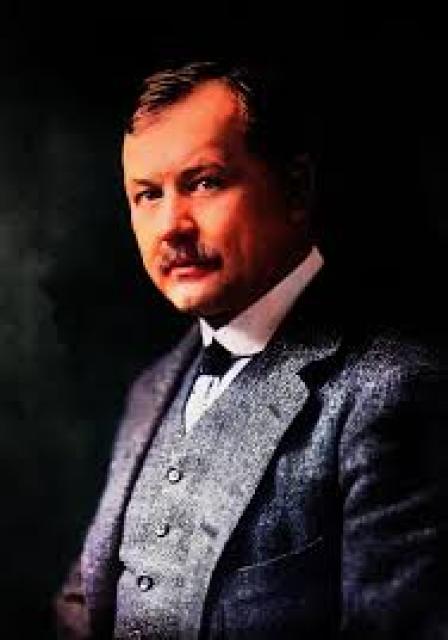
Franz Leher
 Hungary
- Biography of Franz Lehár
- Early Career and Military Service
- Breakthrough with "The Merry Widow"
- Later Works and Collaboration with Richard Tauber
- Legacy and Later Years
Biography of Franz Lehár
Franz Lehár was a renowned composer and conductor, known for his mastery of Viennese operetta. He was born on April 30, 1870, in the Slovak town of Komárom (now Hungary) in a family of a military bandmaster. In 1882, Lehár entered the Prague Conservatory, where he studied violin under A. Bennewitz, harmony under J. B. Foerster, and composition under A. Dvořák.
Early Career and Military Service
After completing his studies, Lehár worked as a concertmaster violinist in the Barmen-Elberfeld Theater Orchestra. He then served in the Austro-Hungarian Army for ten years, becoming one of the most popular bandmasters of military orchestras. During this time, Lehár composed his first pieces, including violin pieces, songs, marches, and waltzes. One of his most enduring compositions, the waltz "Gold and Silver," was published in 1899. He also composed his opera "The Cuckoo," which premiered in Leipzig in 1896.
Breakthrough with "The Merry Widow"
Lehár's breakthrough came when Viennese librettist Victor Léon approached him to compose music for his libretto "The Tinker." Premiered in 1902, this operetta served as a strong foundation for Lehár's future success. Three years later, Lehár achieved worldwide fame with his operetta "The Merry Widow" (Die lustige Witwe). Known for its freshness, inventiveness, and magnificent orchestral score, "The Merry Widow" marked a new era in Viennese operetta history. It enjoyed a successful run of 483 performances at the Theater an der Wien and reportedly reached a total of 60,000 performances worldwide within the first 50 years of its staging.
Later Works and Collaboration with Richard Tauber
In the three decades following "The Merry Widow," Lehár composed 19 operettas, including "The Count of Luxembourg" (Der Graf von Luxemburg, 1909), "Gypsy Love" (Zigeuner Liebe, 1910), "Eva" (1911), "Where the Lark Sings" (Wo die Lerche singt, 1918), and "Frasquita" (1922). The delightful Serenade from "Frasquita," in an arrangement by F. Kreisler, gained widespread recognition. Lehár's collaboration with renowned German tenor Richard Tauber began when Lehár was already in his fifties. Together, they created successful operettas such as "Paganini" (1925), "Prince Methusalem" (1927), "Friederike" (1928), "The Land of Smiles" (Das Land des Lächelns, 1929), "The Beautiful World!" (Schön ist die Welt, 1931), and Lehár's final work, "Giuditta," premiered at the Vienna State Opera in 1934.
Legacy and Later Years
Among the four masters of late Viennese operetta (alongside O. Strauss, E. F. Kalman, and L. Fall), Lehár stood out as the brightest. His melodic talent was inexhaustible, and his rhythmic and harmonic language was characterized by its diversity, while his orchestration was strikingly effective. Lehár incorporated various influences, including Viennese and Hungarian flavors, as well as elements from Paris, Russia, Spain, Poland, and even China. Although he faced criticism for moving away from the true musical comedy tradition and towards melodrama, there is no doubt that Lehár's works brought widespread international renown to Viennese operetta.
During World War II, Lehár resided in Austria before eventually moving to Switzerland in 1946. He returned to his Austrian home in Bad Ischl two years later. Franz Lehár passed away in Bad Ischl on October 24, 1948.




