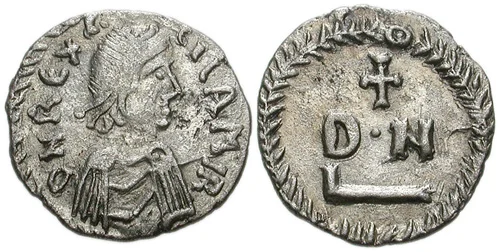
Gelimer
- Rise to the Throne
- The Byzantine Invasion
- Exile on Mount Pappua
- Life After the Kingdom
- A King at the End of an Era
Gelimer was the last king of the Vandal kingdom in North Africa. His reign, from 530 to 534, began with a coup against his predecessor and ended with the Byzantine reconquest of Carthage and the surrender of the Vandal ruler. Though his kingdom fell quickly to the forces of Emperor Justinian I and his general Belisarius, Gelimer’s story survives in vivid detail through the history of the campaign written by Procopius.
Rise to the Throne
Gelimer belonged to the ruling family of the Vandals, a people who had crossed into North Africa in the fifth century and established a kingdom centered on Carthage. By the early sixth century, the Vandal realm controlled a wealthy Mediterranean region as well as islands including Sardinia and the Balearics. Gelimer was a relative of King Hilderic, who had cultivated close ties with the Byzantine Empire.
In 530, Gelimer deposed Hilderic and took the throne. The move gave Justinian a political pretext to intervene: the emperor presented his campaign as a defense of the deposed ruler and of Roman interests in Africa. Gelimer’s seizure of power therefore set off a confrontation with a much larger empire whose leaders had ambitions to recover former western Roman territories.
The Byzantine Invasion
In 533, Belisarius led a Byzantine expedition across the Mediterranean. Gelimer had sent his brother Tzazon and a substantial force to Sardinia to put down a revolt, leaving his forces divided when the Byzantines landed in North Africa. The first major clash took place at Ad Decimum, near Carthage. The Vandals initially had opportunities to defeat parts of Belisarius’s army, but confusion and the deaths of Gelimer’s brother Ammatas and nephew Gibamund undermined their position. Belisarius entered Carthage soon afterward.
Gelimer withdrew inland and tried to regroup. At Tricamarum, later in 533, the Vandals fought another major battle. Tzazon was killed, and the Vandal army broke. Without an effective field force or a secure capital, Gelimer’s options narrowed. The defeat effectively ended organized Vandal resistance, though the king himself remained at large.
Exile on Mount Pappua
Gelimer escaped to Mount Pappua in Numidia, where he found refuge among local Moorish communities. The rugged mountain offered protection, but Byzantine commander Pharas established a blockade that lasted through the winter. Procopius describes the hardship of the siege and records that Gelimer asked his opponents for basic provisions and a lyre while he considered his future.
After several months, Gelimer agreed to surrender. In March 534, he was brought to Belisarius near Carthage under assurances that he would be treated with honor. His surrender marked the final collapse of the Vandal kingdom in North Africa and allowed Justinian to incorporate the region into the Byzantine Empire.
Life After the Kingdom
Gelimer was taken to Constantinople and appeared in Belisarius’s triumph. Procopius recounts that, as he watched the ceremony, the defeated king repeated a line from Ecclesiastes about the vanity of worldly things. The memorable anecdote reflects the dramatic contrast between his former royal status and his public defeat, though it comes from a literary account written after the event.
Justinian granted Gelimer estates in Galatia, in Asia Minor, where he lived in retirement. The precise details of his later life and death are uncertain. His kingdom, by contrast, was permanently absorbed into the empire, and the conquest of Africa became the opening phase of Justinian’s broader campaigns to recover territories once held by Rome.
A King at the End of an Era
Gelimer’s reign was brief but consequential. His coup helped trigger a war that erased the last independent Vandal state, while the Byzantine victory restored imperial rule over much of North Africa. His defeat also became part of a larger story about the changing Mediterranean world: kingdoms founded during the migrations of late antiquity gave way to the renewed ambitions of Constantinople.