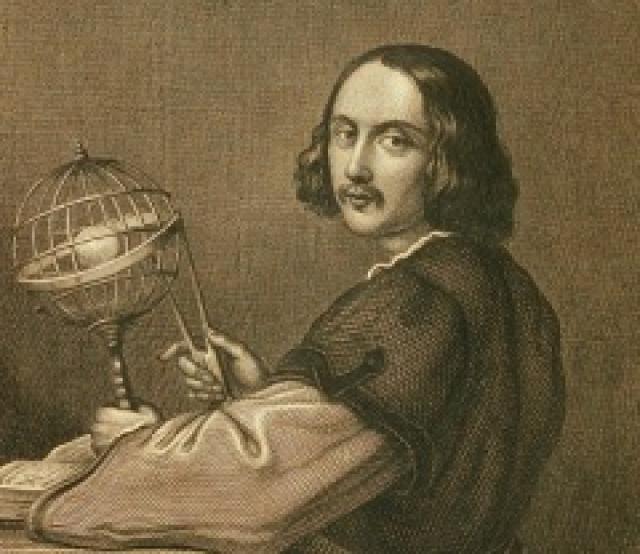
Georg Lauchen
 Germany
- Early Life and Education
- Influential Position at Wittenberg
- Meeting Copernicus and Publishing "Narratio Prima"
- Securing Copernicus's Manuscript and Printing his Tables
- Return to Wittenberg and Subsequent Travels
- Accusations and Later Life
- Legacy and Recognition
Early Life and Education
Born as Georg Joachim von Lauchen in Feldkirch, Austria, in 1514, the German mathematician and astronomer widely known as Rheticus had a troubled childhood. His father, a doctor, was executed when Rheticus was 14 years old.
Rheticus's stepfather, Achilles Gasser, supported his education. He studied in Feldkirch, Zurich, and Wittenberg, where he obtained his master's degree in 1536.
Influential Position at Wittenberg
At Wittenberg University, the renowned theologian Melanchthon invited Rheticus to teach astronomy and mathematics. In 1538, Melanchthon granted Rheticus a two-year leave to pursue advanced astronomical knowledge.
Meeting Copernicus and Publishing "Narratio Prima"
Rheticus traveled to visit various astronomers, including Copernicus in Frauenburg, whose heliocentric theory had been circulating in manuscript form since the 1510s. Deeply impressed, Rheticus spent two years with Copernicus.
In 1540, Rheticus published "Narratio Prima," a clear exposition of the heliocentric system. This work served as an introduction to Copernicus's later masterpiece, "De Revolutionibus Orbium Coelestium."
Securing Copernicus's Manuscript and Printing his Tables
Rheticus secured the Duke of Albrecht's support for the publication of Copernicus's book. He also published trigonometric tables for Copernicus's work separately.
Return to Wittenberg and Subsequent Travels
After returning to Wittenberg, Rheticus periodically visited Copernicus to oversee the printing of his work, which was completed in 1543, shortly before Copernicus's death.
Accusations and Later Life
In 1551, Rheticus was accused of sodomy and fled to Prague. He later studied medicine at the University of Vienna and moved to Krakow, where he published several works on trigonometry. He died in Kassa, Hungary, in 1574.
Legacy and Recognition
Rheticus's contributions to astronomy include his role in publishing Copernicus's work and his own research in trigonometry. The lunar crater Rhaeticus and asteroid 15949 Rhaeticus are named in his honor.


