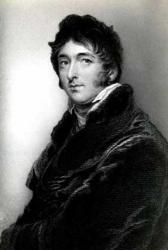
George Canning
 Great Britain
Biography of George Canning
Early Life and EducationGeorge Canning was born on April 11, 1770, in London, into the family of a modest lawyer. His grandfather, a wealthy landowner from Ireland, disinherited his father for marrying a woman from a different social circle. After his father's death, Canning's mother, along with the infant George, severed ties with respectable society and became the mistress of actor Samuel Reddish. Canning was then taken in by his wealthy uncle, who sent him to Eton and later to Christ Church College, Oxford. Although he initially pursued a legal career at Lincoln's Inn, Canning eventually chose a political path.
Political Career
Canning entered Parliament in 1793 with the patronage of William Pitt the Younger. He quickly established himself as a brilliant orator and was appointed as Assistant Secretary to the Foreign Office in Pitt's cabinet in 1796. Canning's subsequent appointments included special envoy to the Board of Control for India in 1799 and the United Military Treasury in 1800. In 1801, he and Pitt resigned but returned to government in 1804, with Canning becoming Treasurer of the Navy. Following Pitt's death in 1806, Canning and his allies remained in opposition until March 1807.
Foreign Secretary and Premier
Under the leadership of the Duke of Portland, the supporters of Pitt returned to power, and Canning became Foreign Secretary. During his time in this position, Canning pursued a policy of active financial and military support for Spain in its war against Napoleon. However, in 1809, he clashed with the War Secretary, Lord Castlereagh, over military operations against France. Canning and Castlereagh dueled and both were forced to resign. A few weeks later, the Duke of Portland also resigned, citing ill health. Canning expected to be appointed Prime Minister by King George III but refused to serve under Spencer Perceval. In the summer of 1812, he also declined the offer of Foreign Secretary from Perceval's successor, Lord Liverpool.
Later Career and Legacy
After his resignations, Canning served as the ambassador to Portugal from 1814 and, two years later, returned to the government as President of the Board of Control. In December 1820, he resigned due to his disagreement with the government's position on King George IV's attempt to divorce Queen Caroline. Canning was appointed Governor-General of Bengal and was preparing to sail to India when his old adversary Castlereagh, now Foreign Secretary and Speaker of the House of Commons, committed suicide in August 1822. In September, Canning was appointed to the vacant positions by the King.
As Prime Minister, Canning was met with opposition from the anti-Catholic members of his Tory party. With the support of the Whigs, as well as independent Members of Parliament, Canning obtained a majority in the House of Commons. However, his Corn Laws were rejected by the protectionist Tories in the House of Lords. One of his significant achievements as Prime Minister was resolving the so-called Greek question, which had caused turmoil in Europe since Greece's uprising against the Ottoman Empire in 1821. Canning sought to prevent Russian intervention in support of the Greeks, as it could have strengthened Russia's position in the Balkans. Instead, he proposed a tripartite cooperation between Russia, England, and France to negotiate acceptable peace terms with the Ottoman Empire. This policy led to the signing of the London Protocol in July 1827, which demanded autonomy for Greece from the Sultan, backed by an annual tribute. When the Sultan refused, the European powers sent a naval fleet to Turkish shores, defeating the Turkish forces in the Battle of Navarino in 1827. The Greek question was ultimately resolved during the Russo-Turkish War of 1828-1829.
Sadly, Canning did not live to see the fruits of his labor. He passed away on August 8, 1827, in Chiswick. Canning's foreign policy principles, which emphasized non-interference in the internal affairs of other states, influenced the United States' Monroe Doctrine in 1823, which aimed to counter European intervention in the Americas. Canning's popularity in foreign affairs drastically changed King George IV's opinion of him. In April 1827, following the resignation of Lord Liverpool, the King appointed Canning as Prime Minister, choosing him over Sir Robert Peel and the Duke of Wellington.