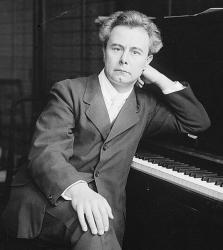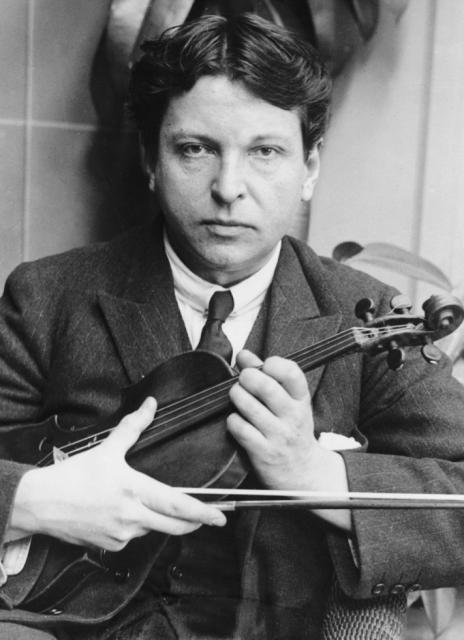
George Enescu
 Romania
Biography of George Enescu
George Enescu was a Romanian composer, violinist, conductor, and educator, widely regarded as one of the greatest musicians of the first half of the 20th century. He began composing music at the age of five and was sent to the Vienna Conservatory at the age of seven, where he graduated with a silver medal. He performed concerts in Vienna and in 1895, he moved to Paris to study with composers such as Jules Massenet, Martin Marsick, and Gabriel Fauré, alongside fellow student Guy Ropartz.
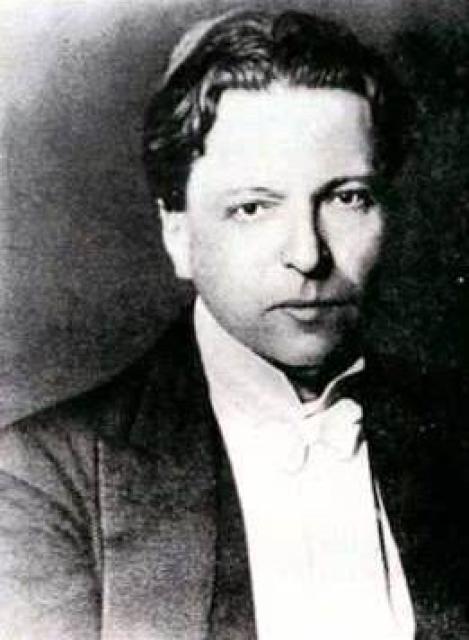
Early Career
In 1923, Enescu made his conducting debut in New York and during the 1920s and 1930s, he lived in Bucharest and Paris. After 1946, he settled permanently in Paris but continued to actively perform as a violinist and conductor in Europe and the United States. He gave concerts in Moscow in 1909, 1919, and 1946. In 1932, Enescu was elected a full member of the Romanian Academy. He performed with renowned musicians such as Béla Bartók, Eugène Ysaÿe, Clara Haskil, Pablo Casals, David Oistrakh, and György Novák. Many prominent violinists, including Yehudi Menuhin, Arthur Grumiaux, Ginette Neveu, Christian Ferras, and Leonid Kogan, were among Enescu's students.
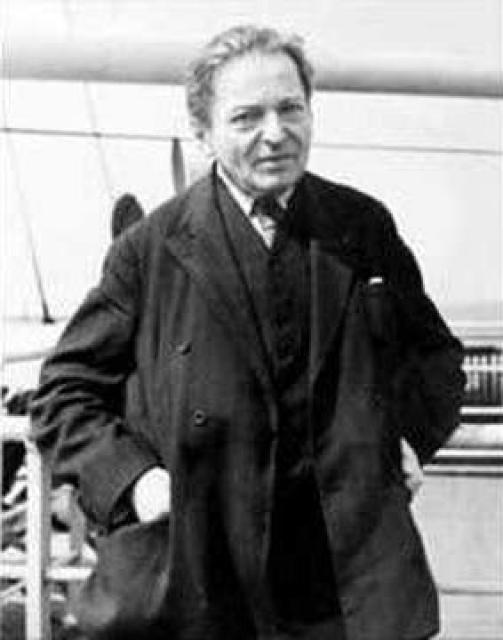
Music
Enescu's compositions include three symphonies, three piano and two string quartets, three violin and two cello sonatas, and vocal works set to the poems of French symbolist writers. He produced a relatively small number of completed works (33 opuses), with many of his compositions, including two symphonies, remaining unfinished. Enescu's music was influenced by European Romanticism (Schumann, Wagner, Brahms) but also developed in parallel with the innovations of Stravinsky and Prokofiev. In his operas, such as "Oedipe" (1910-1931), he incorporated the influence of Richard Strauss as well as the Neo-Viennese School, Neoclassicism, and Neobaroque. Throughout his career, Enescu consistently drew inspiration from Romanian folklore, with his two Romanian Rhapsodies (1901 and 1902) becoming widely recognized.
Legacy
Following his death, the village of Liveni was renamed in his honor, and a memorial museum was opened in Bucharest. The name "Enescu" was given to the Bucharest Philharmonic Orchestra, as well as the University of Arts in Iași (1997). The International George Enescu Society was established to promote and preserve his legacy, publishing collections and research on his works. Every two years, the George Enescu International Festival and Competition is held in Bucharest. The Romanian Academy also awards the George Enescu Prize annually to outstanding musicians.