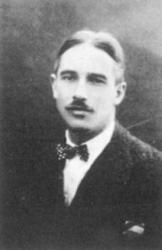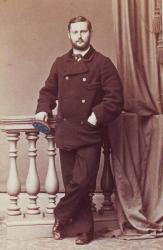
Gerard Jacob De Geer
 Sweden
- Early Life and Education
- Career in Geology
- Varve Chronology
- Polar Expeditions
- Academic and Political Roles
- International Recognition
- Later Years
Gerhard Jacob De Geer: Swedish Geologist, Geographer, and Polar Explorer
Gerhard Jacob De Geer was a pioneering geologist and geographer from Sweden who made significant contributions to the study of Quaternary geology.
Early Life and Education
Born into the Swedish aristocracy on October 2, 1858, De Geer began his studies in 1869 at the elementary school and later attended the Stockholm Gymnasium. In 1877, he enrolled at Uppsala University, where he received his Bachelor of Arts degree in May 1879.
Career in Geology
In 1878, De Geer joined the Swedish Geological Survey as an unpaid employee. He became an assistant geologist in 1882 and a permanent geologist in 1885. In 1897, he left the Geological Survey to accept a professorship in general and historical geology at Stockholm University.
Varve Chronology
De Geer's most notable achievement was the development of the varve chronology method. This technique uses the counting of pairs of layers in glacial lake sediments to determine the age of past glacial deposits. Using this method, De Geer reconstructed the deglaciation chronology of southern and central Sweden and established the Swedish Geochronological Scale, which enabled precise dating of key events in the late Pleistocene and early Holocene of Northern Europe.
Polar Expeditions
De Geer participated in several expeditions to the Arctic, beginning with the Swedish Spitzbergen Expedition in 1882. He conducted six expeditions to the archipelago between 1882 and 1910, studying the contemporary ice sheet.
Academic and Political Roles
De Geer held the positions of Rector (1902-1910) and Vice-Chancellor (1911-1924) at Stockholm University. He was also a member of the Swedish Parliament from 1900 to 1905.
International Recognition
In 1910, De Geer served as President of the X International Geological Congress held in Stockholm. He delivered the renowned lecture "The Geochronology of the Last 12,000 Years" and organized a field trip for delegates to Dicksonfjorden in Spitzbergen.
Later Years
After 1924, De Geer retired from teaching and founded the Institute of Geochronology at Stockholm University. He passed away in Stockholm on July 24, 1943, leaving behind a legacy of groundbreaking research in geology.