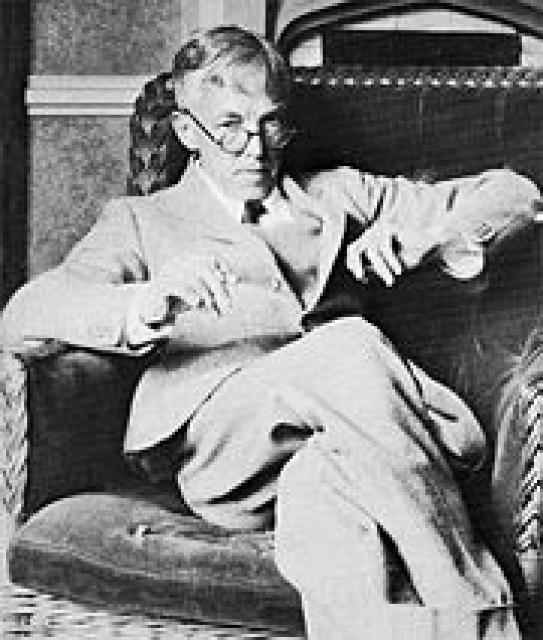
Godfry Harold Hardy
 Great Britain
Biography of Godfrey Harold Hardy
Godfrey Harold Hardy was an English mathematician known for his work in number theory and mathematical analysis. He was born in a small town in southern England to a family of teachers, both of whom had a inclination towards mathematics, although they taught other subjects. Hardy's own mathematical abilities began to show at the age of two. In 1896, he entered Trinity College, Cambridge University. After just two years of study, he achieved fourth place in the graduate examination. In 1900, Hardy became a faculty member, and from 1906, he served as a lecturer with a workload of 6 hours per week, which allowed him plenty of free time for his own research. In 1919, he took up the position of a professor of mathematics at the University of Oxford. In 1931, Hardy returned to Cambridge, where he remained as a professor until 1942.
Collaboration and Discoveries
One of Hardy's greatest discoveries was the Indian mathematician Srinivasa Ramanujan, with whom he later co-authored many works. Starting from 1911, Hardy had a very fruitful collaboration with John Littlewood. Most of Hardy's works were written in collaboration with Littlewood. There was even a joke that in England there were three great mathematicians - Hardy, Littlewood, and Hardy-Littlewood, with the latter being the greatest.
Contributions and Recognition
Hardy was a Fellow of the Royal Society (1910). He preferred to call his work pure mathematics, as opposed to applied mathematics, which had practical, especially military, significance. In his book "A Mathematician's Apology," he stated, "I have never done anything 'useful.' No discovery of mine has made, or is likely to make, directly or indirectly, for good or ill, the least difference to the amenity of the world."
In the field of number theory, Hardy worked on the theory of prime numbers, the zeta function, and the Waring problem. Together with Littlewood, they proved several conditional results and put forth two important conjectures concerning the distribution of prime numbers. In the field of function theory, Hardy focused on the theory of trigonometric series and the study of inequalities. He also conducted research on integral transformations and integral equations.
Hardy is also one of the authors of the Hardy-Weinberg law in population genetics.