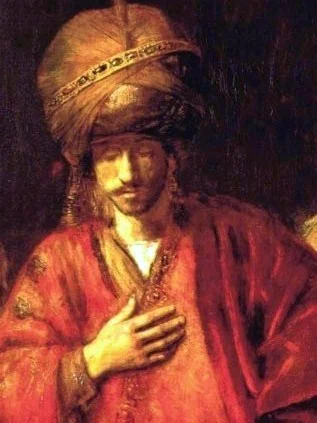
Haman
Haman is the antagonist of the biblical Book of Esther, a court official whose ambition turns a personal grievance into a threat against an entire people. The story calls him “the Agagite” and places him at the court of King Ahasuerus, commonly identified with the Persian ruler Xerxes I. Unlike the king, Haman is not independently documented in surviving Persian records; what is known of him comes from Esther and the religious traditions shaped by its story.
A powerful courtier
In Esther, Haman is the son of Hammedatha and a high-ranking official whom the king elevates above the other courtiers. The book gives little background about his life before this rise. Instead, it introduces him through a conflict with Mordecai, a Jewish court official who refuses to bow before him.
Haman responds with a plan far beyond punishing one man. After learning that Mordecai is Jewish, he seeks the destruction of all the Jews in the Persian Empire. He presents them to the king as a people whose customs make them disloyal and offers a large payment to the royal treasury in exchange for permission to carry out the plan. The king grants him authority and gives him the royal signet ring.
Haman then casts lots—pur—to select the date for the planned attack. The lot gives the Jewish festival of Purim its name. The decree is sent throughout the empire, turning Haman’s private resentment into an official policy of violence.
Esther turns the court against the plot
Haman’s plan encounters resistance from Esther, the Jewish queen, who has kept her background private, and Mordecai, who urges her to intervene. Esther approaches the king at great personal risk and hosts a series of banquets at which she exposes Haman’s intention to destroy her people.
The reversal is swift. The king orders Haman punished, and the gallows he had prepared for Mordecai becomes the instrument of his own death. The king transfers Haman’s property to Esther and gives Mordecai authority in the court. Because the original decree cannot simply be withdrawn within the story’s account of Persian law, a second order allows the Jews to defend themselves.
The narrative’s structure makes the reversal central: Haman’s power, which seemed absolute, collapses through the very court mechanisms he had used against Mordecai. His downfall turns the threatened massacre into a story of survival and communal deliverance.
From antagonist to symbol
Haman’s “Agagite” designation connects him in Jewish interpretation to Agag, a king of Amalek, a people remembered in biblical tradition as an enemy of Israel. This association gives his conflict with Mordecai a larger symbolic dimension, linking the characters’ personal clash to an older struggle in the scriptural imagination.
The Book of Esther does not present itself as a modern biography, and scholars debate how closely its events correspond to Persian history. The court setting reflects knowledge of Persian customs, but Haman’s story has not been corroborated by independent records. His enduring significance instead lies in his place within the Purim narrative and in the way later readers have understood his combination of power, prejudice and vengeance.
At Purim, the reading of Esther recalls the danger Haman’s decree posed and the reversal that saved the Jewish community in the story. Across centuries of interpretation, he has remained a vivid warning about what can happen when private hatred gains the authority of the state.