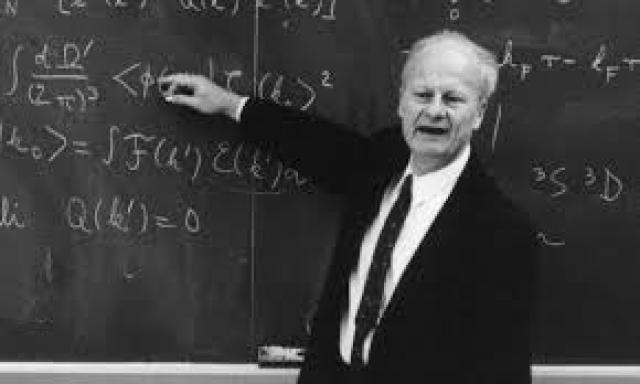
Hans Bete
 USA
USABiography of Hans Bethe
Hans Albrecht Bethe, an American theoretical physicist, was born in Strasbourg, Alsace-Lorraine (then part of Germany), and was the only child of Albrecht Theodor Julius Bethe, a prominent physiologist and professor of medicine, and Anna (nee Kun) Bethe from a family of professors. From 1915 to 1924, Bethe attended Goethe Gymnasium in Frankfurt am Main, and then spent two years as a student at the University of Frankfurt. After spending another two and a half years as a graduate student at the University of Munich under the guidance of Arnold Sommerfeld, who made significant contributions to modern physics, he earned his doctorate in theoretical physics in 1928. As a graduate student, Bethe showed interest in quantum mechanics, its mathematical theory that describes the interaction between matter and radiation. Formulated in the mid-1920s by Werner Heisenberg, Erwin Schrödinger, and P.A.M. Dirac, it was the result of earlier research in quantum theory. Max Planck discovered that radiation is not continuous, but consists of discrete energy packets later called quanta; Albert Einstein showed that photons, the quanta of light (electromagnetic radiation), act like particles in the photoelectric effect; Niels Bohr applied quantum theory to describe atomic energy levels responsible for characteristic emission spectra; and finally, Louis de Broglie made the bold assumption that if radiation (light) can behave like a particle, then a particle can behave like a wave. De Broglie's idea was experimentally confirmed by Clinton J. Davisson, who observed the wave behavior of electrons. In 1927, Bethe wrote a scientific paper on electron diffraction in crystals, using quantum mechanics to explain Davisson's observations, which was not yet understood by most physicists at the time. Bethe was one of the first scientists to convincingly demonstrate the application of the new theory. After obtaining his doctorate, Bethe worked as a physics lecturer at the universities of Frankfurt and Stuttgart from 1928 to 1929. He was appointed as a lecturer at the University of Munich in 1929, but spent most of his time over the next three years in Cambridge, England, where he met with Ernest Rutherford, and in Rome, where he worked with Enrico Fermi. He also established contact with Niels Bohr. During this time, Bethe developed the application of a mathematical method known as group theory to understand the quantum mechanical behavior of crystals. Making significant contributions to the theory of atomic structure, Bethe began his theoretical study of the process of fast energy loss by particles passing through matter in the early 1930s, periodically returning to this question throughout his scientific career. Appointed as an assistant professor at the University of Tübingen in 1932, Bethe, whose mother was Jewish, lost this position in the following year after an anti-Semitic decree was issued by Adolf Hitler, who became the Chancellor of Germany. Bethe left Germany in 1933, spent a year lecturing at the University of Manchester in England, and then became a member of the scientific council at the University of Bristol from 1934 to 1935. In 1935, he became an assistant professor at Cornell University in Ithaca, New York, and then a full professor in 1937.
Contributions to Nuclear Physics
Here, Bethe returned to the study of nuclear physics. In 1936, in collaboration with American physicists Robert F. Bacher and M.S. Livingston, Bethe wrote several comprehensive papers summarizing the known results in this still nascent field at the time. These papers quickly became classics and were widely used as a fundamental textbook on nuclear physics for over 20 years. In 1938, at a conference on theoretical physics in Washington, D.C., Bethe became interested in an unsolved question about the nature of energy generation in the Sun and other stars. Astronomers had accumulated a wealth of information about extremely high temperatures and other stellar characteristics and concluded that the energy source must have a thermonuclear nature. However, they were unable to identify the reactions that would provide quantitative characteristics consistent with the observed radiation, size, age, and other properties of stars. Quickly familiarizing himself with the astronomical data and applying his encyclopedic knowledge of nuclear physics, Bethe solved this problem in six weeks.
For the first time, German astronomer Karl Friedrich von Weizsäcker proposed the synthesis of two protons (hydrogen nuclei, abundant inside the Sun) to form deuterium (also known as heavy hydrogen, a nucleus containing a proton and a neutron) and release energy in the form of a positron (a positive electron) and a neutrino (an uncharged particle). Protons are positively charged, and the number of protons in the nucleus determines the element (hydrogen nuclei contain one proton, but can also contain neutrons, which have a mass approximately equal to that of a proton but no charge). In the synthesis of two protons, a positive particle (positron) is emitted, transforming one of the protons into a neutron. Bethe examined solar characteristics such as temperature, density, composition, as well as the expected reaction rates, and calculated that the synthesis reaction occurs at a rate that accounts for the observed energy emission by the Sun. However, his calculations showed that for more massive stars than the Sun, heavier nuclei must be involved in the reaction. For massive stars, Bethe proposed the carbon-nitrogen cycle, a six-step process. On the first step, carbon with an atomic weight of 12 (the most common and stable form of carbon with 6 protons and 6 neutrons in the nucleus) captures a proton, becoming nitrogen-13 (7 protons, 6 neutrons) and emitting energy in the form of gamma rays. The unstable nitrogen-13 decays, emitting a positron (which transforms a proton into a neutron) and a neutrino, and becomes carbon-13 (6 protons, 7 neutrons). Carbon-13 then captures one of the available protons and becomes nitrogen-14 (7 protons, 7 neutrons), again emitting gamma rays. Nitrogen-14, in turn, captures a proton and becomes oxygen-15 (8 protons, 7 neutrons), once again emitting gamma rays. The unstable oxygen-15 emits a positron (replacing a proton with a neutron) and a neutrino, transforming into nitrogen-15 (7 protons, 8 neutrons). On the final step, nitrogen-15 captures a proton, but instead of producing a heavier nucleus with 8 protons and 8 neutrons, which would be oxygen-16, it splits into two nuclei: carbon-12 and helium-4 (2 protons, 2 neutrons). Carbon-12 can then repeat the cycle, and helium-4 replenishes the star's supply of this gas. At each step of the cycle, energy is released in the form of various types of radiation, giving the star its brightness. Bethe's calculations allowed for a deeper understanding of the behavior and evolution of stars.
In the late 1930s, Bethe continued his theoretical investigations of atomic nuclei. Among his numerous achievements was the first mathematical justification that the newly discovered meson could be associated with the force that holds nuclei together. He also studied highly complex shock waves produced by explosions, which proved useful for his later work on the Manhattan Project in the development of the atomic bomb. In 1941, shortly before the United States entered World War II, Bethe became a U.S. citizen. For a brief period, he worked on microwaves and their applications to radar at the Radiation Laboratory of the Massachusetts Institute of Technology, and then joined the Manhattan Project at Los Alamos, New Mexico, in 1943. There, as the head of the theoretical physics division, he was responsible for calculating the possible behavior of the atomic bomb. His profound knowledge of nuclear physics, shock waves, and electromagnetic theory played a crucial role in the success of the program.
Returning to Cornell University in 1946, Bethe continued his research in many areas of interest, for example, making significant contributions to modern quantum electrodynamics. He also made substantial efforts, together with other scientists, to raise public awareness of the dangers that nuclear weapons pose to humanity. He was always an advocate for arms control while supporting the idea of using nuclear energy for peaceful purposes. From 1956 to 1959, Bethe served on the President's Science Advisory Committee. In 1967, Bethe was awarded the Nobel Prize in Physics "for his contributions to the theory of nuclear reactions, especially his discoveries concerning the energy production in stars." Presenting the laureate, Oscar Klein, a member of the Royal Swedish Academy of Sciences, noted Bethe's breadth of knowledge and stated that some of his discoveries in physics individually deserved a separate Nobel Prize. Klein said that Bethe's work on stellar energy sources "represents one of the most important applications of fundamental physics in our time and leads to a deeper understanding of the universe."
Furthermore, Bethe studied the matter distribution in neutron stars and the collapse of giant stars. His research on high-speed entry into Earth's atmosphere contributed to the development of both military and civilian spacecraft. Reflecting on his work at Los Alamos as "terrifically exciting," he spoke out against the government-supported program of deploying an anti-ballistic missile system, considering it practically unfeasible.
In 1939, Bethe married Rose Ewald, the daughter of a well-known German physicist who also left Nazi Germany. They have two children. Modest and attentive to others, Bethe was once interested in skiing and mountaineering, and later, as they say, became interested in economics. His colleagues highly respected him for his brilliant mind and meticulously developed scientific methods.
In addition to the Nobel Prize, Bethe received the U.S. government award Medal for Merit (1946), the Henry Draper Medal of the National Academy of Sciences (1947), the Max Planck Medal of the German Physical Society (1955), the Enrico Fermi Award of the U.S. Atomic Energy Commission (1961), the Eddington Medal of the Royal Astronomical Society (1963), and the Vannevar Bush Award of the National Academy of Sciences (1985). He is a member of the American Philosophical Society, the National Academy of Sciences, the American Physical Society, and the American Astronomical Society, as well as a foreign member of the Royal Society of London. He has received honorary degrees from the University of Birmingham and the University of Manchester.


