Hans Kluge
 Germany
Hans von Kluge Biography
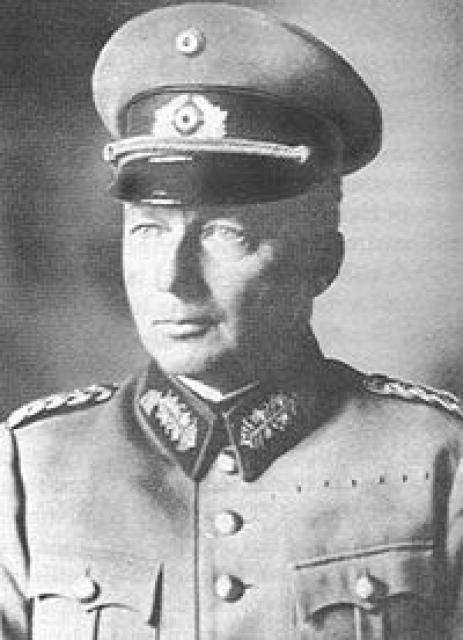
Günther Hans von Kluge, born on October 30, 1882, in Posen, German Empire (now Poznań, Poland), was a German military commander and a Field Marshal (1940). He was the son of a Major General who was ennobled in 1913. Kluge attended a military school and joined the 46th Artillery Regiment in 1899, where he was promoted to lieutenant in 1901. In 1912, he graduated from the War Academy and served in the First World War on the Western Front, initially as a battalion commander and later as an officer in the General Staff. After the demobilization of the army in 1919, Kluge continued to serve in the Reichswehr. From 1923 onwards, he held staff positions in the Ministry of Defense and became the commander of the 5th Battalion of the 3rd Artillery Regiment in 1926. In 1928, he became the Chief of Staff of the 1st Cavalry Division in Frankfurt (Oder). Kluge became the commander of the 2nd Artillery Regiment in 1930 and the commander of the artillery of the 3rd Division on October 1, 1931. In February 1933, he became the Inspector of Signal Troops of the Army. Kluge rapidly rose in ranks under Adolf Hitler's regime, and in October 1934, he became the commander of the 6th Division and the 6th Military District in Münster. In 1935, as a Major General, he was appointed as the commander of the 6th Military District while also leading the 6th Army Corps during the expansion of the army. Kluge actively supported General Werner von Fritsch and was dismissed from service in 1938 due to his support for him. However, he was called back to duty at the outbreak of World War II and commanded the 6th Army Group during the invasion of the Polish Corridor. In 1940, he was transferred to the Western Front and on July 19, 1940, he was promoted to Field Marshal. Kluge participated in the attack on the Soviet Union and served as the commander of the 4th Army in 1941 and the overall commander of Army Group Center until 1943. In the autumn of 1943, Kluge was seriously injured in a car accident on the Orsha-Minsk highway, which incapacitated him for a long period. On July 2, 1944, Hitler appointed Kluge as the commander of Army Group West, replacing Field Marshal Gerd von Rundstedt, in an attempt to halt the Allied invasion of Normandy. However, Kluge also faced failures and was replaced by Field Marshal Walter Model. Depressed by the military defeats, Kluge took his own life on August 18, 1944.
In addition to his military career, Kluge was involved in the Anschluss of Austria and the occupation of the Sudetenland in 1938. He retired in the middle of 1938 and in Hannover, on November 24, 1938, he formed the 6th Army Command (Hannover), which included the 9th, 10th, and 11th Military Districts. In August 1939, the 4th Army was formed from the 6th Command, with Kluge as its commander. As part of General Fedor von Bock's Army Group North, Kluge participated in the Polish Campaign, where he successfully cut off the Polish Corridor in just three days. During the French Campaign, he operated on the right flank of Army Group A. His army was then transferred to the Eastern Front, where it was positioned to the west and northwest of Brest. Kluge supported the plan for the war against the Soviet Union, and on June 26, 1941, the 2nd and 3rd Tank Armies were placed under his command. In September 1941, he opposed the advance towards Moscow but participated in the Battle of Moscow. Faced with the impossibility of reaching Moscow, he began the withdrawal of his troops on December 4. From December 18, 1941, he became the commander of Army Group Center and managed to remove Generals Guderian, Kübler, Höpner, and Strauss from their positions. Kluge achieved significant victories, such as the defeat of General Belov's cavalry corps (20,000 men) near Kirov and the 39th Army (40,000 men) near Bely. He successfully defended against large-scale Soviet offensives near Rzhev and Belev. During the winter of 1942-1943, he resisted fierce Soviet attempts to break through his defense and only lost Velikiye Luki. The influential conspiratorial group led by General Henning von Tresckow operated freely in Kluge's Army Group headquarters, although Kluge himself did not actively participate in the conspiracy. Nevertheless, he opposed the inhumane treatment of Soviet prisoners of war. Kluge was against the implementation of Operation Citadel – the Battle of Kursk – and command was transferred to Walter Model, sparing Kluge from blame after its failure in July 1943. On July 15, 1943, Soviet forces broke through Kluge's front near Orel, forcing him to retreat to the Dnieper. On October 28, 1943, Kluge was involved in a car accident on the Orsha-Minsk highway and was sent back to Germany for treatment. On November 2, 1943, he was awarded the Knight's Cross of the Iron Cross with Oak Leaves and Swords. Due to his health condition, he was replaced by Field Marshal Erich von Manstein as the commander of Army Group on November 4, 1943, and Kluge was placed in reserve. On July 7, 1944, he replaced Field Marshal Gerd von Rundstedt as the commander in the West, leading Army Group D. After inspecting the troops, Kluge realized the impossibility of resisting the future Allied offensive and made contact with a group of conspirators planning to assassinate Hitler. After the failed July Plot in 1944, Kluge sent a loyal message to Hitler. Following the arrest of the conspirators, Major C. von Hofacker implicated Kluge. On August 18, Kluge was relieved of his command and summoned to the headquarters. While en route to Metz, he took his own life by poisoning himself with potassium cyanide. The official cause of his death was reported as a cerebral hemorrhage.