Hans Salmuth
 Germany
- Early Life and Military Career
- Interwar Period
- World War II
- Eastern Front
- Western Front
- Normandy Invasion
- Postwar and Legacy
Early Life and Military Career
Hans von Salmuth was born into a Prussian military family in Metz, Alsace-Lorraine, Germany. He joined the German army in 1907 and fought in both the Eastern and Western Fronts of World War I, rising to the rank of Captain of the General Staff.
Interwar Period
After the war, Salmuth continued his service in the Weimar Republic's Reichswehr. He was promoted to Colonel on May 1, 1934, and served as Chief of Staff of the 2nd Army Corps from 1934 to 1937.
World War II
On August 1, 1937, Salmuth was promoted to Major General and given command of Army Group 1. He was appointed Chief of Staff of the 2nd Army in 1938. On August 1, 1939, he attained the rank of Lieutenant General.
At the outbreak of World War II, Salmuth served as Chief of Staff to Army Group North under Fedor von Bock, helping to develop the "White Plan" invasion of Poland. He later transferred with Bock to Army Group B in October 1939 to plan the "Yellow Plan," the invasion of Belgium and France in May 1940.
Eastern Front
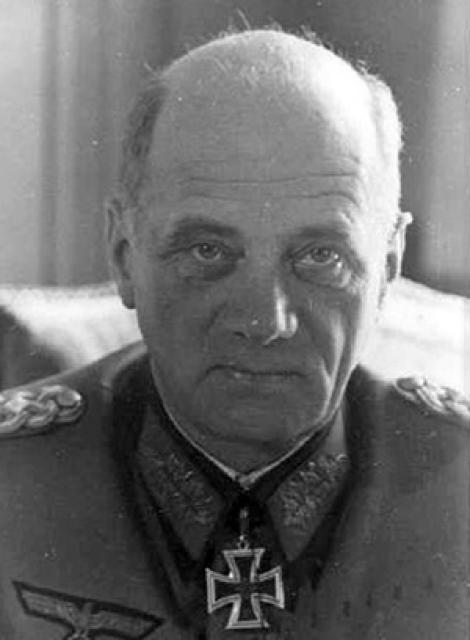
After the crushing defeat of the Allies and the fall of France, Salmuth was awarded the Knight's Cross of the Iron Cross on July 19, 1940. In 1941, he was transferred to the Eastern Front, taking command of the 30th Army Corps within the 11th Army. He participated in Operation Barbarossa and his corps took part in the Battle of Sevastopol.
Western Front
In April 1942, Salmuth assumed command of the 17th Army. He briefly replaced Gotthard Heinrici as commander of the 4th Army from June 6 to July 15, 1942. In mid-July, he took command of the 2nd Army.
In January 1943, Salmuth was promoted to Colonel General. He relinquished command of the 2nd Army to Walter Weiss on February 3, 1943, and succeeded Heinrici once more. He led the 4th Army until July 1943.
Normandy Invasion
In August 1943, Salmuth left the Eastern Front for France, where he assumed command of the 15th Army. The Pas-de-Calais region where the 15th Army was stationed was believed by Hitler to be the site of the Allied invasion. The army was reinforced with 17 divisions, making it the largest German force on the Western Front.
On June 6, 1944, the day of the D-Day landings, Salmuth recorded in his diary: "The invasion has begun."
Postwar and Legacy
Salmuth was relieved of command in late August 1944 after the Allies broke through the front line in Normandy in Operation Cobra. He was replaced by Gustav-Adolf von Zangen. Salmuth did not command any further units before the war's end.
After the war, Salmuth was imprisoned until 1948 as one of 185 defendants in the Subsequent Nuremberg Trials. He was convicted of war crimes and crimes against humanity and sentenced to 20 years in prison. However, he was released early after serving five years, in 1953. He died in Heidelberg, West Germany, in 1962 and is buried in the Nordfriedhof cemetery in Wiesbaden.
Salmuth's role was portrayed by German actor Ernst Schröder in the 1962 film "The Longest Day."