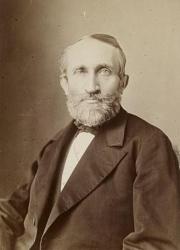
Harry Nyquist
 USA
USA- Biography of Harry Nyquist
- Career at AT&T’s Development and Research Department
- Nyquist's Contributions to Information Theory
- Later Life and Legacy
Biography of Harry Nyquist
Early Life and EducationHarry (or Harald) Nyquist was born in Nilsby, Sweden. He immigrated to the United States in 1907 and enrolled at the University of North Dakota in 1912. He earned his Ph.D. in physics from Yale University in 1917.
Career at AT&T’s Development and Research Department
From 1917 to 1954, Nyquist worked at AT&T’s Development and Research Department (which later became part of Bell Telephone Laboratories in 1934) until his retirement. As an engineer at Bell Labs, Nyquist conducted important research on thermal noise (known as "Johnson-Nyquist noise"), stability of feedback amplifiers, telegraphy, facsimile transmission, television, and other significant telecommunications issues. He collaborated with Herbert I. Ivor to develop the first AT&T facsimile machine, which was introduced to the public in 1924. Nyquist's early work on defining the frequency bandwidth required for information transmission, published in the article "Certain factors affecting telegraph speed" (Bell System Technical Journal, 3, 324—346, 1924), laid the foundation for Claude Shannon's subsequent success in developing information theory.
Nyquist's Contributions to Information Theory
In 1927, Nyquist determined that the number of independent pulses that can be transmitted without distortion in a given unit of time is limited by the double width of the frequency bandwidth of the communication channel. Nyquist published his findings in the article "Certain Problems in the Telegraph Transmission Theory" (1928). This rule is commonly referred to as the Nyquist-Shannon theorem (similar results were obtained by Russian scientist Kotelnikov and are known as the Kotelnikov theorem in Russian literature). Nyquist was awarded the Medal of Honor by the Institute of Radio Engineers in 1960 for his "fundamental contributions to the quantitative understanding of thermal noise, data transmission, and negative feedback." In October 1960, he was honored with the Stuart Ballantine Medal at the Franklin Institute for his "theoretical analysis and practical contributions in the field of communication systems over the past 40 years, including original work on telegraph transmission theory, thermal noise in electrical conductors, and feedback." In 1969, he was awarded the Founders Medal by the National Academy of Engineering "in recognition of his fundamental contributions to engineering."
Later Life and Legacy
After retiring, Nyquist lived in Farr, Texas. He passed away on April 4, 1976.