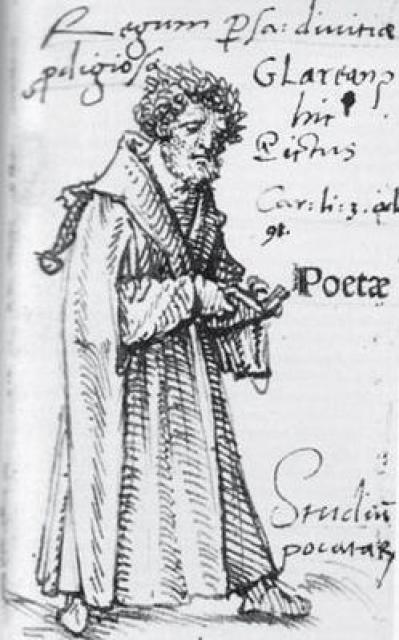
Heinrich Glarean
 Sweden
- Early Life and Education
- Imperial Recognition and Italian Influence
- Settling in Basel
- Professor at Freiburg University
- Musical Treatises and Importance of Terminology
- Doctrine of the Modes
- Influence on Renaissance Music
Early Life and Education
Born in Switzerland as Heinrich Loris, Glareanus Latinized his name to reflect his native canton. He graduated from the University of Cologne in 1510, where he studied philosophy, theology, mathematics, and music under the guidance of the renowned theologian and music theorist Johann Cochlaeus.
Imperial Recognition and Italian Influence
Glareanus's poetic eulogy for Maximilian I Habsburg earned him imperial awards, including the laurel wreath in 1512. In 1516, he traveled to Italy, where he met with leading humanists, including the composer Jean Mouton.
Settling in Basel
From 1514 to 1529, Glareanus resided in Basel, establishing connections with prominent scholars of the time. He befriended Erasmus of Rotterdam, whose influence profoundly shaped his worldview and his interpretation of ancient philosophy and culture.
Professor at Freiburg University
In 1529, Glareanus became a professor of poetry, history, and geography at the University of Freiburg. A vocal opponent of the Reformation, he maintained close ties with the Catholic Church.
Musical Treatises and Importance of Terminology
Glareanus's significant contributions to music theory include his 1516 treatise "Introduction to Music" and his most famous work, "Dodecachordon" ("The Twelve-Stringed Instrument"). Published in 1547, "Dodecachordon" emphasized the importance of precise terminology and clarity in musical scholarship.
Doctrine of the Modes
Glareanus's theory of musical modes formed the core of "Dodecachordon." He expanded the traditional eight church modes to twelve, incorporating the Ionian, Aeolian, and other modes from ancient Greek sources. He considered the quint-octave framework and the specific melodic patterns (phrasis) characteristic of each mode.
Influence on Renaissance Music
Glareanus's innovative modal system became widely adopted by music theorists in the Renaissance era. Composers like Claudio Merulo and the Gabrieli brothers used his twelve modes in their instrumental works, inspiring advancements in musical composition.


