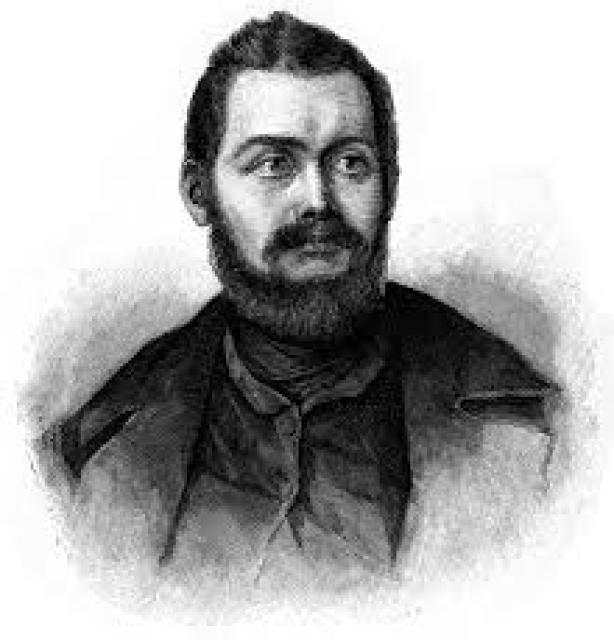
Heinrich Laube
 Germany
- Heinrich Laube: German Writer and Dramaturg
- Literary Career
- Political Involvement
- Literary Works
- Later Works and Legacy
Heinrich Laube: German Writer and Dramaturg
Early Life and ActivismHeinrich Laube was a German writer and dramaturg born in Sprottau, Prussia, in 1806. As a young man, he joined the radical literary movement known as "Young Germany." After traveling to Italy with fellow writer Karl Gutzkow, Laube was arrested and expelled from Saxony. He subsequently served nine months in prison in Berlin.
Literary Career
In 1835, the Frankfurt Union Congress condemned Laube's works as politically subversive. Accusations against the Russian emperor in his history of Poland led to an additional one-year prison sentence. After extensive travels in France and Algeria, Laube settled in Leipzig in 1840.
Political Involvement
In 1848, Laube was elected to the German National Assembly, where he aligned himself with the left-center. From 1849 to 1879, with brief interruptions, he directed the Vienna Burgtheater.
Literary Works
Laube's novel "Das junge Europa," published in installments between 1833 and 1837, reflected his transition from radicalism to a more moderate worldview. In "Reisenovellen," he wittily captured the differences between northern and central Germany. He also created numerous political, social, and literary portraits in "Moderne Charakteristiken."
In the 1840s, Laube wrote a "History of German Literature," several novels, and the plays "Monaldeschi," "Struensee," "Rokoko," and "Gottsched und Geliert." His greatest success came with "Die Karlsschuler," based on Friedrich Schiller's life.
Later Works and Legacy
After the events of 1848, Laube published "Das erste Deutsche Parlament." His most acclaimed drama was "Graf Essex" (1856), followed by "Cato von Eisen," "Montrose, der schwarze Markgraf," "Der Statthalter von Bengalen," "Bose Zungen," and "Demetrius."
Laube's historical novel "Der deutsche Krieg" depicted the Thirty Years' War. He also wrote novels and stories such as "Die Bohminger," "Der Schatten Wilhelms," and "Ruben."
Laube's contributions to German theater were significant. His books on the Burgtheater, North German Theater, and Vienna Stadttheater reflected his long experience. His collected works were published in 16 volumes from 1875 to 1882.
Heinrich Laube died in Vienna in 1884, leaving behind a legacy as a prolific writer, ardent activist, and influential figure in German theater.