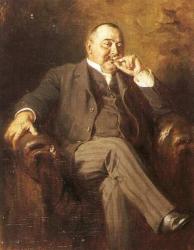
Heinrich Mann
 Germany
- Henry Mann: A German Writer with Strong Social Commitment
- Early Life and Career
- Literary Success and Personal Tragedies
- Exile and Later Life
Henry Mann: A German Writer with Strong Social Commitment
Henry Mann, a German writer known for his socially-oriented works, was born on March 27, 1871, in Lübeck, a city in northern Germany. He was the eldest son of Thomas Johann Heinrich Mann, a respected merchant and local senator in economics and finance, and his wife Julia da Silva Bruhns. Henry had four siblings: his younger brother Thomas, who would later become a Nobel laureate in literature, and his sisters Julia and Carla, as well as his youngest brother Viktor.

Early Life and Career
Henry Mann's childhood was a happy one. In 1889, he began working as an apprentice in a bookstore in Dresden and from 1890 to 1892, he worked at the S. Fischer Verlag publishing house in Berlin while studying at Humboldt University of Berlin. In 1892, he suffered from pulmonary bleeding and went to Wiesbaden and Lausanne for treatment. Unfortunately, their father passed away in 1891 at the age of 51 from bladder cancer, and two years later, their mother moved with the children to Munich, where Henry began his writing career. He traveled extensively, including a visit to Saint Petersburg, and from 1899 until the start of World War I, he lived in various places, often in Italy, which had a beneficial climate for his weak lungs.

Literary Success and Personal Tragedies
In 1904, Henry Mann wrote his famous novel "Professor Unrat oder Das Ende eines Tyrannen" ("Professor Unrat or The End of a Tyrant"), which was published in 1905. Although the book was later adapted into the renowned film "The Blue Angel" starring Marlene Dietrich, it was initially ignored or criticized in his hometown. In 1910, his sister Carla tragically took her own life, which deeply affected Henry.
In 1914, Henry married Maria Kanová, a Prague actress who was 15 years younger than him, and they settled in Munich. Two years later, they had a daughter named Leonie Mann. However, Henry's relationship with his brother Thomas became strained after Thomas published a book supporting Germany's involvement in World War I. They did not speak to each other until 1922.
In 1918, Henry Mann published his most successful book, "Der Untertan" ("The Loyal Subject"), which sold nearly 100,000 copies within the first two weeks. Despite ridiculing German society and explaining how the country's political system led to war, the book and Henry's essay about Emile Zola gained him respect during the Weimar Republic.
Exile and Later Life
Tragedy struck once again when their mother passed away in 1923, followed by the suicide of his sister Julia four years later. Henry separated from his first wife and moved to Berlin in 1928, divorcing her in 1930. Meanwhile, in 1929, he met Nelly Kröger Mann, who would become his second wife.
In 1933, Henry Mann became persona non grata in Nazi Germany and had to leave the country due to his open criticism of the authoritarian and militaristic regime. He moved to France, where he lived in Paris and Nice, and then managed to escape to Spain in 1940 via Marseille. From there, he immigrated to the United States.
During his exile, Henry's literary career suffered, and he struggled financially. On March 11, 1950, he died in Santa Monica, California, completely alone and without money, just one month before his planned move to East Germany, where he had been offered the position of president of the Prussian Academy of Arts.