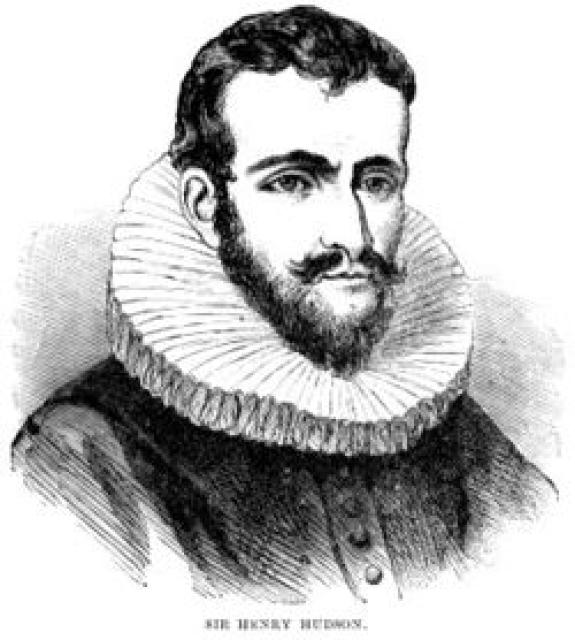
Henry Hadson
 Great Britain
- Biography of Henry Hudson
- Explorations in the Arctic
- Second Expedition and the Discovery of North America
- Arrest and Final Expedition
- Mutiny and Disappearance
Biography of Henry Hudson
Henry Hudson was an English navigator of the early 17th century. His exact date and place of birth are unknown, but according to some theories, he was born on September 12, 1570, in London. It is believed that he died in 1611 in the present-day Hudson Bay in Canada as a result of a mutiny on his ship. In some Russian-language publications based on outdated transliteration of his name, he is known as Henry Gudzon.
Explorations in the Arctic
In 1607, the Muscovy Company, one of the few companies with a royal charter, hired Captain Henry Hudson to search for a northern passage to Asia. At that time, the Arctic region was largely unexplored, and traders believed that by heading north, northeast, or northwest, they would find the shortest route to Asia. Hudson set sail on the ship Hopewell in the North Arctic Ocean and headed northwest. In early June, he reached the eastern coast of Greenland and sailed along it in a northern direction, while mapping the area. On June 20, the ship left the coast and set course eastward, reaching the northern tip of the Svalbard archipelago on July 17. At that point, the ship was only 577 nautical miles (1,100 kilometers) away from the North Pole, but further progress was blocked by ice. On July 31, Hudson decided to return to England. On the return journey, Hudson possibly discovered the island of Jan Mayen (according to other sources, it was later discovered by a Dutch captain and named after him).
Second Expedition and the Discovery of North America
In 1608, Hudson made another attempt to find a northern trade route, this time heading further east. However, when he reached the Novaya Zemlya archipelago, he encountered impassable ice and was forced to turn back. Other ships of the company had reached this farthest point before, but the northern route to Asia remained elusive. Hudson was determined to continue his search and joined the Dutch East India Company. The company was also keen to find an eastern passage, and for this purpose, they equipped a ship called Halve Maen (Half Moon) and appointed Hudson as its captain. In May 1609, the ship set course for the New Land, but before reaching it, it had to turn back due to crew dissatisfaction. Instead, the ship sailed west, crossed the Atlantic Ocean, and in early July, reached the shallows of the Grand Banks off the coast of Newfoundland in North America. Over the next four months, Hudson explored and described the coast of North America. On September 11, 1609, he discovered Manhattan Island. He also explored and described the coast of present-day Maine and Cape Cod. Although these lands had been discovered by Italian explorer Giovanni da Verrazzano in 1524, Henry Hudson became the first European to describe them in writing. He also sailed up the river, now named after him (Hudson River), to the location where the capital of New York State, Albany, is currently located. Later, the Dutch established the city of New Amsterdam at the mouth of this river, which became New York City.
Arrest and Final Expedition
Upon his return to England in November 1609, Hudson was arrested for sailing under a foreign flag, according to the Navigation Acts, a series of English laws established to protect trade routes from the Dutch. However, he was soon released. In 1610, Hudson embarked on another expedition aboard the ship Discovery, this time under the English flag, having been hired by the Virginia and British East India Companies. He set course north, arriving at the shores of Iceland on May 11, and then on June 4, he reached southern Greenland, circumnavigated its southern tip, and headed west. There was a strong belief that the northern passage to Asia had finally been found. On June 25, the explorers reached Hudson Strait north of Labrador. Moving south along the coast, they arrived at Hudson Bay on August 2. Over the next few months, Hudson and his crew explored and mapped the coastline of America. In November, the ship became trapped in ice in James Bay, and the crew was forced to go ashore for the winter.
Mutiny and Disappearance
In the spring of 1611, after the path was cleared of ice, Hudson planned to resume his explorations. However, the crew mutinied, demanding to return home. In June 1611, eight members of the crew returned home, but not before leaving Hudson, his son, and seven other sailors stranded in a small boat without food or water. There is no further reliable information about his fate.