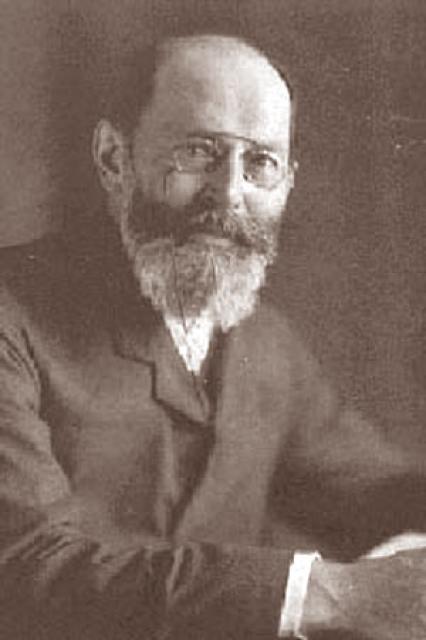
Hermann Emil Fischer
 Germany
Biography of Emil Fischer
Emil Hermann Fischer, a German organic chemist, was born on October 9, 1852, in Ohschirchen, near Bonn, Germany. From a young age, Fischer showed exceptional aptitude for natural sciences. After completing his education at the schools in Wetzlar and Bonn, he enrolled at the University of Bonn in 1871, where he attended lectures by renowned chemist August Kekulé. However, he transferred to the University of Strasbourg in 1872, attracted by the brilliant laboratory of Adolf von Baeyer.
In 1875, Fischer completed his doctoral dissertation on phthalene dyes, discovered by Baeyer, and made his first discovery with his brother Otto Fischer – the synthesis of phenylhydrazine, which was used as a reagent for aldehydes and ketones. Baeyer offered Emil a position as his assistant, and until 1879, Fischer's career was closely tied to the University of Strasbourg. It was during this time that he not only mastered the finest experimental methods but also learned to plan experiments, constructing them according to the logic of his chosen field.
In 1882, at the University of Erlangen, Fischer delved into the study of purine compounds, a nearly hopeless task from the perspective of 19th-century chemistry. His research on the structure of purine compounds culminated in the synthesis of various physiologically active derivatives, including caffeine, theobromine, xanthine, hypoxanthine, guanine, and adenine (1897). In 1898, Fischer synthesized purine itself, and a year later, he completed Bayer's unfinished synthesis of uric acid, an oxypurine derivative.
In 1884, Fischer began his research on carbohydrates. These studies, carried out in collaboration with numerous students and colleagues, transformed the chemistry of sugars from fragmented research into a systematic science. Fischer gave sugars nomenclature still in use today and developed rational formulas for them. He synthesized a significant number of monosaccharides and disaccharides, proving the possibility of interconversion between different sugars and creating their rational classification. By condensing glycerol aldehyde and other methods, he (together with Yulius Tafel) obtained a mixture of sugar-like substances, from which he isolated acrose using phenylhydrazine. Alpha-acrose turned out to be identical to methylenitane, a sugar-like substance obtained by Aleksandr Butlerov in 1861. In 1890, Fischer synthesized grape sugar and fruit sugar from glycerose and formaldehyde, and in 1893, he proposed a new method for synthesizing glucosides from alcohol and sugars, obtaining a large number of glucosides.
In 1894, Fischer opened a new chapter in the history of chemistry and biology. He used the properties of biocatalysts, enzymes, to solve purely chemical problems. In doing so, he demonstrated that enzymatic activity depends on the structure of the substrate, leading to the famous "lock and key" principle. The ability of enzymes to cleave only one of the synthetic stereoisomers was used by Fischer to develop a method for separating stereoisomers, which he successfully applied in the study of the chemistry of protein substances.
Fischer's work on proteins marked the pinnacle of his career. Already a world-renowned scientist, he began studying proteins in 1899, with the help of the renowned German biochemist Albrecht Kossel. In his investigations of amino acids, polypeptides, and proteins, Fischer's characteristic "normativity" found its fullest expression. He proposed that proteins are products of the combination of amino acid residues and set out to determine how these residues are connected. In essence, he recreated the synthetic and analytical chemistry of amino acids and developed numerous methods for synthesizing D- and L-amino acids. Using the ether method of amino acid analysis that he developed, he conducted the first-ever studies of the amino acid composition of proteins, discovering valine, proline, and hydroxyproline. Fischer then attempted to connect amino acids into polymeric derivatives. For the synthesis of these polyamino acids (which he called peptides and polypeptides), he developed various methods, many of which are still used in laboratory practice. In 1902, he and his colleague Ernest Fourneau obtained the first pure dipeptide, a compound consisting of two amino acid residues. Later, they synthesized an 18-membered polypeptide containing amino acid residues of two types. Fischer compared the synthesized peptides with peptides obtained by careful partial hydrolysis of proteins, proving that proteins are polypeptides consisting of amino acid residues connected by a peptide bond (-CO-NH-). In the final years of his life, he studied tannins, demonstrating that they are derivatives of digallic acid.
Fischer's laboratory became a remarkable international school. Among his students, several were honored with Nobel Prizes, including Otto Diels, Adolf Windaus, Fritz Pregl, and Otto Warburg, not to mention the "students of his students," second-generation Nobel laureates such as Adolf Butenandt, Kurt Alder, Hans Krebs, and Gerhard Domagk. In addition to the 1902 Nobel Prize in Chemistry, Fischer received numerous awards and was elected as a member of prestigious scientific societies and academies. In 1899, he became a foreign corresponding member of the St. Petersburg Academy of Sciences. During his lifetime, the German Chemical Society, of which he served as president for several years, established the Emil Fischer Medal in 1912. This medal is awarded every two years to chemists for outstanding achievements in the field of organic chemistry.
The First World War interrupted Fischer's scientific work. After 1914, his research lost the brilliance and breadth for which it was renowned in his multinational laboratory. The war was also tragic for Fischer personally, as two of his sons were killed on the frontlines. Although he resumed his scientific research after the war, cancer and severe mental distress led to his tragic death on July 15, 1919. Emil Fischer was laid to rest in the Wannsee district of West Berlin.


