Hideky Todsio
 Japan
Japan- Hideki Tōjō
- Rise to Power
- Architect of Japanese Aggression
- Prime Minister and Attack on Pearl Harbor
- Dictatorial Rule and the War Effort
- Downfall and Legacy
Hideki Tōjō
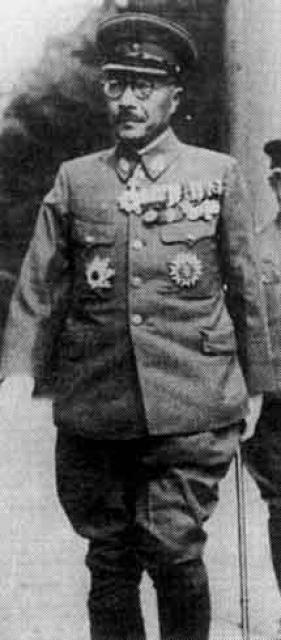
Early Life and Military CareerHideki Tōjō was born into a military family in 1884. He attended the Imperial Japanese Army Academy in 1905, later graduating from the Army War College in 1915. As a military officer, he participated in the Allied intervention in the Russian Far East during the Russian Civil War. Afterwards, he served as military attaché in Bern and Berlin from 1919 to 1922.
Rise to Power
Tōjō returned to Japan and joined the faculty of the Army War College in 1922. In 1927, he was transferred to the War Ministry and later commanded the 1st Infantry Regiment from 1931 to 1933. In 1934, he became commander of the 24th Brigade.
Aligned with the "Tōseiha" faction within the Japanese military, Tōjō opposed the radical "young officers" group. In 1935, he became commander of the Kwantung Army gendarmerie in Manchuria and purged the army of young officers.
Architect of Japanese Aggression
Tōjō played a pivotal role in Japan's aggression in Asia. As Chief of Staff of the Kwantung Army from 1937 to 1938, he initiated the creation of the puppet state of Manchukuo in Manchuria. He also advocated for the use of any means necessary to establish Japan's hegemony in East Asia, including sabotage and the formation of "fifth columns."
Tōjō became Deputy War Minister in 1938 and strongly supported the continuation of the war in China. He believed that the world could be divided into "absolute enemies" (such as the Soviet Union) and "relative enemies."
Prime Minister and Attack on Pearl Harbor
On October 17, 1941, Tōjō was appointed Prime Minister while retaining the position of War Minister. He also held the portfolio of Home Minister. Despite his vast power, he faced resistance from the imperial bureaucracy and the navy.
On November 1, 1941, Tōjō's cabinet approved the plan to prepare for war against the United States, United Kingdom, and the Netherlands if negotiations in Washington failed to yield concessions. He orchestrated Japan's attack on Pearl Harbor on December 7, 1941.
Dictatorial Rule and the War Effort
Tōjō sought to suppress opposition within Japan, passing the Special Extraordinary Law in 1942, which expanded the government's powers to detain suspected dissenters. He also attempted to gain control over the Japanese economy by creating the Ministry of Wartime Supplies in 1943.
In February 1944, Tōjō assumed the additional role of Chief of the General Staff, consolidating his authority. Despite the deteriorating war situation, he remained adamant about continuing the war.
Downfall and Legacy
The fall of the Mariana Islands and the Allied advances brought increasing pressure on Tōjō to resign. On July 18, 1944, he stepped down as Prime Minister. After the war, he was arrested by American soldiers and attempted suicide but survived.
Tōjō was tried by the International Military Tribunal for the Far East and convicted as a war criminal. On November 12, 1945, he was sentenced to death and executed by hanging.
In 1978, his name, along with those of other executed war criminals, was inscribed on a memorial at the Yasukuni Shrine. A monument was erected in 1980 at the site of his execution.