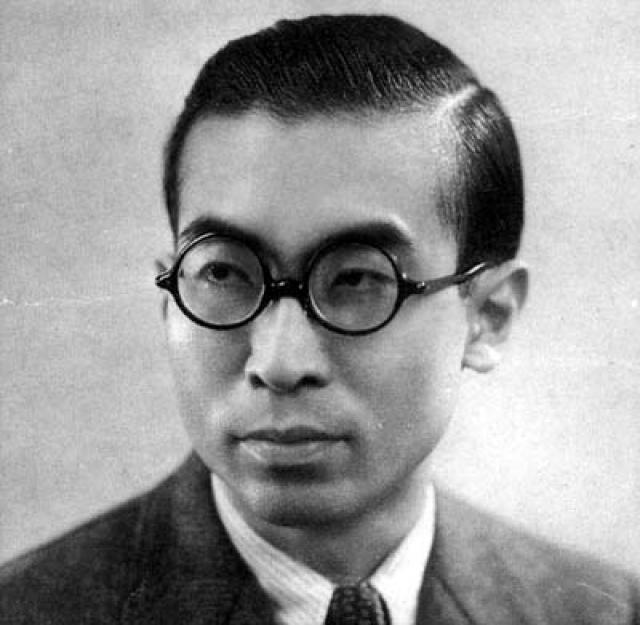
Hidemaro Konoye
 Japan
JapanBiography of Hidemaro Konoe
Hidemaro Konoe was a Japanese conductor and composer during the Showa era, which was the reign of Emperor Hirohito. He was born on November 18, 1898, in Kojimachi, a suburb of Tokyo. He was the youngest son of Prince Atsumaro Konoe, a descendant of one of the five regent houses of the Fujiwara clan. The Konoe clan traditionally served as a source of gagaku musicians, one of the genres of Japanese classical music, for the imperial court. Hidemaro decided to follow in the musical traditions of his family, as his older brother Fumimaro pursued a career in politics.
He attended the Gakushuin Peers School, established in 1877 in Tokyo for children from aristocratic families, where he found a close friend in Takashi Inukai, a future poet and literary scholar. In 1913, he entered the Tokyo University of the Arts, specializing in violin.
In 1915, he briefly went to Germany to study musical composition, becoming a student of Kosaku Yamada, a composer, conductor, and music educator who is considered the founder of the Japanese composer school. In 1920, he made his professional conducting debut with an amateur orchestra conducted by Toukichi Setoguchi.
In 1923, Konoe returned to Europe and studied in Paris under Vincent d'Indy, a prominent French musical figure, and in Berlin under Austrian composer and conductor Franz Schreker. He also studied conducting under Erich Kleiber and Karl Muck. In 1924, Konoe conducted the Berlin Philharmonic and returned to Japan later that year. It is interesting to note that the young conductor chose to study under German musicians, possibly due to Japan's longstanding pro-German policies in various fields, from the military to science.
In 1925, Konoe became one of the founders of the Japan Symphonic Association and agreed to become the conductor of the orchestra. He later founded the New Symphony Orchestra of Tokyo, now known as the NHK Symphony Orchestra, and within a little over ten years, he transformed it into an ensemble that could compete with the best orchestras in Europe. Konoe is also remembered as the conductor who made the first recording of Gustav Mahler's Symphony No. 4 in May 1930.
Konoe was frequently invited to work in Europe and America, conducting around 90 different orchestras, including the La Scala Orchestra in Milan and the renowned NBC Symphony Orchestra in America. He had friendly relationships with Erich Kleiber, Leopold Stokowski, Wilhelm Furtwängler, and Richard Strauss.
In the late 1930s, Konoe returned to Germany and conducted the Berlin Philharmonic. He also planned a tour of the United States with the NBC Symphony Orchestra, but those plans were disrupted by World War II. Konoe composed original compositions, but he was more interested in arranging the works of other composers, including Modest Mussorgsky's "Pictures at an Exhibition" and orchestral pieces by Franz Schubert.


