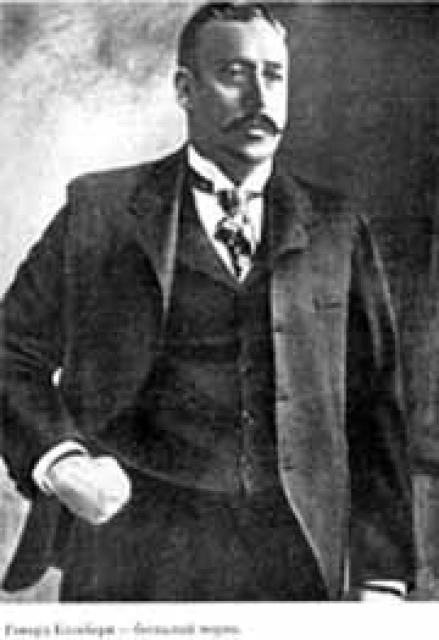
Hovard Blackbern
 Canada
- Early Life and Seafaring
- A Frigid Ordeal
- Returning Home a Hero
- A Solo Transatlantic Voyage
- A Daily Routine at Sea
- Reaching Landfall
- Legacy
Early Life and Seafaring
Howard Blackburn was born in 1859 on the Canadian coast. From the age of thirteen, he embarked on various vessels sailing the Atlantic and Pacific oceans. Life at sea was challenging, but Blackburn developed a resilience and strength that would serve him well in the trials that lay ahead. Standing at an imposing 190 centimeters, he was known for his powerful physique and fearlessness.
A Frigid Ordeal
In the winter of 1883, Blackburn was fishing for halibut off Newfoundland. Caught in a sudden blizzard, he and a fellow fisherman, Welch, became stranded in their small dory. As the storm intensified, they struggled to row back to their ship. Hours passed, the wind grew stronger, and the waves rose higher. With Welch on the brink of death, Blackburn moved his lifeless body to the stern as ballast.
For five grueling days and nights, Blackburn tirelessly rowed north, his frostbitten hands reduced to icy claws. His body weakened by starvation and exhaustion, his will to survive remained unyielding. Despite losing fingers on both hands, five toes, and his heel, Blackburn persevered, driven by an unyielding determination to reach land.
Returning Home a Hero
Upon his return to Gloucester, Blackburn was hailed as a hero. The local newspaper raised $500 in donations, which he used to open a small shop. After saving some money, he generously donated $500 to charity. However, his restless spirit led him to join a group of gold seekers heading to Alaska. He returned on crutches, having failed to find any riches.
A Solo Transatlantic Voyage
Inspired by stories of Joshua Slocum, Blackburn became obsessed with the idea of sailing solo across the Atlantic. In 1899, he embarked on an ambitious journey from Gloucester, Massachusetts to Gloucester, England aboard a 9.1-meter sloop.
Despite his disability, Blackburn devised ingenious modifications to his vessel and mastered the challenging sail plan. He navigated the open sea with remarkable skill, steering with the tiller and hoisting sails with the help of his elbows or his teeth.
A Daily Routine at Sea
Blackburn adopted a peculiar daily routine aboard his sloop. He would sleep for five hours during the afternoon, while his vessel drifted with the current. He would then prepare a hot meal and set sail, navigating throughout the night. In the morning, he would eat breakfast before sleeping again at midday, following an 18-hour watch.
During calm days, Blackburn would rest longer, lighting a large lantern at night. His diet consisted of simple but nourishing fare: crackers, canned goods, dried meat and fish, oatcakes, and potatoes.
Reaching Landfall
On August 16, Blackburn sighted the Scilly Isles, the first sign of land after 62 days at sea. He then sailed northeast and entered the Bristol Channel, which led him to Gloucester. On August 19, amidst a massive welcome from the local community, he arrived at the Gloucester docks, his solo transatlantic voyage complete.
Legacy
Howard Blackburn's extraordinary feats of endurance and determination have been celebrated for generations. His story serves as a testament to the indomitable spirit that resides within us all, capable of overcoming even the most daunting of challenges.


