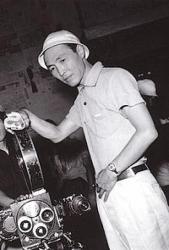
Howard Hawks
 USA
USABiography of Howard Hawks
Sam Howard Hawks, an American director, screenwriter, and producer, referred to himself as a craftsman of cinema, adding, "I am a storyteller - that is the most important quality for a director." In 1974, he was awarded an honorary Oscar for his contribution to the art of film.
Howard Winchester Hawks was born on May 30, 1896, in Goshen, Indiana, into a wealthy family. From his childhood, Hawks attended the prestigious private school, Phillips Academy, and later studied at the Polytechnic Institute and the technological faculty of Cornell University. During World War I, Howard joined the United States Army Air Forces. His love for aviation would remain with him throughout his life, and he even made several movies on the subject.
After his military service, Hawks began his career in Hollywood. He worked as an assistant director, producer, subtitle writer, and screenwriter for several films. Howard befriended influential figures in Hollywood such as Victor Fleming and producer Irving Thalberg. In 1926, he started his directing career at Fox. The film that brought him wide popularity was "A Girl in Every Port" (1928) - the story of two brawling sailors (Victor McLaglen and Robert Armstrong). This was the first film that introduced the theme that would be common throughout Hawks' work - the theme of male friendship.
François Truffaut described Howard Hawks' universal directing formula as follows: "His films can be divided into two categories: adventure films and comedies. In the former, man is celebrated, his intelligence, physical and moral strength; in the latter, degeneration and helplessness of the same man in the modern civilization are described. Therefore, Howard Hawks is a kind of moralist." True success came to him with the advent of sound cinema. In 1932, Howard Hawks created an undisputed masterpiece - "Scarface". It was a fictionalized version of the story of Al Capone and his associates. Gangster classic - Paul Muni played a dangerous criminal with a scar on his cheek, and dark-haired, wide-eyed Ann Dvorak played his sister.
The gangster named Tony Camonte rises to power with terrifying ease, drawing the audience's attention with his primitive brutality. Truffaut believes that Hawks intentionally shot Paul Muni to make him look like a monkey with hanging arms, slightly hunched, with a face constantly distorted by a grimace. The cross symbol appears throughout the whole film (on walls, doors, created by lighting). Critics note that this visual idea, like a musical motif, serves as an "orchestration" to Tony's scar, a sign of death. Hawks easily shifted from one genre to another. In 1934, his comedy "Twentieth Century" was released - a satire on theatrical manners. In another eccentric comedy, "Bringing Up Baby" (1938), the hero is an obsessed paleontologist who doesn't notice anything around him. Gradually, he acquires a taste for life and comes to the conclusion that not only mummies but also living women are beautiful. Cary Grant and Katherine Hepburn played brilliantly in this film. The film also featured a real leopard, with whom Grant flatly refused to work. As Hepburn recalled, there was constant laughter on the set, "We laughed from morning till night."
Hawks was always embarrassed when his films were overly praised. He didn't like noisy gatherings. Howard would disappear with Clark Gable for hunting or motorcycle rides in his free time. Howard was only remembered when his new work hit the screens. Indulging in his youthful passion, Hawks made the aviation film "Only Angels Have Wings" (1939) with Cary Grant, then received an Oscar nomination for the biographical film "Sergeant York" (1941), and responded to current events with the film "Air Force" (1943).
In 1945, Hawks brought Ernest Hemingway's novel "To Have and Have Not" to the screen. Humphrey Bogart played Morgan, an American, a rough seafarer with a golden heart. The role of his lover was given to 19-year-old newcomer Lauren Bacall.
Howard worked with enthusiasm. Every morning, he held rehearsals. First, the actors read the script, and then the scene was played out until it satisfied the director.
Hawks was known as an eccentric person. When another producer came to observe the filming, he immediately declared a break and continued working only after the visitors left. Howard admitted that he learned this clever trick from John Ford.
As it is claimed, Hawks was the only director William Faulkner agreed to work with. They were old and good friends, went hunting together. The writer read his new works to Howard and even borrowed money from him. In 1948, Howard Hawks released his first western, "Red River," starring John Wayne and young newcomer Montgomery Clift. The film's hero kills anyone who claims their rights to his territory. He always buries the dead and then reads the Holy Scripture over the grave. Gradually, a whole cemetery grows on his land... The highlight of the film was the scene when a stampeding herd rushes across the prairie, trampling cowboys who try to stop the animals. This scene was incredibly difficult for Hawks. It took one and a half weeks and fifteen cameras to shoot it. To make the herd on the screen look like an unstoppable force sweeping everything in its path, the cameras worked in slow-motion mode. As it turned out, Hawks' efforts were not in vain - this scene became a classic in American cinema.
"Red River" made a stunning impression on audiences and critics. The enthusiasm was overwhelming and universal.
In the early 1950s, Hawks directed comedies starring Marilyn Monroe - the whimsical extravaganza "Monkey Business" (1952) and "Gentlemen Prefer Blondes" (1953). Producer Zanuck was looking for a director who could utilize Marilyn Monroe's persona. He invited Hawks, saying, "We would like to achieve Marilyn's definitive recognition. Every time we try to present her in a certain plot, either the plot or Marilyn eludes us. What are your thoughts on this?" "The mistake lies in the fact," Hawks replied, "that you are trying to present Marilyn Monroe as a realistic character, while she is not created for that. I see only one way to make her acceptable - to shoot a musical comedy." He cast Jane Russell, a strong actress, as Monroe's partner in the film.
When Zanuck watched "Gentlemen Prefer Blondes" and heard Marilyn singing with her sweet, thin voice, "Diamonds Are a Girl's Best Friend," he realized that the success would be overwhelming. François Truffaut expressed an unexpected opinion about this film, "Gentlemen Prefer Blondes" is not at all a cute and cynical entertainment film, as is commonly believed, but a harsh, wicked work, smart and merciless... Funny in Hawks' films, regardless of the label attached to him, always stands out for its novelty and originality."
Following the sparkling comedy, Hawks directed the biblical drama "Land of the Pharaohs" (1955), followed by the western "Rio Bravo" (1959). "If I were asked to name the film that justifies the existence of Hollywood, I would name 'Rio Bravo'," wrote English critic Robin Wood. "This film truly represents the quintessence of American classicism." In "Rio Bravo," there are no complex psychological maneuvers, the overall tone is joyful, and, as usual, male friendship triumphs in the end, with all the laws of the classical western being observed.
As the author of the scripts for most of his films, one of the most talented representatives of classical Hollywood cinema, Hawks failed to adapt to the new situation that emerged in the 1970s when new themes, plots, and stylistic techniques were being developed, and he stopped working in film. In this regard, Truffaut's words are often remembered, "A director with an impeccable past and a controversial present."
Hawks lived a long life. He became a guru for young filmmakers. Howard Howard referred to himself as a craftsman of cinema, adding, "I am a storyteller - that is the most important quality for a director." In 1974, he was awarded an honorary Oscar for his contribution to the art of film.