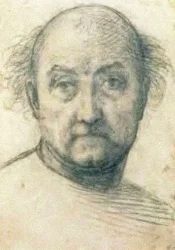
Hugo van der Goes
Hugo van der Goes created some of the most emotionally charged paintings of the early Netherlandish Renaissance. His figures can be monumental and intensely present, even within scenes of Christian devotion, and his celebrated *Portinari Altarpiece* brought this visual power to Florence, where Italian painters studied it closely. The surviving record of his life is sparse, but it traces a remarkable passage from successful civic artist in Ghent to lay brother at a monastery near Brussels.
A painter in Ghent
Van der Goes was probably born in Ghent around 1440, though his early life is undocumented. He first appears in the records in 1467, when he became a master in the city’s painters’ guild. He soon emerged as one of Ghent’s leading artists, receiving commissions from wealthy patrons, religious institutions, and the city itself.
He also held positions within the guild and took part in the public life of the town. Large civic ceremonies often required painters to produce decorations, banners, and other temporary works, and Van der Goes was employed on such projects. Almost none of this material survives. He did not sign his paintings, and the attribution of much of his known work has depended on stylistic comparison and later testimony.
The Portinari Altarpiece
Van der Goes’s most famous painting was commissioned by Tommaso Portinari, a Florentine banker working in Bruges. The large triptych, showing the Adoration of the Shepherds, was painted in the 1470s and reached Florence in 1483, after the artist’s death. Portinari intended it for the church of Sant’Egidio, attached to the hospital of Santa Maria Nuova.
The central panel places the newborn Christ at the center of a crowded but carefully structured scene. The Virgin and Joseph kneel before him, while shepherds approach with strikingly individual faces and gestures. Flowers, vessels, and other details are rendered with close attention, yet the painting’s force comes equally from the monumental scale and emotional intensity of its figures.
The work made a powerful impression in Italy. Its scale, realism, and treatment of sacred figures offered Florentine artists a vivid example of northern painting. The triptych became an important point of comparison for painters such as Domenico Ghirlandaio, and its arrival helped bring Netherlandish techniques and visual ideas into Italian artistic circles.
Monastic life and final years
Around 1476, Van der Goes left Ghent and entered the Roode Klooster, an Augustinian priory near Brussels, as a lay brother. The reasons for his decision are unknown. Joining the community did not immediately end his work as an artist: he continued to paint and received visitors, and he traveled with other members of the monastery.
A fellow brother, Gaspar Ofhuys, later recorded that Van der Goes suffered a serious mental crisis while returning from a journey. The account describes an episode of despair and disturbance, but it does not provide enough evidence for a modern diagnosis. The testimony has nevertheless shaped later images of Van der Goes as a tormented or melancholic artist, a portrait that should be treated cautiously.
He died at the monastery in 1482 or 1483. His precise age is unknown. The *Death of the Virgin*, now in Bruges, is often considered one of his final works, although the chronology and attribution of paintings in his small surviving body of work remain debated.
Style and legacy
Van der Goes’s paintings combine the minute observation associated with Netherlandish art with strikingly large-scale compositions. He used color, gesture, and expressive faces to make sacred subjects feel immediate. His work could be tender and contemplative, but also unsettling in its directness and emotional pressure.
Only the Portinari triptych can be securely tied to him through documentation; many other attributions remain open to discussion. That uncertainty has not diminished his importance. The works associated with Van der Goes helped define the expressive reach of early Netherlandish painting and influenced artists far beyond his native city. His life remains partly hidden, but the intensity of his images continues to make him one of the most compelling painters of his generation.