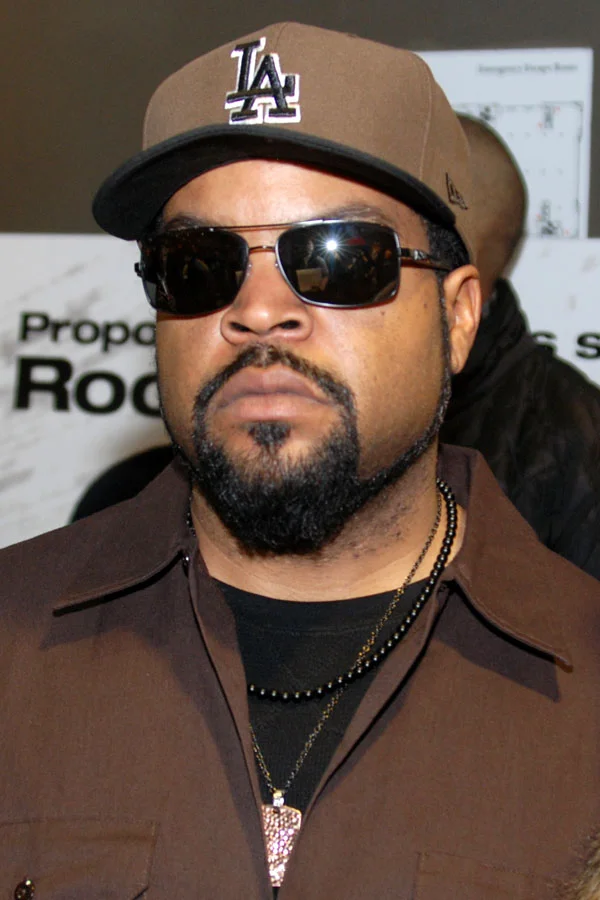
Ice Cube
- From South Central to N.W.A
- Solo Success and a Second Career
- Family and Public Life
- Recent Work and Legacy
Ice Cube built his career on a rare combination: a writer’s precision, a performer’s force, and an instinct for turning conflict into a story. He first became famous as a teenage voice in N.W.A, whose blunt accounts of police brutality and life in Los Angeles reshaped rap. He then left the group, launched a solo career, and became a familiar film star—all while continuing to court debate with lyrics and political positions that divide audiences.
From South Central to N.W.A
Born O’Shea Jackson on 15 June 1969, he grew up in South Central Los Angeles, the son of a hospital clerk and a groundskeeper. He began writing rhymes as a teenager and formed the group C.I.A. with friends. After graduating from high school, he studied architectural drafting in Phoenix, Arizona, while his music career was taking shape.
Jackson returned to Los Angeles and joined N.W.A, the group formed around rapper Eazy-E and producer Dr. Dre. As its principal lyricist, he helped write the material that made “Straight Outta Compton” a landmark album in 1988. The group’s song “F*** tha Police” drew national attention for its furious protest against police brutality and racial profiling; the FBI sent the group a letter criticizing the song. N.W.A’s confrontational sound unsettled critics and authorities, while giving voice to experiences that mainstream audiences rarely heard.
Jackson left the group in 1989 amid a dispute over his contract and payment. He later said he was not being compensated fairly. The split became one of hip-hop’s most famous breakups, and he answered it with “No Vaseline,” a sharp diss track aimed at his former bandmates and manager.
Solo Success and a Second Career
His first solo album, “AmeriKKKa’s Most Wanted” (1990), established him as a major artist in his own right. “Death Certificate” (1991) and “The Predator” (1992) followed, bringing political argument, street storytelling, humor, and provocation into the same frame. “The Predator,” released amid the 1992 Los Angeles unrest, became one of the defining rap albums of its era.
The heat around his lyrics was real as well as artistic. “Death Certificate” drew condemnation for “Black Korea,” which threatened Korean-American shopkeepers, and for lines critics described as antisemitic and misogynistic. Supporters argued that his music reflected anger and racial tension in the communities he wrote about; critics said those lyrics crossed into hateful generalization. The debates became part of his public image and continue to shape how the album is heard.
In 1991, he made a striking screen debut as Doughboy in John Singleton’s “Boyz n the Hood.” He moved into comedy and action with the “Friday” films, “Barbershop,” “Three Kings,” and later “Ride Along.” As an actor, writer, and producer, he helped build films that reached audiences far beyond rap. He also co-produced “Straight Outta Compton” (2015), the dramatized story of N.W.A, in which his son O’Shea Jackson Jr. played him.
Family and Public Life
Ice Cube married Kimberly Woodruff in 1992, and they have four children. He has often kept his family life relatively private while making his public persona larger than life. Outside music and film, he co-founded the BIG3, a professional three-on-three basketball league, in 2017, and helped build it into a national sports property.
His political voice has remained outspoken. He created the Contract with Black America, a policy proposal focused on economic opportunity and racial justice. In 2020, he drew criticism after Donald Trump’s campaign said it had consulted him while developing its “Platinum Plan.” Jackson said he was pushing his proposal with both parties and that advising on policy was not an endorsement of a candidate. The episode reinforced the tension between his long history of social critique and his willingness to engage politicians across party lines.
Recent Work and Legacy
In 2024, he released “Man Down,” followed in 2025 by “Man Up,” his twelfth studio album. He also celebrated four decades in music with the “Truth to Power: 4 Decades of Attitude” tour. Alongside the BIG3, these projects keep him active as a performer and entrepreneur.
Ice Cube’s career has never fit into a single lane. He has moved from protest rap to Hollywood comedy, from a bitter group split to a public reunion, and from outspoken lyrics to policy conversations. His work remains admired for its force and storytelling, while some of its most controversial lines continue to prompt serious criticism. That tension—between cultural influence and provocation—is central to his legacy.