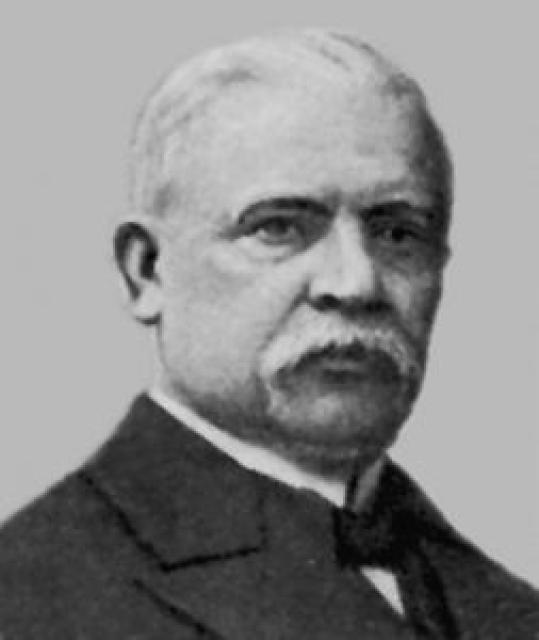
Ignatiy Iagich
 Croatia
- Vatroslav Jagic: A Prominent Figure in Slavic Philology
- Early Works and Diverse Interests
- Archiv fur slavische Philologie: A Landmark Publication
- Contributions to Church Slavonic Language and Paleography
- Other Contributions and Initiatives
- Legacy and Criticisms
- Written by A.I. Yatsimirsky.
Vatroslav Jagic: A Prominent Figure in Slavic Philology
Vatroslav Jagic, also known as Ignatius Vatroslav Jagic, was an exceptional representative of modern Slavic philology. Born in 1838 in Varazdin, Croatia, he studied at the University of Vienna and taught at the Zagreb Gymnasium. Jagic held professorships in Odessa (1871-1874), Berlin (1874-1880), and St. Petersburg (1880-1885), and is currently a professor in Vienna.
Early Works and Diverse Interests
Jagic's first article, "Pabirci po cviecu nasega narodoga pjesnictva" (Preliminary Remarks on the Flowers of Our National Poetry), was published in 1861 as an appendix to the annual report of the Zagreb Gymnasium. A year later, he published his first linguistic work, "Deklinacija imena samostavnoga usporedjena, kako se razvi u staroslovenskom-srbskom-hrvatskom jeziku" (Comparison of the Declension of Nouns, as Developed in Old Church Slavonic-Serbian-Croatian Language).
In 1864, Jagic wrote a significant and comprehensive article titled "Jihoslovane" (South Slavs), which determined his future interests. This article was published in the Riegr Encyclopedia in Prague ("Naucny Slovnik"). Jagic stood out among other Slavists due to the breadth and diversity of his scholarly interests, distinguishing him from his immediate predecessor at the University of Vienna, the linguist Miklosich.
Archiv fur slavische Philologie: A Landmark Publication
Jagic's most significant contribution was the establishment of the "Archiv fur slavische Philologie" (Archive for Slavic Philology) in Berlin in 1876. It was the first specialized Slavic journal, which not only acquainted European scholars with the state of Slavic philological science but also fostered collaboration among Slavic scholars and some Western academics, bridging the Slavic world with the German-Romance West. The journal aimed to present "Slavdom" as a unified and integral entity.
Over its 28-year existence, the journal produced numerous valuable articles that "rehabilitated" Slavdom in the eyes of the West, which previously only recognized Germanic and Romance philology as legitimate fields of study. Jagic's inaugural lecture in Vienna in 1886, titled "Lecture by Professor Jagic" (Vestnik Evropy), held equal significance as a proclamation of the importance of Slavic philology. He also organized a Slavic seminar at his chair in Vienna.
Contributions to Church Slavonic Language and Paleography
Among Jagic's notable works are his editions of ancient monuments of Church Slavonic language. Together with F. Raski, he published "Assemanovo Evangelie" (Assemanian or Vatican Evangelical) in Zagreb in 1865. He also edited the Zograph Gospel ("Quattuor Evangeliorum, codex glagoliticus olim Zographensis nunc Petropolitanus") in 1879 and the Mariinsky Gospel ("Pamyatnik glagolicheskoi pis'mennosti. Mariinskoe Chetveroevangelie") in 1883, published by the Academy of Sciences in St. Petersburg.
In addition to the accurate reproduction of texts with variants, these editions are valuable for Jagic's prefaces, which not only provide characteristics of individual manuscripts and determine their mutual relationship but also offer general observations on Glagolitic monuments. Jagic's opinions have greatly influenced further research in this field. He also participated in the publication of the Miroslav Gospel from the 12th century (Belgrade, 1897).
Jagic's important works in paleography include articles on the Sinai Trebnik ("Archiv fur slavische Philologie," 1883), in which he rejects the theory of the Glagolitic script's origin from Albanian writing and defends Greek minuscule as its prototype. He further develops this idea in "Four Paleographic Articles" ("Collection of the II Department," XXXIII). His significant work on the history of the Church Slavonic language, "Zur Entstehungsgeschichte der Kirchenslav. Sprache" (Vienna, 1900), also deals with the issue of Glagolitic script.
Other Contributions and Initiatives
Aside from his linguistic and paleographic works, Jagic also made contributions to the history of Slavic literature. His major works in this field include "Historija knizevnosti naroda hrvatskoga i srpskoga" (History of Croatian and Serbian Literature, Zagreb, 1867), "Vopros o Kirille i Mefodii v slavyanskoi filologii" (The Question of Cyril and Methodius in Slavic Philology, "Collection of the II Department," XXXVIII), and "Vnov' naidennoe svidetel'stvo o deyatel'nosti Konstantina Filosofa" (Newly Discovered Evidence on the Activity of Constantine the Philosopher, "Collection of the II Department," LIV).
As an eminent scholar, Jagic displayed broad initiatives. In 1876, he felt the need to establish a Slavic bibliography. In 1880, he presented a report to the academy about his planned edition of a comparative dictionary of all Slavic languages. In 1882, he undertook the complete edition of outstanding monuments of Russian writing from the 11th-12th centuries. In 1893, he conceived the idea of publishing a Slavic encyclopedia. All of these issues were identified as the main tasks of the upcoming Congress of Slavists. As the chairperson of the preliminary congress, Jagic discussed these matters with knowledge and expertise.
Legacy and Criticisms
Although Jagic was an exceptionally accomplished scholar, he did not personally collect folk creative works or study dialectology on-site. He also faced criticism from Austrian Slavs for being too accommodating to the Viennese government. The "Bosnian language" he "created" became a derogatory term with rather sad connotations. Nonetheless, Jagic's contributions to Slavic philology and his wide-ranging initiatives have left an indelible mark on the field.



