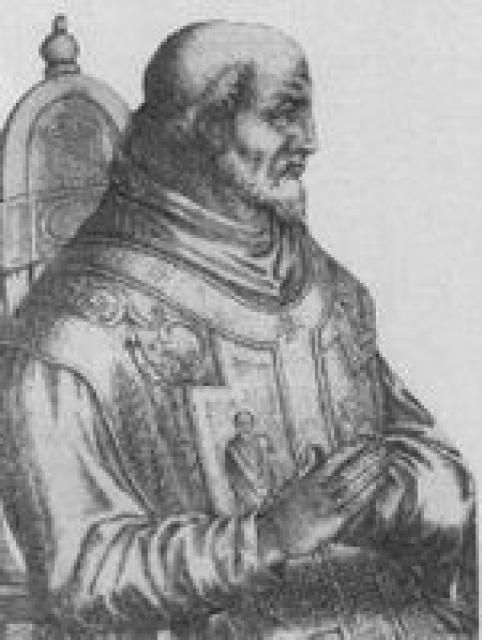
Innokentiy II
 Vatican
- Early Life and Career
- Exile and Diplomatic Mission
- Election to the Papacy
- Dual Papacy
- Struggle for Recognition
- Imperial Coronation
- Restoration of Papal Authority
- Later Years
- Conflict with Arnold of Brescia
- Spiritual Reign
- Conflict with Louis VII
- Later Synods
- Death and Legacy
Early Life and Career
Gregorio Papareschiwas born in Rome, the son of Gregorio de Galgano. He began his ecclesiastical career as a canon of the Lateran Basilica. In 1118, he was made a Cardinal-Deacon of Sant'Angelo by Pope Paschal II.
Exile and Diplomatic Mission
In 1118, Papareschi went into exile with Pope Gelasius II. Notably, one of his companions was the future rival Cardinal Pietro Pierleoni. In 1119, Pope Calixtus II sent Papareschi to Germany with Lamberto Scannabecchi to prepare for the Concordat of Worms.
Election to the Papacy
Contested ElectionIn 1130, upon the death of Pope Honorius II, the Roman aristocracy divided into two factions: the Frangipani and the Pierleoni. Both factions sought to secure the election of their candidate. On the following day, 16 cardinals elected Papareschi, the Frangipani candidate, as Pope Innocent II. On the same day, 30 cardinals elected Pietro Pierleoni as Pope Anacletus II.
Dual Papacy
Both Innocent II and Anacletus II were consecrated on February 23, 1130. The Frangipani quickly abandoned their support for Innocent II, who fled to his castle in Trastevere and subsequently to France, where he was welcomed by King Louis VI.
Struggle for Recognition
Support from GermanyIn France, Innocent II convened several synods, convincing bishops of the legitimacy of his election. Meanwhile, in Germany, Norbert of Magdeburg and Conrad of Salzburg organized a synod in Würzburg, where King Lothair pledged allegiance to the pope. On March 22, 1131, Lothair and Innocent II met in Liège, where the pope solemnly crowned Lothair and his wife Richenza.
Imperial Coronation
Innocent II spent Easter 1131 in Paris and crowned Prince Louis during a synod in Reims in the autumn of the same year. In August 1132, at the pope's request, Lothair invaded Italy and reached Rome. On June 4, 1133, Innocent II crowned him Emperor in the Lateran Palace, as St. Peter's Basilica and the Castel Sant'Angelo were controlled by Anacletus II.
Restoration of Papal Authority
End of the SchismAfter the emperor's departure, Innocent II was forced to leave Rome again. In 1137, he persuaded Lothair to launch a new campaign in Italy and re-entered the city with his army. Months later, Anacletus II died, and his successor, Antipope Victor IV, renounced the tiara. Thus, Innocent II became the sole ruler of the city and the papacy.
Later Years
Second Lateran CouncilTo eliminate remnants of heresy, Innocent II convened the Tenth Ecumenical Council, also known as the Second Lateran Council, in 1139. The acts of Anacletus II were condemned, and the bishops he had ordained were deposed, with few exceptions. Thirty canons were passed against simony and clerical immorality.
Conflict with Arnold of Brescia
The council also condemned the heretical teachings of Arnold of Brescia, who advocated for the voluntary poverty of the clergy and opposed the pope's claims to temporal power. The Roman people, outraged by this decision, rebelled, deposed the papal prefect, and established a senate and patrician. Arnold later became the ideological leader of the "communal republic" founded in 1143.
Spiritual Reign
Innocent II spent the remainder of his pontificate in Rome, remaining only a spiritual authority without political power. He received Malachy, Archbishop of Armagh, in Rome in 1139 and made him legate for all Ireland but refused his request to leave his diocese for a monastery in Clairvaux.
Conflict with Louis VII
In 1141, Innocent II had a conflict with King Louis VII of France over the appointment of the Archbishop of Bourges. The French king refused to confirm Pierre de la Chatre, desiring to appoint his own candidate. After lengthy and unsuccessful negotiations, Innocent II placed France under an interdict.
Later Synods
In the final years of his pontificate, Innocent II held several minor synods to address matters of church discipline, resolve matrimonial disputes, and canonize saints.
Death and Legacy
Innocent II died in 1143 and was buried in the Basilica of St. John Lateran. Eight years later, his remains were transferred to the Church of Santa Maria in Trastevere.


