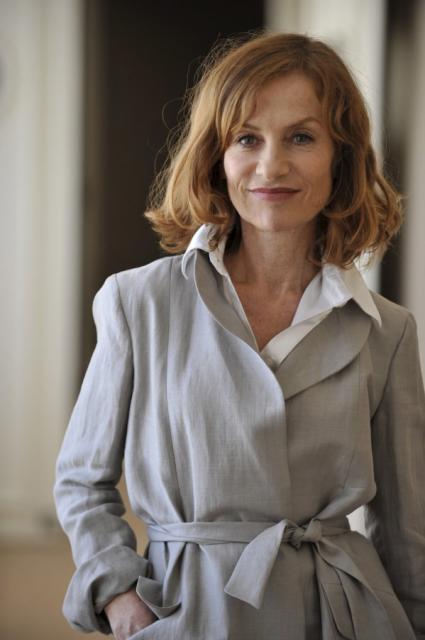
Isabelle Huppert
 France
Biography of Isabelle Huppert
Isabelle Huppert, a French film actress, is often referred to as an icon of European cinema. Her films have repeatedly triumphed at the Cannes Film Festival, the oldest and most prestigious film competition. Huppert's deep emotional intensity and refined aristocratic demeanor allow her to create incredible and intense characters ranging from saintly virgins to sinful prostitutes.

Isabelle Huppert was born on March 16, 1953, in the suburb of Paris, Ville-d'Avray. Her father was involved in safe production, while her mother was an English teacher at a private school. It was her mother who instilled in the future actress a love for philology and art. Thanks to her mother, Isabelle became fluent in English and later enrolled at the Sorbonne University to study Slavic languages.

Another interest of Huppert's was music. She attended piano lessons at the Versailles Conservatory for a long time until she became fascinated with theater. Unlike music, acting completely captivated her. Isabelle began regularly performing in amateur theaters and made her debut in film at the age of 19 in Nina Companeez's "Faustine and the Beautiful Summer" (1972). Although her role in the film was small, it caught the attention of filmmakers, and she started receiving regular invitations to act in movies. Roles in films such as "Cesar and Rosalie" (1972), "Going Places" (1974), "Dupont Lajoie" (1975), and "Aloise" (1975) brought her initial fame in France. In essence, during the 1970s, Isabelle played the same role. She changed names, costumes, and appearances, but she always remained the same - charming yet impulsive teenager.

Huppert's breakthrough role came in the film "The Judge and the Assassin" (1975), where she played Rose, a young woman involved in the labor movement. This work marked a turning point in her career and opened up new opportunities for her. She began to receive interesting offers, one of which was life-changing. It was with director Claude Chabrol and his film "Violette Nozière" (1978). Portraying the 18-year-old prostitute Violette Nozière in Chabrol's film, Isabelle Huppert changed her life forever. The film participated in the main competition at the Cannes Film Festival, where the jury unanimously awarded Huppert the prize for "Best Actress." Later, the collaboration between Huppert and Chabrol produced numerous masterpieces, but they were never able to surpass their first work together.

Soon, Isabelle realized that her calling was in artistic, non-commercial cinema. That's why she resisted American films for a long time, and that's why her filmography is dominated by movies by European intellectuals. She started working with directors such as Bertrand Blier, Werner Schroeter, Bertrand Tavernier, Jean-Luc Godard, and Maurice Pialat. However, in 1980, Huppert did appear in an American film. It was Michael Cimino's western "Heaven's Gate," which failed at the box office. Although her reputation as an actress was not affected, she still left Hollywood for a long time. Huppert felt more comfortable working with European directors, where there was more freedom and the ability to play fatalistic, enigmatic, and mysterious women - the kind of "heroines with a twist" who both horrify and fascinate, embodying both heaven and hell. One such character was her Alphonsine Plessis in the film "La Traviata" (1981). The film was praised in Europe, but the American audience remained indifferent towards it.

In the 1980s and 1990s, Isabelle Huppert created a plethora of unforgettable characters. These include the young Nelly in the drama "Loulou" (1980), Isabelle in the melodramatic film "Passion" (1982), Marie Latour in the war drama "Story of Women" (1988), Emma Bovary in the adaptation of Flaubert's novel "Madame Bovary" (1991), and the charming swindler Betty in the crime comedy "Rien ne va plus" (1997). Each of these characters can be considered a true work of art.

A new stage in Isabelle Huppert's career occurred in 2001 with the release of Michael Haneke's controversial film "The Piano Teacher." Her role as Erika Kohut, a professor at the Vienna Conservatory obsessed with sadomasochistic tendencies, earned her a second Cannes Film Festival award, reigniting interest in her work. This performance, executed with exquisite mastery, is considered one of Huppert's best. A year later, another notable film featuring the actress was released - the comedic detective film "8 Women" (2002). The film won the Silver Bear at the Berlin Film Festival for its ensemble cast, showcasing Huppert's exceptional talent once again. These works marked a new phase in her career, making her a popular actress in the world of auteur cinema, with Haneke becoming her new patron. After "The Piano Teacher," Huppert starred in Haneke's films "Time of the Wolf" (2003) and "Amour" (2012), which also received critical acclaim.

While she remained focused on auteur cinema, Huppert broke her principles twice by appearing in the American comedy "Heartbreakers" (2004) and the American action film "One Less" (2013). However, the former cannot be considered purely commercial, and the latter featured a minor role for the actress. Currently, Isabelle's creative career continues to develop as intensively as it did in her youth. In 2016, she starred in the thriller "Elle" directed by Paul Verhoeven. Her portrayal of Michèle Leblanc earned her a Golden Globe Award and an Oscar nomination. In the same year, audiences could see her in the comedy "False Confessions" directed by Luc Bondy, portraying the love story between a poor young man and a wealthy widow. Overcoming prejudices, the couple finds happiness. In 2017, Huppert starred in the drama "Barrage" about the relationship between a mother and daughter, the thriller "Mrs. Hyde" about a school teacher who changes after being struck by lightning, and the family drama "Happy End" about members of a wealthy family tired of their privileged lives.
On February 21, 2018, the latest project featuring Isabelle Huppert was released - the melodrama "Eva" about the connection between a young writer and a femme fatale. The protagonist, Bertrand, creates a play about a young man who falls in love with a kept woman. The writer himself decides to experiment by falling in love with the prototype of the play's heroine - Eva. The film will have its premiere in Russia on March 8.
Isabelle Huppert is currently working on the historical series "Romanovs" directed by Matthew Weiner, the creator of the series "Mad Men." In this series, Huppert stars alongside Aaron Eckhart.


