Izrail Gohberg
 Israel
- Early Life and Education
- Academic and Professional Journey
- Research Contributions and Recognition
- Emigration to Israel and Continued Success
- International Significance
Early Life and Education
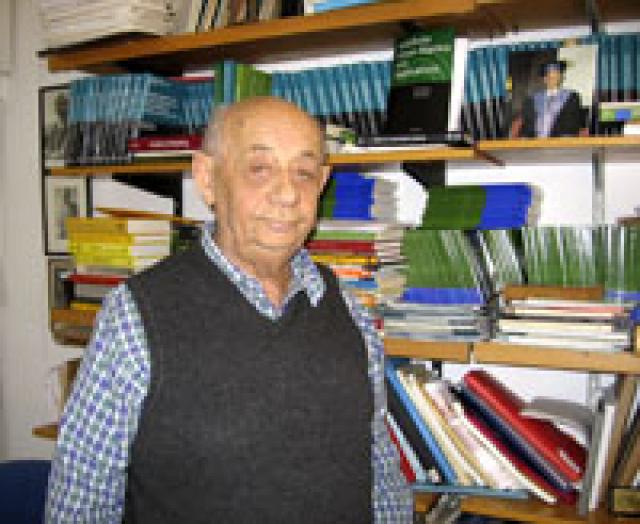
Israel Gohberg, a prominent Moldovan and Israeli mathematician, was born in Tarutino, Bessarabia, in 1928. His parents were Tsudik Itskovich and Khaia Isaakovna Gohberg, humble laborers with a printing shop and midwifery practice. Gohberg attended a Jewish school in Tarutino and later a Romanian gymnasium in Orgeyev.
With the Soviet takeover in 1940, Gohberg's father was arrested and perished in a prison camp in 1942. The young Gohberg, his mother, and sister fled to Kyrgyzstan during World War II. His mathematical education was significantly influenced by his high school teacher, Modest Semyonovich Shumbarsky, a graduate of Warsaw University who studied under Karol Borsuk.
Academic and Professional Journey
In 1946, Gohberg enrolled at the Kyrgyz State Pedagogical Institute, where he received a Stalin scholarship. After completing his second year, he returned to Moldova and graduated with honors from the Physical-Mathematical Faculty of Chișinău State University. Notable mentors during his studies included V.A. Andrunakievich, D.L. Pikusch, and I.A. Itskovich.
Despite his academic achievements, Gohberg was initially denied admission to graduate school and was sent to teach at the Soroca Pedagogical Institute in 1951. Undeterred, he published his first scientific paper in functional analysis that year and continued to contribute to leading mathematical journals from Soroca.
In 1953, Gohberg was transferred to the Pedagogical Institute in Bălți, where he became an associate professor and later the head of the mathematics department. While in Bălți, he defended his candidate dissertation externally at the Leningrad State Pedagogical Institute (1954) and established a scientific collaboration with the renowned Soviet mathematician Mark Grigorievich Krein.
Krein became Gohberg's mentor, leading to two joint monographs and the defense of Gohberg's doctoral dissertation at Moscow State University in 1964. In 1959, Gohberg was invited to Chișinău to head the functional analysis department at the Institute of Mathematics of the Moldavian Academy of Sciences.
Research Contributions and Recognition
Together with Krein, Gohberg made groundbreaking advancements in the theory of linear non-self-adjoint operators (published in 1965), Fredholm operators, and their applications, establishing him as a leading Soviet mathematician. Their second joint monograph, "Theory of Volterra Operators in Hilbert Space and its Applications," was published in 1967.
Gohberg received the title of professor in 1966 and became a member of the Moscow Mathematical Society. He also led the functional analysis and approximation methods sector of the Institute of Mathematics of the Moldavian Academy of Sciences. In 1970, he was elected a corresponding member of the Moldavian Academy of Sciences.
By 1974, Gohberg had published 136 scientific works and 7 monographs, supervised numerous doctoral students, and mentored over 30 candidates of science. However, his scientific and pedagogical activities in Moldova faced obstacles. Participation in international conferences became impossible, and his place was often taken by junior colleagues under the pretext of health issues.
Emigration to Israel and Continued Success
In 1974, Gohberg obtained an exit visa and settled in the suburbs of Tel Aviv. He immediately joined the faculty of Tel Aviv University (becoming an emeritus professor in 1996) and the Weizmann Institute of Science in Rehovot (1975-1983). From 1981 to 1998, he chaired the Nathan and Lily Silver Chair of Mathematical Analysis and Operator Theory at Tel Aviv University.
Concurrently, Gohberg was a professor at the Vrije Universiteit in Amsterdam (emeritus professor since 1998) and a visiting professor at universities in the United States and Canada. He was elected as a foreign member of the Royal Netherlands Academy of Arts and Sciences in 1985.
Gohberg received numerous prestigious awards, including the Landau Prize in Mathematics (1976), the Rothschild Prize in Mathematics (1986), the Alexander von Humboldt Prize (1992), and the Hans Schneider Prize in Linear Algebra (1994). In 1996, he was reinstated as a corresponding member of the Academy of Sciences of Moldova.
Gohberg's scientific output is prolific. As of 2007, he had published over 500 articles and 25 monographs in English, many of which have been translated into other languages. He founded the journal "Integral Equations and Operation Theory" (1978) and edited the book series "Operator Theory: Advances and Applications" (180 volumes published).
Academic conferences were held to commemorate his 60th, 70th, and 75th birthdays. A symposium celebrating his 80th birthday was planned for 2008.
International Significance
Gohberg established the International Workshops on Operator Theory and Applications (IWOTA) and served as its lifelong president. IWOTA organized 18 conferences in operator theory and applications up to 2007. Additionally, Gohberg organized 11 "Teplitz Conferences" at Tel Aviv University in memory of Otto Toeplitz, a German mathematician who lived in Jerusalem after fleeing Nazi Germany.
Israel Gohberg's groundbreaking contributions to mathematics, particularly functional analysis and operator theory, have left an enduring mark on the field. His research and mentorship have inspired generations of mathematicians worldwide.